




A mouse problem can grow faster than a few droppings suggest. Effective mice control for homes in areas like Mott Haven means addressing active mice, limiting access to food and shelter, and closing the ways they enter. House mouse young are born 19 to 21 days after mating, and litters usually contain five or six young.
It’s understandable to want a quick fix, especially when you’re protecting children and pets. But traps or bait alone may not solve the problem if mice can still reach food, hide in an attic or wall, or enter through small gaps.
This guide explains how house mice reproduce and what signs to look for, then compares practical control approaches for interiors and attics. You’ll also learn why placement and careful handling matter around children and pets, and why sealing entry points helps keep mice from returning.
Key Takeaways
- House mice can reproduce quickly, so address signs of activity early and look beyond the room where you first notice them.
- UC Statewide IPM Program advises sealing all holes larger than 1/4 inch to keep rats and mice out.
- Match the control method to the location: attic activity and mouse traffic along interior walls may call for different placements.
- Keep bait and traps inaccessible to children and pets, and use care when handling captured mice.
- UC Statewide IPM Program (UC IPM) estimates that 5% of house mice in the United States carry and can transmit the LCM virus.
Attic treatment and interior bait stations
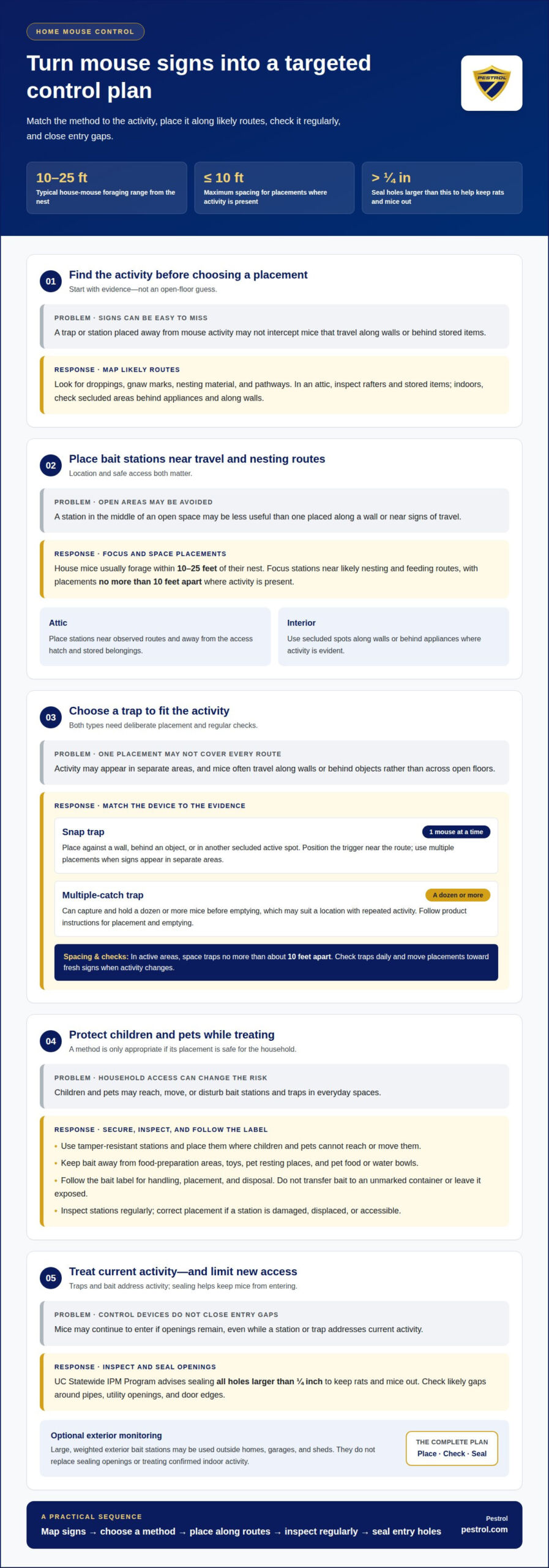
To control mice at home, locate activity, choose an appropriate method, place it near travel routes, and seal entry holes. With bait stations, placement, safe access, and regular inspection all matter.
Bait Selection and Placement
Choose bait stations based on where mouse activity appears and whether children or pets use nearby spaces. Place stations along walls and near signs of travel, rather than in open areas mice may avoid. House mice usually forage within 10-25 feet of their nest, so focus placements near likely nesting and feeding routes. Keep placements no more than 10 feet apart where activity is present.
Inspect an attic before treatment. Look for droppings, gnaw marks, nesting material, and pathways along rafters or stored items. Place stations near those routes, where household members are unlikely to disturb them. In an apartment, focus interior placements on secluded areas behind appliances or along walls where you find signs of activity.
After placing stations, include entry-point control in the plan. According to UC Statewide IPM Program, all holes larger than 1/4 inch should be sealed to keep rats and mice out. A station can address current activity, while sealing helps limit new access. Check likely gaps around pipes, utility openings, and the edges of doors as part of the inspection.
Bait Station Safety
Keep bait stations inaccessible to children and pets. Choose tamper-resistant stations and place them where children or pets cannot reach or move them. In an attic, position a station away from the access hatch and stored belongings. Indoors, avoid areas where food is prepared, toys are kept, or pets regularly rest.
Follow the bait label for handling, placement, and disposal. Don’t transfer bait into an unmarked container or leave it exposed. A secure station helps contain bait, but it still needs regular inspection. If a station is damaged, displaced, or accessible, correct its placement before continuing treatment.
Replenishment keeps a bait program active as mice consume bait. Inspect stations and replace bait according to the label and each station’s condition. Record which placements show feeding, then prioritize those locations during follow-up. Don’t assume every station needs replenishment at the same time or in the same amount. Mouse activity and bait condition should guide the next step.
Large, weighted exterior bait stations may be used outside homes, garages, and sheds as an optional add-on. They can extend monitoring beyond interior rooms, but they don’t replace sealing openings or treating confirmed indoor activity. Place exterior stations appropriately and secure them against disturbance. Combining careful placement with attic inspections, interior checks, and entry-point repairs creates a more complete control plan.
Snap traps and multiple-catch traps
Choose traps based on mouse activity and the room layout. First locate droppings, gnaw marks, or other signs, then place an appropriate trap along a likely travel route. Position matters: a trap in the middle of an open floor may miss mice that follow walls or move behind stored items.
A snap trap catches one mouse at a time. Place it against a wall, behind an object, or in another secluded spot where activity is evident. Position the trigger near the route to intercept a mouse as it travels. Keep traps away from places where people may step on or disturb them, and use multiple placements when signs appear in separate areas.
Spacing helps cover active routes without leaving large gaps. In areas with mouse activity, traps should be spaced no more than about 10 feet apart. For example, a long wall with droppings at both ends may need placements along the route, rather than one trap at a single end. Reassess locations as activity changes, and move traps toward fresh signs instead of leaving them in inactive spots.
A multiple-catch trap offers another approach: it can capture and hold a dozen or more mice before needing to be emptied. That capacity may suit a location with repeated activity, such as a secluded utility area. The trap still needs regular attention. Check its condition and follow the product instructions for placement and emptying, so captured mice aren’t left unnoticed.
Build trap checks into a daily routine. Check mouse traps and glue boards daily to identify activity and avoid leaving a catch unnoticed. Record each check’s location and result. If one trap remains untouched while another catches mice, use that pattern to adjust placements near walls, behind objects, and beside fresh signs.
- Map activity: Note droppings, gnaw marks, and pathways before placing traps.
- Choose the device: Use snap traps for individual catches or a multiple-catch trap where repeated activity warrants its capacity.
- Place and space: Position traps in secluded active areas, with no more than about 10 feet between traps where mice are active.
- Check and adjust: Inspect traps daily and shift placements based on fresh evidence.
Traps catch mice already moving through a room, but they don’t close entry gaps or remove food access. Combining focused trapping with attention to those conditions makes the plan more complete. In an apartment, record where signs appear and when traps are checked. This pattern helps distinguish a one-time catch from ongoing activity.
Child and pet safety
Plan mouse control around the children and pets who use each room. The key rule is simple: place mouse baits where children and pets cannot reach them. Consider a curious child near a kitchen baseboard or a dog exploring behind stored items. A station’s location matters as much as the method you choose.
Before placing bait, consider household routines and access points. Note where children play, where pet food and water bowls sit, and which areas pets explore. Keep bait away from those locations. In a home with limited storage, an open shelf or accessible cupboard may not be suitable. A secured, tamper-resistant station can help contain bait, but it still belongs out of reach.
Read the product label before handling or placing bait. Follow its directions for station use, placement, and replenishment. Don’t move bait into another container or leave it exposed where a child or pet could encounter it. Single-dose rodenticide baits should never be left exposed for more than three or four days. Remove exposed bait within that period and follow the label’s disposal instructions.
Traps also need careful placement. Put them where children and pets cannot reach them, rather than beside play spaces, pet beds, or food bowls. A trap behind an appliance may still be reachable by a pet investigating that space. Check the surrounding area before setting it, and make sure the device cannot be easily disturbed.
- Map access: Identify children’s play areas, pet routes, and feeding spots before treatment.
- Secure bait: Place stations out of reach and keep bait contained according to its label.
- Limit exposure: Never leave single-dose bait exposed beyond three or four days.
- Use care after a catch: Wear gloves when handling mouse carcasses to help prevent disease transmission.
After catching a mouse, don’t handle the carcass with bare hands. Wear gloves, then follow appropriate cleanup and disposal directions. Keep children and pets away from the area while you complete the task. Wash your hands after removing gloves, and clean any tools used during handling.
Include safety in every follow-up. Check that stations remain secure, inaccessible, and in their intended locations. If a child or pet can reach a station, correct its placement promptly. In a household with several rooms or changing routines, record station locations so adults know where bait or traps are present. This helps prevent accidental contact as family activity shifts throughout the day.
Reasons to control house mice
A mouse sighting matters because house mice can reproduce throughout the year. A female may have five to 10 litters in a single year, and young mice reach reproductive maturity in six to 10 weeks. That means a small problem can grow if activity and entry points remain unaddressed.
House mice can produce six to 10 litters continuously throughout the year. A litter usually contains five or six young, and one mouse can become dozens within weeks. The practical takeaway is to respond to fresh signs promptly, then assess whether activity extends beyond the room where it first appeared.
NYC landlords should respond to reported rodent activity with an inspection, control measures, and attention to entry points. Tenants can make a specific request by identifying the affected room, signs observed, and whether shared areas also show activity.
In Mott Haven, tenants can report the issue to their landlord and submit a service request through NYC 311. Include the building address, apartment location, dates of sightings, and any clear evidence, such as droppings or gnaw marks.
Mice can contaminate household areas, and UC Statewide IPM Program (UC IPM) estimates that 5% of house mice in the United States carry and can transmit the LCM virus. Keep children and pets away from affected areas during cleanup. Wear gloves when handling mouse carcasses to help prevent disease transmission.
For a useful report, note where signs appear and whether they recur after cleanup. One sighting in a kitchen gives different information from repeated signs near a shared hallway or utility opening. These details help property management decide where to inspect and whether the problem may involve more than one area.
Control works best when it addresses both mice and the conditions supporting them. Record new signs, report ongoing activity, and note whether access points remain open. If mice continue appearing after an initial response, share that pattern with the landlord or NYC 311 so the report reflects continuing activity, not only the first sighting.
The reproductive pattern is one reason control should be treated as an ongoing task rather than a reaction to a single alarming discovery. House mice can produce 6-10 litters continuously throughout the year, so there is no seasonal pause to rely on when deciding whether signs still matter. The possibility of repeated litters makes a quiet interval an uncertain measure of whether the underlying problem has ended. A lack of fresh evidence in one room does not, by itself, settle what is happening elsewhere in the home or building.
Follow-through matters: keep initial observations distinct from later ones, and report any change in location or recurrence. A response focused only on where a mouse was first noticed may miss a broader pattern. Ongoing signs can help guide further inspection. The goal is not just to remove what is visible at one moment, but to determine whether activity has stopped and whether identified conditions have been addressed. Treat new evidence as useful information instead of assuming the first report resolved the issue. This helps residents and property management assess whether more attention is needed.
How can residents identify signs of a mouse infestation in a Mott Haven apartment?
Start with the evidence mice leave behind. House mouse droppings are about 1/8 to 1/2 inches long, and may appear near food, along walls, or inside cabinets. Look for repeated droppings in the same area, gnaw marks on packaging, and shredded material that could indicate nesting. A single sign deserves attention, especially if more appear during later checks.
House mice are nocturnal, so residents rarely see them directly. Listen for movement after dark around walls, ceilings, or stored items. A brief sighting still matters, but don’t rely on seeing a mouse to identify activity. Check quiet spaces such as under a sink, behind an appliance, or beside a pantry for droppings and damaged food packaging.
Inspect room by room to make the signs useful. Start in the kitchen, then check closets, utility areas, and other places with stored food or clutter. Note the exact location and type of evidence. For example, droppings beside a cabinet and gnawed food packaging nearby point to a route worth inspecting further.
- Droppings: Note their location and whether fresh signs appear again.
- Gnawing: Look for damaged food packages or edges of stored materials.
- Sounds: Pay attention to nighttime movement near walls or ceilings.
- Patterns: Record which rooms show evidence and when you noticed it.
Keep a dated record instead of relying on memory. A note such as “droppings by pantry cabinet, Monday evening” helps distinguish isolated evidence from recurring activity. If signs appear in a shared hallway or near a utility opening, include that detail in a report to building management. Specific locations help direct an inspection and show whether activity may extend beyond one apartment.
Don’t disturb suspected nesting material or sweep droppings into the air. If cleanup is needed, wear gloves when handling mouse remains, and keep children and pets away from the affected spot. The earlier safety steps in this guide also apply when inspecting areas where traps or bait may be present. Clear notes and careful observation help determine whether mouse activity is continuing and where control should focus.
Sanitation alone will not normally eliminate an existing house mouse infestation. During an inspection, Pestrol identifies rodent entry points and maps activity throughout Mott Haven properties.
Pestrol
Pestrol provides Mouse Control for households dealing with recurring signs, activity in several rooms, or uncertainty about where mice are entering. The next step is to address the infestation and the conditions that let mice return, rather than relying on isolated catches. Share where you’ve noticed droppings, sounds, or damage, and whether activity continues after control measures. Those details help focus attention on the problem in your home.
Professional mouse control is a practical option when signs persist, appear in multiple areas, or involve hard-to-reach spaces such as attics. Pestrol can help create a clear treatment plan for your household.
Take the Next Step Toward a Mouse-Free Home
Once you’ve noticed signs of mice, a clear next step is more useful than guessing which room to treat first. Consider the pattern of activity in your home and whether you need help with an active mouse problem or broader household pest concerns. Pestrol offers Mouse Control, along with Home Pest Protection – Basic, Home Pest Protection – Plus, and Home Pest Protection – Premium. These options give Mott Haven households a way to discuss their needs and find a suitable service.
For mice control in Mott Haven, bring the details you’ve observed into the conversation: where activity appears, whether it keeps returning, and which areas need attention. That gives the discussion a practical starting point, so you don’t have to solve the problem alone.
A calmer, more comfortable home starts with taking the next step. Reach out when you’re ready to discuss the mouse activity you’ve found.
Frequently Asked Questions
Need Rodent Control in Mott Haven?
Yes. Pestrol offers Mouse Control for rodent activity in homes and apartments. For mice control in Mott Haven, note where you’ve seen signs, such as a kitchen cabinet, storage area, or ceiling space. Sharing those details helps focus the discussion on the affected parts of your home. If you live in a multi-unit building, mention any activity in shared areas too.
What mouse control and extermination services are available in Mott Haven, Bronx?
Pestrol offers Mouse Control and Rodent Proofing. Mouse Control addresses an active mouse problem, while Rodent Proofing focuses on reducing rodent access to a building. These services can help when you find signs inside an apartment or suspect entry around the structure. Describe the rooms and areas affected, including shared spaces, so the service discussion starts with a clear picture of the problem.
Which licensed pest control companies serve Mott Haven and offer mouse control?
Pestrol offers Mouse Control and Rodent Proofing, but a service listing alone doesn’t establish licensing status. The available company information supports identifying Pestrol as an option for mouse-specific help, not labeling it or other providers as licensed. For a Mott Haven apartment, useful details include where mice have appeared, whether activity is recurring, and whether you’ve seen signs in shared building areas.
Are mouse traps, bait stations, or rodenticides safest for homes with children and pets?
No single method is safest in every home; placement and access matter. Keep bait stations and traps where children and pets cannot reach them, and follow product-label directions for rodenticides. Consider household routines: a trap near a child’s play area or a pet’s usual route creates an avoidable exposure risk. Choose placements based on observed mouse activity while keeping household members away from treatment sites.