



What if finding pests says nothing about how clean your home is? Embarrassment over pest problems is common, especially when you worry that friends, family, neighbors, or a landlord might find out. But pests can enter even well-kept homes through small gaps, moisture, luggage, or secondhand furniture. Their presence isn’t a verdict on your home or your character.
It’s understandable to feel uneasy about asking for help. You may wonder what caused the problem, how much to share, or whether seeking support will make a private concern feel exposed. A pest issue is a situation to address, not a personal failure. Start with what you’ve observed, then choose a practical next step.
This article explains why pests can appear in clean homes and how shame can make it harder to act. You’ll learn how to record what you notice, take reasonable housekeeping steps, and describe the issue without oversharing. If activity continues or you’re unsure what you’re seeing, professional pest management can help you decide what to do next. Pestrol provides targeted pest treatments and Home Pest Protection plans.
Key Takeaways
- Recognize that embarrassment over pest problems is a social reaction, not evidence about your character or housekeeping.
- Learn how pests may enter homes and shared buildings, and why one sighting alone can’t establish the source.
- Use a calm sequence to record what you observe, take reasonable housekeeping steps, and share factual details when needed.
- Understand when professional pest management can help you assess the situation and choose a practical next step.
Why embarrassment over pest problems feels so personal
Finding a pest at home can bring a rush of shame, worry, or fear that someone will judge you. You might picture a guest spotting a roach, a neighbor hearing about mice, or a landlord making assumptions about how you care for your home. Those feelings can make a practical problem seem like a personal verdict. Embarrassment over pest problems is a social reaction: it reflects concern about how others may see you, not proof of anything about your character.
A pest’s presence is not a measure of your cleanliness, care, or worth.
Why a pest sighting can feel like a personal judgment
Home is personal. It’s where you expect to feel comfortable and in control, so an unexpected pest can feel like an intrusion into more than your space. If you’re worried about hosting guests, protecting family privacy, or becoming the subject of gossip, it makes sense that the discovery may feel exposing. That distress is real, even if others might see the issue as routine.
Embarrassment is closely tied to perceived attention and social judgment. Embarrassment is a self-conscious emotion often triggered by perceived social blunders or unwanted attention. That helps explain why you might focus on what someone could assume before you know what caused the sighting. You don’t have to dismiss the feeling to respond calmly.
What a pest problem does, and does not, say about you
A single sighting doesn’t establish where a pest came from, how long it has been present, or the overall condition of a home. Pests may be drawn to available food or moisture, enter through small gaps, travel with belongings, or move through shared parts of a building. These are possible contributing factors, not a diagnosis or proof of the source.
Even a tidy home can have conditions that attract pests or offer an entry point. A delivered package, luggage, or a piece of furniture may provide an unrecognized route inside. In an apartment or multi-unit building, activity in shared spaces can also complicate the picture. None of these possibilities means you caused the problem. A sighting alone can’t tell you which explanation applies.
Separate what you know from what you fear others might assume. Note what you saw and where, rather than turning the discovery into a judgment about yourself. That keeps the focus on useful evidence and a manageable next step. For broader prevention context, the 2026 guide to home pest protection covers ways to think about protecting a home without assuming every household faces the same conditions.
How pests can reach clean homes and shared buildings
A clean home can still experience pest activity. Pests may find food or moisture, enter through small openings, arrive unnoticed with luggage or furniture, or move through connected parts of a building. These are possible routes, not a checklist that identifies what happened in a particular home. The presence of a pest doesn’t, by itself, reveal its source or say anything definitive about housekeeping.
For example, a New York apartment resident might spot a roach near the kitchen. Food crumbs or a damp area could be relevant, but so could a gap around a pipe or activity elsewhere in the building. Those possibilities can guide what to observe; they don’t prove that the resident, a neighbor, or a property manager caused the problem.
Shared walls and building systems can complicate the picture
In some multi-unit properties, connected spaces can give certain pests routes between areas. Depending on the pest and building, openings around pipes, wall gaps, or shared service areas may be relevant. Other pests may be more closely associated with items brought into a home. A tenant may not control every possible entry route, but that doesn’t establish that another resident or the landlord is responsible.
Keep the focus on what you can document. Note where you noticed activity and whether there’s a pattern, such as repeated sightings in the same area. If shared spaces could be involved, factual notes can help you describe the concern to a building manager without making assumptions about its cause.
Why a sighting is not the same as a confirmed infestation
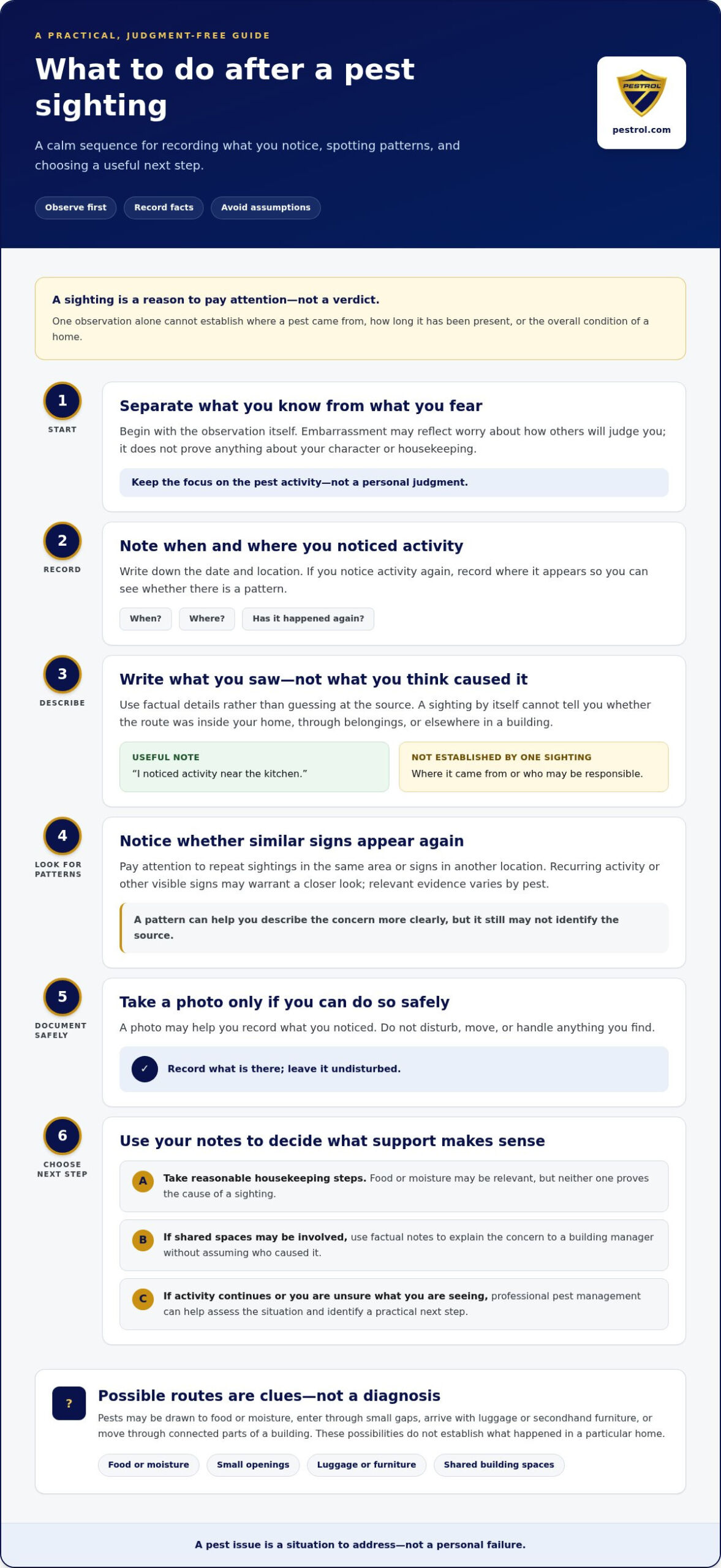
One observation is a reason to pay attention, but it may not explain the full situation. Recurring sightings or other visible signs may warrant a closer look, and relevant evidence varies by pest. Avoid disturbing anything you find. Record the date and location, and take a photo if you can do so without moving or handling it.
- Write down when and where you noticed activity.
- Describe what you saw rather than guessing at the cause.
- Note whether similar signs appear again or in another location.
This simple record helps replace worry with clearer observations. It can also make it easier to explain the concern if you need guidance. For details specific to identifying and addressing bed bug concerns, Pestrol’s professional bed bug treatment guide provides focused information.
If activity continues or you’re unsure how to interpret what you’re seeing, professional input can help you choose a practical next step. Pestrol provides residential pest management, including targeted treatments and Home Pest Protection plans. Explore Pestrol’s residential pest management for support focused on the pest activity, not on judging you or anyone else.
Pest-related shame versus practical reality: what evidence can tell you
Shame can turn a discovery into a story: “People will think I don’t clean,” or “I must have caused this.” Those conclusions may feel convincing, but they aren’t evidence. Separate what you fear others might assume from what you have actually observed. That shift can make embarrassment over pest problems easier to manage and help you focus on information that supports a next step.
- Assumption: Any pest means a resident hasn’t cleaned properly. Evidence can show: A sighting or sign may indicate pest activity, but it doesn’t establish the cause or a home’s overall condition.
- Assumption: A particular person must be responsible. Evidence can show: Where and when activity occurs, but not necessarily how it began or who contributed to it.
- Assumption: One clue explains everything. Evidence can show: A detail worth recording, while identification and context may still matter.
Assumptions people make about cleanliness and pests
Housekeeping can influence some conditions, such as whether food is accessible, but it cannot explain every sighting by itself. It also can’t prove where activity started. Avoid turning a general possibility into blame directed at yourself, a neighbor, a visitor, or a property manager. Without specific evidence, those are guesses, not conclusions. The aim is to understand the situation, not assign fault.
General stories about pests and cleanliness can’t diagnose an individual home. Your own observations are more useful for deciding what to record and whether the situation needs closer attention. Focus on details you can verify, such as the location, timing, and whether the activity recurs.
Observations that are more useful than self-blame
Make a simple record. Include the date, location, whether you noticed activity once or more than once, and what you could actually see. If a mark or object might be relevant, describe it plainly or photograph it without moving it. Keep interpretation separate from observation: “small insect near the window” is more useful than guessing at its source.
Different pests can leave different clues, and some signs may be difficult to identify without context. There isn’t one universal checklist that confirms every pest. A recurring pattern, a clear photo, or an identified insect may help narrow the question, but avoid treating any single detail as a complete diagnosis. If you recognize a particular pest, use guidance focused on that species or seek professional input. Bed bug concerns, for example, call for bed-bug-specific information rather than assumptions based on signs associated with another pest.
Evidence won’t always answer every question immediately. It can still replace a judgment about your character with a clearer account of what’s happening. That’s a steadier place to begin.
What to Do When Embarrassment Stops You From Acting
Shame can make avoidance feel safer: you might put off checking a room, telling a building manager, or asking for guidance. But staying silent can leave you with more uncertainty, not more control. Keep the first step small and factual. You don’t need to know the cause or have every detail figured out before you act.
Replace shame-driven avoidance with one manageable next step: write down what you noticed.
- Pause. Take a breath and remind yourself that an observation isn’t a verdict about you or your home.
- Record what you saw. Note the date, location, and any pattern or relevant change.
- Take reasonable housekeeping steps. Store food appropriately, clean up accessible crumbs, and address standing water if you notice it. These are practical habits, not proof that housekeeping caused the activity.
- Seek appropriate guidance. If signs recur, you’re unsure what you’ve seen, or a shared area may be involved, describe the facts to a building manager or pest professional.
A simple way to document what you notice
Keep brief notes with the time and place of each sighting, what you observed, and whether anything nearby changed, such as a delivery or a leak. If useful, take a clear photo from a safe distance. Don’t handle a pest or disturb possible evidence just to get a better view. Stick to what you can verify and leave conclusions about the source for later.
Different pests can leave different clues, so avoid applying a general checklist to every situation. A recurring pattern or a clear image can help explain your concern, but may not identify the pest or establish how it got inside. If you can identify cockroaches, Pestrol’s professional roach removal guide offers information focused on that pest.
How to talk about the problem without oversharing
You can be brief and direct. If a shared space might matter, timely, factual communication gives a landlord or building manager useful information without requiring a personal explanation. Share what you saw, where, and when; avoid guessing who or what caused it. Keep the message private and focused on the issue.
For example: “I noticed a small insect near the kitchen pipe on Tuesday evening. I’ve recorded the location and will let you know if I see more. Could you advise on the next step for this area?” Adjust the wording to fit what you actually observed. You don’t need to apologize or describe your housekeeping.
If embarrassment over pest problems is keeping you from seeking help, remember that asking for guidance is a practical step, not an admission of failure. Avoid using chemicals or improvised treatments without reliable, pest-specific guidance, and don’t delay simply to keep the concern hidden. A clear note, a neutral message, or a request for professional pest management is enough to move forward.
Getting professional pest support without judgment
Professional pest management is a practical way to get help addressing a concern. It isn’t an admission that you’ve done something wrong. You don’t need to solve the mystery or make your home look perfect before speaking with someone. Clear observations, even if incomplete, can help start a useful conversation.
Feeling embarrassed over pest problems may make you want to explain or apologize. You don’t owe anyone an apology for reporting what you’ve noticed. Share the details you have and keep the conversation focused on the pest activity and appropriate next steps.
What a professional conversation can help clarify
Pest identification and the context of a property can help inform what to do next. A conversation may cover what you saw, where it appeared, whether it has happened repeatedly, and whether the home is part of a shared building. These details help frame the concern, though they don’t promise a particular diagnosis, treatment result, or timeline.
Before reaching out, keep a few notes nearby. Mention the pest if you recognize it, or describe its appearance without guessing. Include relevant locations and dates, and say plainly what you’re worried about. For example, explain that you’ve seen activity more than once near a kitchen cabinet or that you’re concerned a shared area could be involved.
- Share observations, not assumptions about who caused the issue.
- Ask what information would help clarify the concern.
- Be direct about any worries, such as privacy or activity in a shared building.
There’s no need to have every answer ready. A calm, respectful conversation should make room for questions and help you understand what information matters. The goal is informed action, not judgment.
A local, supportive next step with Pestrol
Pestrol is a family-owned and operated pest management business serving residential customers in Manhattan, the Bronx, Chester, Cornwall, Crawford, Goshen, Greenville, Highlands, Minisink, Monroe, Montgomery, Mount Hope, New Windsor, Newburgh, Palm Tree, Tuxedo, Wallkill, Warwick, Wawayanda, and Woodbury. Residential support includes targeted pest treatments and Home Pest Protection plans at Basic, Plus, and Premium levels. Those are plan levels, not a judgment about how well you’ve cared for your home.
Professional support can help you address pest activity and consider a practical response. You can begin with the information you have and explain your concerns without self-blame. Taking that step is a reasonable way to care for your home and get a clearer perspective.
Choose a calm next step for your home
You don’t have to wait until you feel completely confident to move forward. Choose one practical action that feels manageable, such as noting a new sighting, sharing a clear concern, or exploring professional support. Small steps can help you feel more in control without turning the situation into a judgment about yourself.
Embarrassment over pest problems can make you feel that you need to hide what’s happening or explain it perfectly. You don’t. Focus on what would help you feel informed and comfortable in your home, then take the next step at your own pace. Asking for support is a sensible way to address a household concern, not a personal failing.
If you’re considering ongoing residential support, Pestrol offers Home Pest Protection plans at Basic, Plus, and Premium levels. Review the options and consider which level fits your needs.
You deserve to feel at ease in your home, and taking one thoughtful step can help you get there.
Frequently Asked Questions
Can pests appear in a clean home?
Yes. Cleanliness doesn’t make a home immune to pests. A pest might enter through a small opening, come in with a delivery or luggage, or be drawn to moisture around a sink or pipe. These are examples of possible routes, not proof of what happened in your home. If you spot activity, focus on what you can observe rather than treating it as a scorecard for your housekeeping.
Does finding one pest mean there is an infestation?
Not necessarily. A single sighting establishes that you noticed something at a particular time; it doesn’t show whether activity is recurring or where it came from. Identify the pest if you can, then watch for repeat observations or related signs. A photo and brief description may help clarify what you saw. Avoid assuming the worst from one moment, but don’t dismiss repeated activity if it continues.
Should I tell my landlord if I find pests in my apartment?
If you rent and suspect the issue could involve shared areas or building features, consider notifying your landlord or building manager promptly. Keep the message factual: say what you noticed, when, and where, and include a photo if it helps. Follow the usual process for reporting maintenance concerns in your building. You don’t need to identify the source or assign blame before sharing a clear observation.
How can I talk to guests about a pest problem without feeling ashamed?
You can keep the explanation brief and share only what feels necessary. Try: “I’ve noticed some pest activity and am looking into it, so let’s use the other room today.” If a guest has seen something, a simple, honest response is enough. You don’t have to defend your housekeeping or give private details. Choose a practical hosting adjustment that helps you feel comfortable while you address the concern.
What should I write down after noticing pest activity?
Record the date and approximate time, the room or exact spot, and what you observed, such as the pest’s appearance or direction of movement. Note whether you saw it again and whether anything nearby changed, like a new delivery or a leak. Keep the description neutral. A photo can help if it’s safe to take one, but don’t handle the pest or move possible evidence for a clearer picture.
Can pests travel between apartments in the same building?
Some pests may move between connected spaces, depending on the species and building layout, but that doesn’t mean every pest uses the same route. Shared walls, pipe openings, or common areas could be relevant in some cases. A sighting in one apartment doesn’t prove where the activity began or who is responsible. If you notice a pattern near a shared area, record it and report the location clearly.
Is it embarrassing to call a pest control professional?
No. Calling a professional is a practical way to get support, not a confession of poor housekeeping. You can start with a simple description of what you saw and where. Pestrol is family-owned and provides residential pest management, including Home Pest Protection plans at Basic, Plus, and Premium levels, for customers in Manhattan, the Bronx, Chester, Cornwall, Crawford, Goshen, Greenville, Highlands, Minisink, Monroe, Montgomery, Mount Hope, New Windsor, Newburgh, Palm Tree, Tuxedo, Wallkill, Warwick, Wawayanda, and Woodbury.
What happens if I ignore a pest problem because I feel ashamed?
Waiting may leave you with less information about whether activity is recurring, and a concern could remain unresolved while you avoid discussing it. You don’t need to panic or make assumptions, but taking a manageable step can reduce uncertainty. Write down what you observed, share relevant details with a building manager if needed, or seek pest-specific guidance. Asking for help is a sensible response, not a reason for self-blame.