



What if that sprinkle of black pepper on your kitchen shelf isn’t a spice rack spill, but the first warning sign of a hidden health hazard? It’s unsettling to find mysterious dark specks near your food or where your children play. You aren’t alone in this worry. Recent 2026 data shows that cockroaches affect nearly a quarter of all U.S. households, often leaving homeowners wondering exactly what do cockroach droppings look like and what they mean for their family’s safety.
We understand the anxiety that comes with a potential infestation, especially when you’re trying to distinguish between roach debris and mouse droppings. This guide provides the professional clarity you need to identify these pests by their size, shape, and species. You’ll learn how to read these signs to catch a problem before it spreads throughout your home. We’ll also cover how to assess the severity of the situation and provide a step-by-step plan for safe, thorough cleanup. From identifying German roach “pepper” to larger American roach cylinders, you’ll gain the confidence to protect your living space and restore your peace of mind.
Key Takeaways
- Identify exactly what do cockroach droppings look like by distinguishing between small “pepper” specks and larger, ridged cylinders.
- Learn to differentiate between German and American cockroach waste to accurately assess the scale of your infestation.
- Master the visual differences between roach debris and mouse droppings to ensure you choose the right treatment plan.
- Locate hidden “fecal maps” in kitchen and bathroom hotspots where roaches are most likely to congregate and breed.
- Protect your family from pathogens and asthma triggers by following safe, professional cleanup protocols for pest waste.
Visual Characteristics: What Does Roach Poop Look Like?
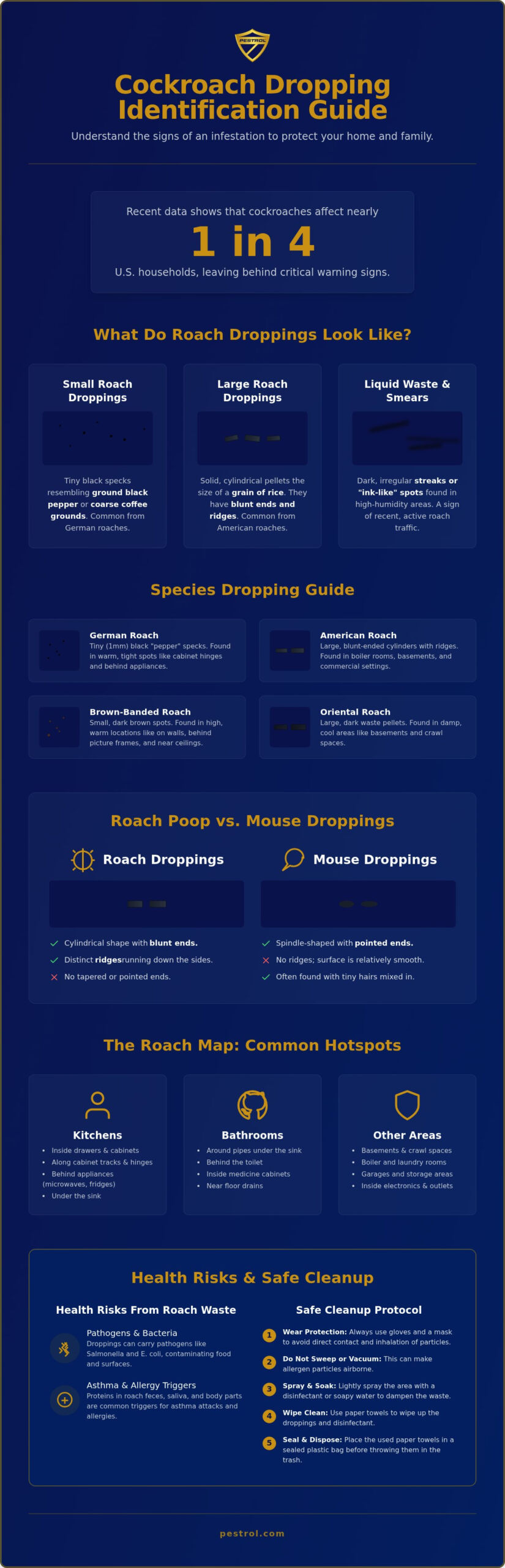
Identifying pest debris starts with knowing exactly what do cockroach droppings look like in different parts of your home. Small nymphs and German roaches, which are incredibly common in NYC apartments, leave behind tiny black specks that resemble ground black pepper. You might find these scattered in kitchen drawers or along the tracks of your cabinets. If the waste looks more like coarse coffee grounds, you’re likely looking at a larger concentration of granular waste from a group of roaches living nearby.
Larger species like the American Cockroach or the Oriental roach leave behind distinct cylindrical pellets. These are roughly the size of a grain of rice and feature blunt ends with ridges running down the sides. Finding these in your pantry or basement is a clear sign that larger pests have moved in. Unlike mouse droppings, which have pointed ends, these pellets are consistently uniform and blunt.
Liquid waste creates a different visual entirely. Smear marks occur when roaches crawl over surfaces in high-humidity areas. On non-porous surfaces like metal pipes or tile, these look like dark, irregular streaks. On porous surfaces like wood or cardboard, the waste soaks in, leaving behind “ink-like” spots that are difficult to scrub away. These marks are often the most overlooked sign of an infestation.
Solid vs. Liquid: The Moisture Factor
In high-moisture environments like Newburgh basements, roaches often leave smears instead of solid pellets. These dark, raised tracks appear on walls and door frames where the pests travel frequently. Fresh droppings often have a slight sheen, while older waste looks dull and brittle. If you see “ink-like” spots that look wet, it’s a sign of active, recent movement in that specific area. Identifying these fresh marks is critical for determining where to focus your Professional Roach Removal efforts.
Quantity as an Infestation Meter
The amount of waste you find acts as a biological meter for the severity of the problem. A single cluster of droppings suggests a nearby aggregation site, or nest, where roaches hide during the day. In contrast, scattered “transit droppings” along baseboards indicate the paths they take to find food. A 2026 study found that in buildings with heavy pest pressure, residents see roaches daily; finding droppings in broad daylight is a strong indicator of a severe infestation that has outgrown its hiding spots.
Species Guide: Dropping Size and Shape Comparisons
Understanding the specific species in your home is the first step toward effective removal. While you may wonder what do cockroach droppings look like across the board, the reality is that size and shape vary significantly by species. In NYC and Orange County, we typically see four main types, each leaving a unique signature that tells us exactly who has moved in. Identifying these differences helps us determine if you’re dealing with a localized kitchen issue or a larger structural problem.
Brown-Banded cockroaches leave behind small, dark brown spots. Unlike other species that stick to the floor, these roaches prefer high, warm locations. You’ll often find their waste on walls, behind picture frames, or near ceiling corners. Conversely, Oriental cockroaches leave large, dark waste in damp, cool areas. These are common in Orange County crawl spaces and basements where moisture levels are high. Because all pest waste carries health risks from cockroaches, pinpointing the species helps us choose the right treatment for your specific environment.
The German Roach ‘Pepper’ Trail
German cockroach waste is the most frequent discovery in Manhattan apartments. These tiny black specks measure about 1mm and look like a trail of spilled black pepper. You’ll find them concentrated in warm, tight spots like cabinet hinges, drawer slides, and behind microwave panels. German roach waste is the primary indicator of a localized kitchen infestation. If you see these specks, it’s time to act before the population grows. Our Roach Exterminator team can help you identify these spots and stop the trail at its source.
Large Roach Pellets and Ridges
American cockroaches leave behind larger waste that often causes confusion for homeowners. These droppings are blunt-ended cylinders with distinct ridges running down the sides, roughly the size of a grain of rice. You’ll frequently see these in commercial settings like New York restaurants or in residential boiler rooms. It’s crucial to distinguish these from mouse droppings. While mouse waste is roughly the same size, it has tapered, pointed ends and lacks the longitudinal ridges found on roach pellets. Recognizing these ridges is the fastest way to confirm you’re dealing with an insect rather than a rodent.
The Roach Map: Where to Find Droppings in Your Home
Finding pest waste is like reading a biological map of a roach’s daily routine. If you know where to look, you can stop the spread before it becomes a full-blown crisis. In the kitchen, start your search in dark, undisturbed corners. Focus on the areas under sinks, behind refrigerators, and deep inside pantry corners where crumbs often hide. These locations provide the food and water roaches need to survive, making them the most common spots for waste to accumulate.
Bathrooms are another primary hideout. Check behind toilets, inside medicine cabinets, and near floor drains. Roaches are also drawn to the warmth emitted by appliance motors. It’s common to find droppings under coffee makers and toaster ovens where food particles are often trapped. In older Bronx buildings, structural gaps near crown molding and baseboards often hide waste. NYC steam heat pipes act as perfect roach “highways,” allowing pests to move between apartments and leaving waste zones behind radiator covers and pipe insulation.
Understanding what do cockroach droppings look like in these specific contexts helps you identify the severity of the problem. Scattered specks along a baseboard might indicate a roach just passing through, but a dense cluster near a motor suggests a nearby nest. Checking these areas regularly allows you to catch an infestation in its early stages before the population migrates into your living areas.
The ‘Heat and Moisture’ Rule
Heat and water are the two biggest magnets for these pests. Droppings frequently cluster near water heaters and dishwasher motors because they provide warmth and a nearby water source. Don’t forget to check the back of electronics like TVs and internet routers. These devices stay warm 24/7, providing a perfect environment for roaches to congregate. Look for “ink-like” smear marks on the plastic casings and dry specks on the surfaces where these electronics sit. This is especially common in apartments where electronics are kept in confined entertainment centers.
Basements and Crawl Spaces in Orange County
Orange County homes face different challenges than NYC apartments. In Goshen, Oriental roach waste is often found in damp, dark crawl spaces and near sump pumps. Finding droppings in these entry points often indicates a need for rodent proofing services, as the same structural gaps allowing roaches in can invite larger pests. Inspect cardboard storage boxes and basement shelving for nesting signs. Roaches love the glue in cardboard, so these boxes often serve as both a food source and a home for growing colonies.
Roach Poop vs. Mouse Droppings: Spotting the Difference
Finding mysterious debris in your kitchen cabinet often triggers immediate anxiety. You need to know exactly what you’re dealing with to choose the right solution. While we’ve discussed what do cockroach droppings look like in terms of species, they are frequently confused with mouse waste. The most critical difference lies in the shape of the ends. Mouse droppings are typically tapered or pointed at one or both ends. In contrast, large cockroach droppings have blunt, squared-off ends that look like they were cut straight across.
Size is another major indicator. Mouse droppings are generally about 1/4 inch long, roughly the size of a grain of rice but often slightly thicker. Roach specks are much smaller; German roach waste looks like tiny pepper flakes while American roach pellets are smaller and thinner than rodent waste. If you look closely with a flashlight, you might see tiny hairs embedded in mouse waste. Mice groom themselves constantly, and these hairs pass through their system. Roaches don’t have this characteristic, so their waste remains hair-free.
Placement patterns also reveal the culprit. Mice are creatures of habit that leave droppings along the specific paths they travel, such as the edge of a wall or behind a baseboard. Roaches tend to cluster their waste in corners or near their aggregation sites. If you see a scattered trail, think rodents; if you see a dense pile in a hinge or corner, think roaches.
The Visual Identification Checklist
Use this quick guide to determine which pest has entered your home. It’s the fastest way to decide on your next steps:
- Pointed ends: It’s likely a mouse. You should check for mouse control options immediately.
- Blunt ends with ridges: This is the signature of an American cockroach.
- Black pepper specks: These are the classic signs of a German cockroach infestation.
When You Find Both
In older New York buildings, it’s not uncommon to experience “pest synergy.” This occurs when different species exploit the same structural weaknesses or moisture issues. Finding both types of waste means your home has multiple entry points that require professional attention. A multi-pest situation is complex. It usually requires professional roach removal to ensure every hiding spot is treated and every entry point is sealed.
Our Home Pest Protection – Basic plan is designed to handle these exact scenarios. It provides a comprehensive defense that covers both roaches and rodents, giving you back your peace of mind. We focus on long-term results rather than quick, temporary fixes. Our team treats your home with the personal care it deserves.
Health Risks and Safe Cleanup Protocols
Confirming what do cockroach droppings look like is only the first step in reclaiming your home. Once you’ve identified those dark specks or ridged cylinders, you must treat them as a serious biological hazard. These droppings aren’t just a nuisance; they’re a primary source of indoor allergens and pathogens. In New York’s densely populated neighborhoods, roach waste is a leading cause of salmonella and E. coli transmission, as these pests move from sewer lines and trash chutes directly onto your kitchen surfaces.
The health impact on your family can be significant. Cockroach waste contains potent proteins that act as triggers for asthma and allergic reactions. This is particularly dangerous for children and elderly residents who spend more time indoors. Beyond the immediate respiratory threat, roach debris serves as a beacon. Fecal matter contains aggregation pheromones, which are chemical signals that tell other roaches your home is a safe, established place to feed and breed. If you don’t clean the waste correctly, you’re essentially leaving a “welcome” sign for the rest of the colony.
Since pest waste can penetrate deep into floor fibers, understanding the composition of your flooring is vital; you can discover The Rutland Cleaning Company to learn more about the heritage and care of quality carpets.
The Danger of Aerosolized Waste
Safe cleanup requires a specific approach to avoid making the problem worse. You should NEVER vacuum dry roach droppings with a standard household vacuum or sweep them with a dry broom. These actions break the brittle waste into microscopic particles, blasting allergens into the air where they can be inhaled. The 2026 health consensus confirms that roach-triggered respiratory issues are now a primary driver of chronic childhood asthma in urban environments. To protect yourself, always wear a high-quality mask and gloves during DIY cleanup. Use a “wet” cleaning method by misting the area with a disinfectant first. This keeps the dust down and ensures the waste stays put while you wipe it away. For those who want to ensure their environment is professionally sanitized, lifestylehomeservice.com offers comprehensive residential cleaning solutions.
Standard soap and water often fail to remove the persistent chemical trails roaches leave behind. These fecal pheromones are stubborn and designed to last. Even if you scrub the visible spots, the invisible scent remains, guiding new roaches to the same hiding spots behind your appliances or inside your walls. Breaking this cycle requires specialized enzymatic cleaners that neutralize these chemical markers. Integrating professional roach removal into your plan ensures these aggregation sites are completely sanitized. We don’t just kill the pests; we focus on removing the biological traces that invite future infestations. This comprehensive approach is the only way to ensure your home stays clean and your family stays safe long-term.
Take Control of Your Home’s Health Today
Identifying the specific signs of a pest problem is the first step toward a healthier home environment. By understanding exactly what do cockroach droppings look like, you can distinguish between minor “pepper” trails and more serious infestations involving larger species. These droppings are more than just an eyesore. They are biological markers that attract more pests while triggering respiratory issues for your loved ones.
Safe cleanup and professional intervention are essential to breaking the infestation cycle. Our family-owned team uses specialized roach elimination protocols to ensure every corner of your space is sanitized and secured. Once we resolve the initial issue, our Home Pest Protection – Basic plan provides the consistent, tiered defense you need to keep your NYC or Orange County property pest-free for the long term. We treat every client like a neighbor and every home with the utmost respect.
Schedule a Professional Roach Inspection with Pestrol Today
You don’t have to face a hidden infestation alone. We have the tools and local experience to restore your peace of mind quickly.
Frequently Asked Questions
Can cockroach droppings make you sick?
Yes, they are a significant source of indoor pathogens and allergens. Roaches frequently travel through unsanitary areas like trash chutes in Manhattan or sewer lines in the Bronx, carrying bacteria like Salmonella and E. coli on their bodies and in their waste. When these droppings dry out, they release proteins into the air that can trigger severe asthma attacks or allergic reactions. Protecting your family requires treating any discovery of waste as a biological hazard.
How do I know if it’s roach poop or just dirt?
Look for consistency and specific placement. Household dirt is usually irregular, while roach droppings are uniform in shape and size. If you find a cluster of dark specks in a warm Newburgh kitchen cabinet or behind a refrigerator, it is likely a pest issue. Roach waste often has a slightly raised texture and, if fresh, will leave a dark smear when wiped with a damp cloth, unlike standard household dust or soil.
What does German cockroach poop look like compared to American roach poop?
The primary difference is the scale of the debris. German roach waste looks like fine grains of black pepper, usually measuring about 1mm. These are common in NYC apartment kitchens. American roach droppings are much larger, roughly the size of a grain of rice, and feature blunt ends with longitudinal ridges. Understanding what do cockroach droppings look like for each species helps our experts determine if you are facing a localized kitchen problem or a structural infestation.
Is it safe to touch cockroach droppings with bare hands?
No, you should never handle any pest waste without protective gear. Touching droppings can transfer harmful bacteria directly to your skin, which can then be ingested or spread to other surfaces. It also increases the risk of inhaling aerosolized allergens. Always wear disposable gloves and a mask when inspecting dark corners in a Goshen basement or crawl space. If contact occurs, wash the area immediately with hot, soapy water and sanitize any tools used.
Why do I see droppings but no actual cockroaches?
Cockroaches are nocturnal and highly skilled at staying hidden during the day. They spend the majority of their time in wall voids, appliance motors, or structural gaps where they feel safe. While the insects themselves remain out of sight, they leave behind “fecal maps” that indicate where they eat and congregate. Finding waste in your Warwick home is a definitive sign of activity, even if you haven’t seen a live bug yet.
Does seeing roach poop mean I have a big infestation?
It usually indicates an established population rather than a single stray. While a lone speck might be a “transit dropping,” dense clusters suggest a nearby aggregation site where roaches gather. If you find waste in multiple areas or see it in broad daylight, the colony has likely grown too large for its original hiding spots. This level of activity in a New Windsor residence suggests a heavy infestation that requires professional intervention to fully eradicate.
How do I clean roach droppings off my kitchen counters safely?
Safety requires a “wet” cleaning approach to prevent allergens from becoming airborne. Never use a vacuum or a dry broom, as this can aerosolize harmful proteins. Instead, mist the waste with a disinfectant to dampen it before wiping it up with disposable paper towels. Once the visible waste is gone, scrub the area with an enzymatic cleaner to break down residual pathogens. This ensures your food preparation surfaces remain sanitary and safe for your family.