



What if the best way to protect your business from pests isn’t a one-size-fits-all treatment, but a plan built around how your workplace runs? Commercial pest control should address the risks a pest sighting can create for customers, staff, inventory, and your reputation, while accounting for the building, daily routines, and specific pest pressures.
It’s reasonable to wonder what a service plan includes and whether inspections or treatments will interrupt normal operations. A useful plan starts with the property and its activity, then sets out practical prevention and targeted treatment suited to the site. For restaurants, food-service needs matter; rodent proofing can also support a broader prevention plan.
In this guide, you’ll learn how commercial pest management works, what to consider in a service plan, and how to reduce pest pressure between professional visits. Pestrol is a family-owned and operated business serving Manhattan, the Bronx, and communities across its New York service area. Whether you manage a restaurant or another workplace, these steps can help you protect staff, customers, and your business.
Key Takeaways
- Commercial pest control works best when the plan reflects the property, pest concerns, and daily business activity.
- A useful service plan connects site observations to targeted action and practical prevention.
- Compare plans by pest coverage, property assessment, prevention, communication, and fit, not by broad promises alone.
- Consistent routines for waste, food storage, and housekeeping help reduce pest pressure between professional visits.
- Record sightings with the date, location, and relevant operating details to make follow-up more useful.
Why Commercial Pest Control Matters for New York Businesses
A pest sighting can unsettle staff, distract customers, disrupt daily work, and put stored goods at risk. Droppings, damaged packaging, or activity near entry points can signal conditions that deserve attention. A professional assessment considers the site and possible sources of activity, rather than relying on a single visible clue.
Commercial pest control is prevention and treatment designed around a business property, its pest concerns, and how the space is used. The plan should address the site’s needs instead of assuming every workplace needs identical treatment. For a general overview of pest management methods and pest types, see Pest control.
Which New York businesses can benefit from a tailored plan?
Restaurants, offices, retail spaces, and other commercial properties can all face pest concerns, but their risks differ. In a restaurant, food handling and waste areas deserve particular attention. Retailers may need to protect merchandise and stockrooms, while offices should consider shared kitchens, deliveries, and places where food is kept. The way a building is used helps shape the plan.
Storage practices, foot traffic, deliveries, and property layout can affect where pests find access or resources. A business in Manhattan, the Bronx, or an Orange County community may occupy a busy storefront, a standalone workplace, or a mixed-use building. Each setting has different routines and pressure points. The service plan should account for those details rather than prescribe the same treatment or frequency for every business.
What can pest activity mean for daily business operations?
Pest concerns are practical as well as unsettling. Staff may feel uncomfortable in work areas, customers may lose confidence if they notice activity, and pests can threaten goods or packaging in storage. Even a concern in one part of the property can draw attention away from serving customers, managing stock, and keeping the workplace running smoothly.
Acting on signs early gives a business a chance to investigate conditions before a concern becomes harder to manage. It can also help clarify whether activity is isolated or associated with access points, storage, or other site conditions. One sign does not necessarily point to a widespread issue. Timely observation and a property-specific assessment can, however, turn uncertainty into a clearer plan.
Local support matters because properties and operating routines vary across the service area. Pestrol provides commercial pest management tailored to business needs, including restaurant pest control and rodent proofing. A focused approach helps owners understand what’s happening, which steps suit the premises, and how prevention can work alongside everyday operations.
How Commercial Pest Control Works: Assessment, Treatment, and Prevention
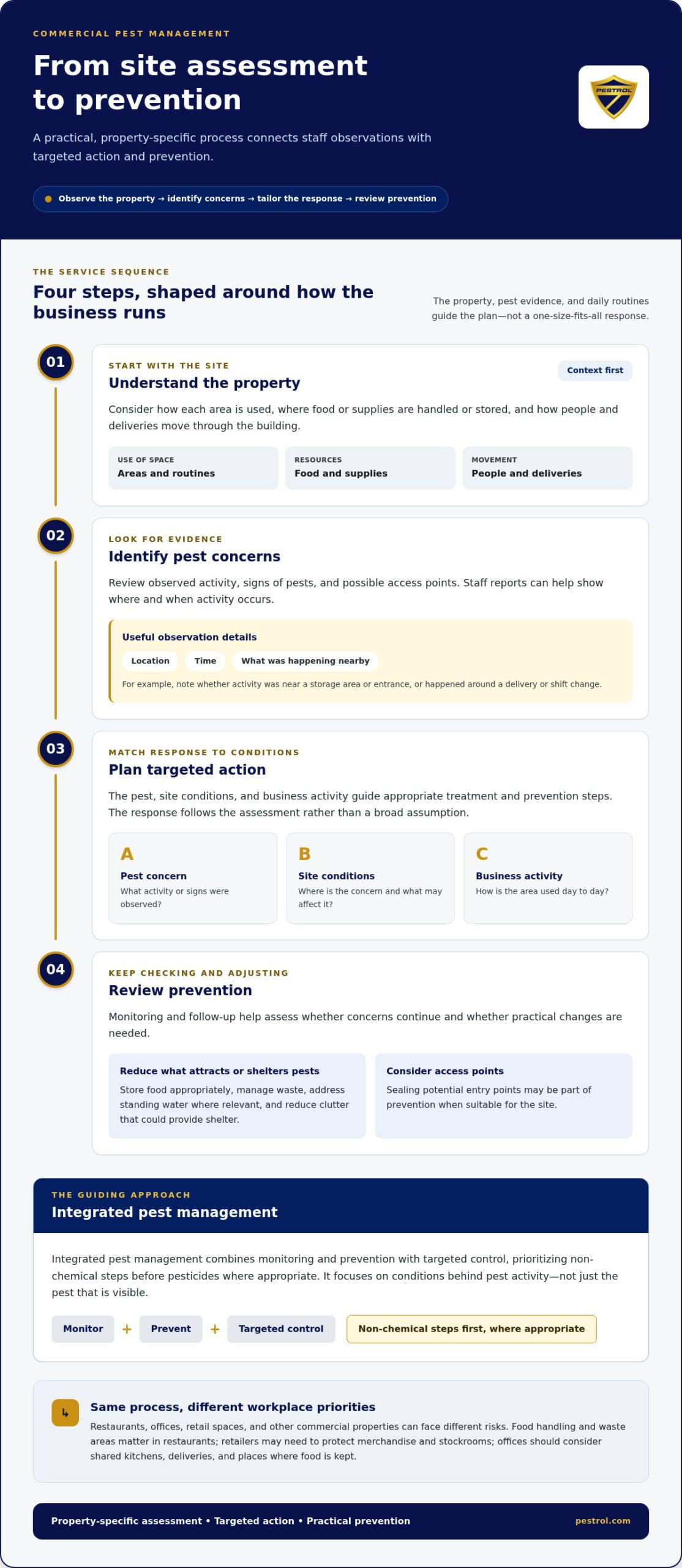
A useful commercial pest management process follows the property’s evidence and routines. It starts with understanding the site, identifying concerns, selecting targeted actions, and reviewing prevention. This sequence connects what staff observe with what the building may need, rather than applying the same response everywhere.
- Understand the property. Consider how each area is used, where food or supplies are handled or stored, and how people and deliveries move through the building.
- Identify pest concerns. Review observed activity, signs of pests, and possible access points. Staff reports can help show where and when activity occurs.
- Plan targeted action. The pest, site conditions, and business activity guide the appropriate treatment and prevention steps.
- Review prevention. Monitoring and follow-up help assess whether concerns continue and whether practical changes are needed.
Integrated pest management combines monitoring and prevention with targeted control, prioritizing non-chemical steps before pesticides where appropriate. This approach focuses on the conditions behind pest activity, not just the pest that’s visible.
What happens during a commercial pest assessment?
An assessment considers the premises in context: areas where activity has been noticed, potential entry points, and business routines that may affect pest pressure. Staff observations add useful detail. Note the location, time, and what was happening nearby, such as a delivery or a shift change. These details help build a clearer picture of the concern.
Observations matter even when the source isn’t obvious. Repeated sightings near a storage area, for example, may call for a different investigation than activity by an entrance. Sharing what staff have noticed helps distinguish an isolated sign from a recurring pattern and informs the next step.
How are treatment and prevention tailored to the site?
There’s no single treatment method that fits every pest or property. The plan should reflect the pest concern, its location, site conditions, and how the business operates. A food-service area, storage room, and public-facing space have different uses, so the response should account for those differences. Specific actions follow the assessment rather than a broad assumption.
Prevention focuses on making the environment less inviting. Store food appropriately, manage waste, address standing water where relevant, and reduce clutter that could provide shelter. Sealing potential access points may also be part of prevention when suitable for the site. Operational adjustments can support professional treatment, but they don’t replace an assessment when signs persist.
Monitoring and follow-up help keep the approach responsive. If activity changes or staff report new signs, that information can guide a review of the plan. Service needs differ by property and pest concern. For a site-specific solution, Pestrol’s commercial pest management is tailored to business needs.
How to Compare Commercial Pest Control Plans for Your Business
A useful plan should match your workplace’s risks and routines, not just sound comprehensive on paper. Compare what each approach addresses, how it accounts for the property, and how service fits around business activity. Look for a clear scope that responds to your concerns and makes sense for your site.
Use these criteria to organize your evaluation:
| What to compare | What a good fit considers |
|---|---|
| Pest scope | The pests you’ve seen, the areas involved, and any recurring concerns. |
| Property assessment | Building layout, access points, storage, and how different spaces are used. |
| Prevention | Practical steps that address conditions contributing to pest activity, alongside treatment where appropriate. |
| Communication | How staff observations and changes in activity can inform a review of the plan. |
| Business fit | Operating hours, access needs, customer traffic, and the day-to-day demands of the site. |
A broad-sounding plan may still miss a specific issue, while a minimal approach may not address conditions that allow pests to return. Look for a clear connection between the concerns identified and the actions proposed. Judge commercial pest control by how well it fits the property, not by how many services a plan lists.
Which questions help match service to business needs?
Start by recording what you know: which pests have been seen, where activity occurs, and whether it appears at particular times. Note operating hours, affected areas, property type, food handling, storage practices, and customer traffic. These details help Pestrol tailor commercial service to business needs. Share access considerations and staff routines, too, so the plan reflects how the premises function.
If you’re concerned about disruption, explain the workday realities: busy periods, areas that need access, and spaces where staff or customers are present. Clear information about routines helps shape a practical approach. The plan should take site use into account, with arrangements suited to the work required.
When does a business need specialized pest support?
Recurring rodent concerns may call for attention to both pest activity and possible access points. Rodent proofing can complement broader pest management by addressing routes into the property, rather than focusing only on sightings. Food-service businesses also have distinct operating patterns and spaces to consider, so a tailored plan can reflect how food is handled, stored, and prepared. Explore restaurant pest control considerations for more context.
For a plan shaped around your business property and its routines, explore Pestrol’s commercial pest control.
A Practical Commercial Pest Prevention Checklist for New York Workplaces
Daily routines can limit the food, water, and shelter that attract pests, while making changes easier to spot. Keep the checklist realistic for your workplace, whether it’s a restaurant kitchen, office break room, retail stock area, or another commercial space. Consistent habits are more useful than complicated rules staff can’t maintain.
Use these steps between professional visits:
- Follow established procedures for removing waste, keeping containers closed, and maintaining the areas around them.
- Store food in designated areas and keep it covered or contained according to workplace practices.
- Clean spills and food residue promptly, including in less visible corners and storage spaces.
- Reduce avoidable clutter so staff can keep work areas clean and notice changes more easily.
- Report pest signs promptly instead of moving or discarding evidence before it can be described.
- Record the date, location, type of sign, and nearby activity, such as a delivery or restocking.
Routine prevention makes a workplace less inviting to pests; professional treatment assesses and addresses concerns that daily housekeeping alone can’t resolve. These steps support a service plan but don’t replace professional guidance. Don’t apply unverified chemicals or attempt do-it-yourself treatment as a replacement for commercial pest control.
What should staff do between professional visits?
Make pest reporting part of normal workplace communication. A short, consistent note is more useful than a vague report: “signs near the rear storage door before opening” gives a location and context. Encourage staff to report repeat sightings, damaged packaging, or other changes, then share the information with the person coordinating pest management. This helps distinguish a new observation from a recurring concern.
How can managers prepare the workplace for service?
Before service, gather staff reports and identify affected areas, including changes in the location or timing of activity. Consider how access can work around customer traffic, deliveries, food preparation, or other operating needs. Share those details with the service team so the approach accounts for the site. Follow the team’s preparation guidance for your premises instead of relying on a universal checklist.
New York workplaces vary in layout and use, so preparation should reflect the actual site. A manager might coordinate access to a stockroom while keeping the main sales floor operating, or share kitchen routines that affect when an area is available. Clear communication helps staff know what to expect and gives the service team relevant context.
Keep the process simple: staff maintain everyday routines, managers document and communicate what they observe, and professionals guide treatment and site-specific preparation. This gives a business a practical way to stay attentive between visits while leaving pest-control decisions to the service plan.
Pestrol Commercial Pest Control: Tailored Support for Local Businesses
A business property has its own routines, layout, and pest concerns. Pestrol provides commercial pest management tailored to local business needs, with practical support informed by how each space is used. As a family-owned and operated company, Pestrol serves Manhattan, the Bronx, and communities across its New York service area.
Commercial pest management for different business settings
A service plan should reflect the property, the activity inside it, and the pest concerns being addressed. An office, retail space, and food-service business don’t use their premises in the same way. Storage, deliveries, food handling, staff, and customers can all shape which concerns need attention and how service fits the workday.
For restaurants and other food-service businesses, Pestrol’s restaurant pest control is tailored to food-service needs. The plan takes account of how food is received, prepared, stored, and cleared away, alongside the building’s layout and observed pest activity. This approach connects pest management to everyday operations rather than treating the property as a generic commercial space.
Rodent concerns may call for more than responding to sightings. Pestrol offers rodent proofing to address potential access points as part of broader pest management. Describe where activity has appeared and relevant site details, such as nearby storage or entry areas. Those observations help focus attention on the property’s specific needs.
Next steps for businesses seeking local pest control
To start a useful conversation, gather a few details about the business and the concern. Share the property type, where pest activity has been observed, and which areas may be affected. Note whether the issue is recurring and mention relevant routines, such as food handling, deliveries, or how the space is used during operating hours. This information helps Pestrol tailor commercial pest control to the premises and business activity.
It’s also helpful to identify practical access considerations and areas that need attention, so the discussion accounts for how the workplace functions. You don’t need to have the cause figured out before reaching out. A clear description of what staff have noticed is a useful starting point for next steps.
Whether you manage a restaurant, office, retail space, or another business property, Pestrol provides tailored local support for your pest concerns.
Take the Next Step Toward a More Prepared Workplace
Your next move can be simple: decide who on your team will track pest concerns and share useful details, such as where activity appears and which areas matter most to daily operations. A clear starting point helps turn uncertainty into a practical conversation about your property’s needs.
Pestrol is a family-owned and operated business providing tailored commercial and restaurant pest management for businesses across Manhattan, the Bronx, and its New York service area. If you’re considering commercial pest control, bring your observations and operational priorities to the discussion. A plan shaped around your workplace helps your team move forward with greater clarity.
With practical support and steady attention from your team, you can take a confident next step toward a workplace that feels ready for business.
Frequently Asked Questions
What does commercial pest control include?
Commercial pest control can include assessing a workplace, identifying pest concerns, and planning treatment and prevention suited to the site. The approach depends on the pest, the building, and how the business operates. For example, a concern near a receiving area may call for attention to delivery routines and access points. Sharing where and when signs appeared helps Pestrol understand the situation and tailor the service plan.
How often should a business schedule pest control?
There isn’t one service schedule that suits every business. The appropriate frequency depends on the property, pest concerns, operating activity, and what’s observed over time. A business can record sightings and changes between visits, then use that information to discuss whether its current approach still fits. Pestrol tailors commercial pest management to business needs rather than applying the same interval to every workplace.
Can commercial pest control be scheduled around business hours?
Business routines are useful planning information, and scheduling should account for the work and the site. Share opening hours, busy periods, access needs, and any areas that are difficult to reach during operations. For example, a manager might note when a stockroom is available or when customer traffic is heaviest. This context helps Pestrol plan commercial pest management around the property’s routines.
What should I do if I see pests at my business?
Record the sighting and report it to the person responsible for the property. Note the date, approximate time, exact area, what you observed, and any nearby activity, such as unpacking a delivery. If signs appear again, add another entry rather than relying on memory. Keep normal food and waste procedures in place, and don’t assume one sighting proves the extent or source of a pest concern.
Is commercial pest control different from residential pest control?
Yes. A business plan needs to account for how people use the premises, including customer access, staff routines, deliveries, and the handling or storage of goods. Pestrol serves businesses across Manhattan, the Bronx, Chester, Cornwall, Crawford, Goshen, Greenville, Highlands, Minisink, Monroe, Montgomery, Mount Hope, New Windsor, Newburgh, Palm Tree, Tuxedo, Wallkill, Warwick, Wawayanda, and Woodbury. The service approach can be tailored to the property and its pest concerns.
How can a business prevent pests between service visits?
Keep workplace food and waste routines consistent, clean up spills, and avoid letting clutter accumulate in areas staff need to inspect or clean. Make reporting easy by giving employees a clear way to share sightings with a manager. A short note about location and timing can help identify a recurring concern. These habits support professional pest management, but they aren’t a replacement for assessment when activity is noticed.
Does a restaurant need specialized commercial pest control?
Restaurant pest management should reflect how the food-service premises operate. Food deliveries, preparation areas, storage, and waste handling all provide useful context when shaping a plan. Pestrol provides restaurant pest control tailored to food-service business needs. Managers can help by sharing which areas are involved and how the concern relates to daily routines. This gives the service plan a practical starting point without assuming every restaurant has the same needs.
How much does commercial pest control cost?
The cost depends on the property, the pest concern, and the work required, so a general figure may not reflect your business’s needs. To make a discussion more useful, describe the property type, affected areas, and any signs staff have recorded. Include relevant operating details, such as storage or access considerations. Pestrol uses this information to understand the project and tailor its commercial pest management approach.