



If you are still setting traps every winter, you aren’t solving a pest problem; you are just managing a cycle. It’s incredibly frustrating to hear that familiar scratching in your walls just weeks after you thought the house was clear. Many homeowners in Middletown and Warwick feel that same anxiety, especially with the 2026 surge in rodent activity across the Hudson Valley. You want your home to be a sanctuary, not a playground for pests that carry health risks like hantavirus. Effective rodent proofing Orange County homes requires more than just reactive measures; it demands a structural defense that addresses why the local Bureau of Public Health investigates hundreds of these nuisances every year.
We understand that recurring sightings cause real stress about property damage and your family’s safety. This guide will show you how to secure your property against mice and rats using professional-grade exclusion techniques specifically designed for New York’s harsh climate and unique architecture. You’ll learn how to identify specific entry points common in local homes and discover how a permanent, tiered protection plan can finally end the cycle of infestations for good.
Key Takeaways
- Learn why the rural-suburban landscape of the Hudson Valley creates unique pest pressures and how the “winter push” drives rodents into local homes.
- Understand the science of the “quarter-inch rule” to see how professional rodent proofing Orange County techniques seal structural gaps that traps alone cannot fix.
- Discover why proactive structural exclusion provides a more permanent, long-term solution than traditional, reactive trapping methods.
- Identify the most common entry points in Hudson Valley architecture, including foundation sill plates and utility penetrations, that serve as highways for pests.
- Explore how customized, tiered Home Pest Protection plans provide a structured defense tailored to your property’s specific needs and layout.
Understanding the Rodent Pressure in Orange County, NY
Orange County, NY, presents a unique challenge for homeowners that differs significantly from more urbanized regions. Our landscape is defined by a rural-suburban mix where residential neighborhoods sit directly adjacent to dense woodlots and agricultural land. This environment provides a perfect breeding ground for rodents. They thrive outdoors during the summer but quickly look for more stable environments when the resources in the Hudson Valley wild change. Understanding this local pressure is the first step toward securing your property.
You’ll mostly encounter two specific invaders in this area. The common House Mouse is a year-round nuisance that prefers living in close proximity to human food sources. However, the White-Footed Mouse is equally common, often entering from the surrounding woods. These aren’t just uninvited guests; they carry bacteria and allergens that compromise your indoor air quality. Local health concerns regarding hantavirus have increased as of June 2026, making The Science of Exclusion a vital part of modern home maintenance. These rodents don’t need an open door to enter; they only need a gap the size of a dime to start a colony in your walls.
The Hudson Valley Climate Factor
The 2026 seasonal shifts have been particularly sharp, leading to what professionals call the “Winter Push.” As temperatures drop in late autumn, a mass migration occurs. Rodents seek the consistent warmth of your basement, crawlspace, or attic. Traditional trapping often fails during these peak months because it’s a reactive strategy. It only removes the mice that have already made it inside. It doesn’t stop the dozens of others waiting to exploit the same entry point. Our local vegetation and heavy leaf litter provide ample cover for these populations to grow unchecked until they reach your foundation.
Historic vs. Modern Home Vulnerabilities
The Science of Exclusion: How Professional Rodent Proofing Works
Rodent exclusion is a structural barrier system designed to stop pests before they ever step foot inside your living space. This method moves beyond the temporary cycle of “trap and repeat” by physically sealing your home’s exterior. It’s the most reliable way to Prevent Rodent Infestations because it targets the building’s vulnerabilities rather than just the animals. Investing in high-quality exclusion provides a significantly better long-term ROI. You’ll save money by avoiding recurring baiting costs and the expensive repairs associated with chewed wires or ruined insulation.
The biggest challenge in effective rodent proofing Orange County properties is the “Quarter-Inch Rule.” A juvenile mouse can compress its body to fit through a gap only six millimeters wide. If you can slide a standard pencil into a crack, a mouse can use it as a doorway. This biological reality is why professional exclusion requires such high precision. We don’t just look for obvious holes; we search for every subtle structural defect that an opportunistic rodent could exploit.
Professional Material Standards
Standard hardware store “Expanding Foam” is a temporary fix that fails almost immediately. Rodents can chew through it in minutes, and the Hudson Valley’s freeze-thaw cycles cause it to degrade and pull away from the siding. We use industrial-grade materials like galvanized steel mesh and heavy-duty copper wool. These are paired with high-performance sealants that remain flexible in sub-zero temperatures. These professional-grade barriers are designed to last for years, providing a permanent shield that withstands both sharp teeth and the New York climate.
The Inspection Process
A successful exclusion plan starts with a meticulous perimeter analysis. We examine everything from the foundation sill plates to the roofline. Our team looks for “rub marks,” which are dark, greasy stains left by the oils in a rodent’s fur. These marks indicate high-traffic entry points. We also identify pheromone trails that lead other rodents to the same gaps. If you’ve struggled with recurring sightings, a thorough rodent proofing inspection is the only way to find every hidden entrance pests are using to invade your home.
Rodent Proofing vs. Traditional Extermination: Which Lasts Longer?
Traditional extermination often relies on a reactive cycle. You see a mouse, you set a trap, and you wait. While this might remove the immediate intruder, it does nothing to prevent the next one from following the same scent trail into your kitchen. Trapping is essentially a population management tool rather than a permanent solution. To achieve a truly rodent-free home, you must shift from a reactive mindset to a proactive one.
Professional rodent proofing Orange County homes involves a “Trap-and-Seal” hybrid approach. We first identify and seal every structural vulnerability to stop new entries. Only then do we remove the rodents already inside. This method ensures you aren’t just thinning the herd; you’re ending the infestation for good. This strategy also carries a significant environmental benefit. By creating a physical barrier, you drastically reduce the need for rodenticides and chemical baits around your property. It’s a safer choice for the local Hudson Valley ecosystem and your family.
The Hidden Costs of DIY Trapping
Many homeowners start with DIY methods, but the costs add up quickly. High-quality traps and fresh bait require constant replacement. You also face the “Smart Mouse” problem. Rodents are naturally neophobic, meaning they’re suspicious of new objects. Over time, survivors learn to avoid specific trap designs or scent profiles, making your efforts less effective. Beyond the expense, there’s the safety factor. Exposed traps and toxic baits pose a constant risk to curious pets and small children. Relying on structural rodent proofing services removes these hazards from your daily life.
Total Value Analysis
The longevity of a structural seal far outweighs the temporary relief of a bait station. A professionally installed galvanized steel barrier can protect your home for a decade or more. Baits, however, must be replenished monthly to remain effective. This makes proofing the more financially sound investment over time. There’s also an emotional value that’s hard to quantify. Knowing your home is physically sealed provides a level of peace of mind that a simple trap can’t offer. You can finally stop listening for scratches in the attic and start enjoying your home again.
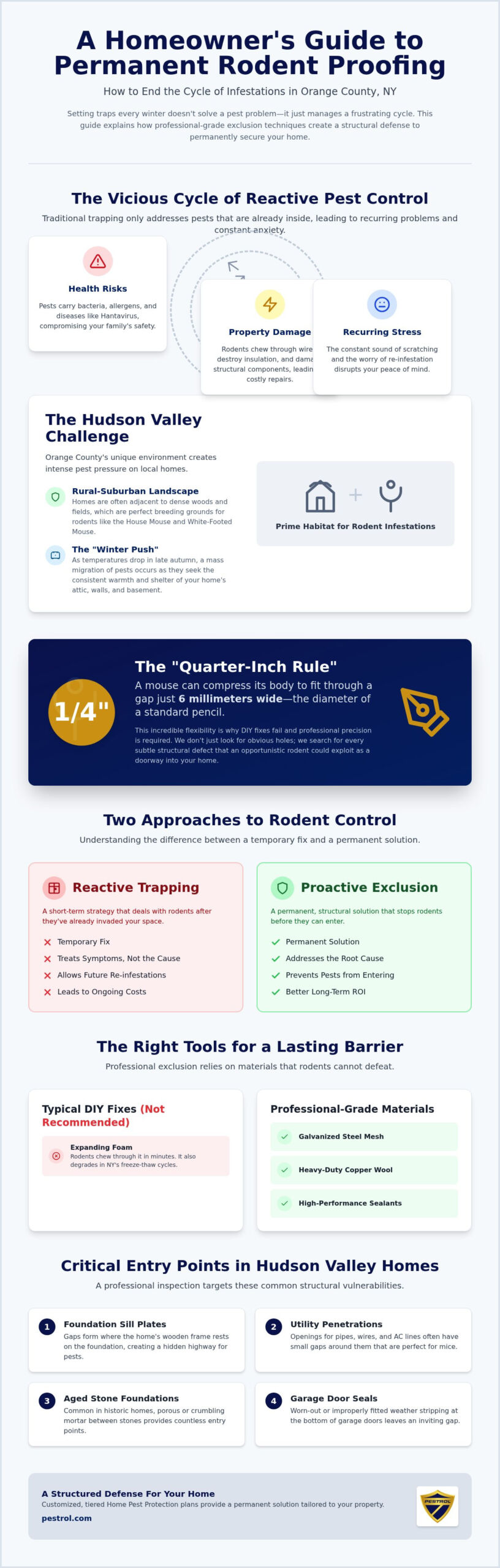
Critical Entry Points in Hudson Valley Homes (And How to Seal Them)
Garage doors represent another significant vulnerability. While they might look solid, the rubber weatherstripping at the bottom is easily chewed through by rats or mice. Once they are inside the garage, they have easy access to the interior walls of your home. Effective rodent proofing Orange County residences requires a meticulous eye for these structural weak spots. Even the roofline isn’t safe, as rats exploit high-altitude entries through loose soffit vents or gaps in the fascia board.
If your home has a brick veneer, pay close attention to the “weep holes” located near the ground level. These are necessary for ventilation but are often large enough for rodents to enter the wall cavity. Crawl space vents and basement windows are also high-risk areas, especially if the screens are rusted or torn. You can easily check these vulnerabilities yourself. If you can slide a standard number two pencil into a gap, a juvenile mouse can easily squeeze through it. Sealing these gaps with professional-grade materials is the only way to ensure your foundation remains secure.
Upper-Level Entry Points
Don’t ignore the roofline when searching for entry points. Rats are excellent climbers and frequently use overhanging tree limbs as bridges to reach your gutters and shingles. Once they’re on the roof, they look for gaps in chimney flashing, attic fans, or dormer intersections. These areas are particularly prone to rot or poor sealing, providing a soft entry point for high-altitude pests. Sealing these upper-level vulnerabilities is a critical part of a comprehensive exclusion strategy. By removing access from both the ground and the air, you create a truly impenetrable home.
Professional Rodent Proofing Services with Pestrol
Pestrol delivers a results-first approach to rodent proofing Orange County homes and businesses. We don’t believe in one-size-fits-all solutions because every Hudson Valley property has unique vulnerabilities. Our family-owned institution treats your home with personal care, focusing on long-term security rather than quick, one-off transactions. We act as a protective guardian for your living space. For business owners in Newburgh, we provide specialized Restaurant Pest Control and commercial proofing that meets strict local health department standards. We take the burden of pest management off your shoulders so you can focus on your family or your customers.
In 2026, we’ve seen a noticeable increase in rodent activity across the county, particularly in residential areas near Middletown and Warwick. This surge makes a structured defense more important than ever. Our technicians are trained to identify the rub marks and pheromone trails that indicate where populations are most active. We use this data to build your customized exclusion plan, ensuring every gap is sealed with professional-grade materials. This persistence and commitment to detail are what set our local team apart from national chains that might overlook the nuances of New York architecture.
Choosing Your Protection Tier
Our Home Pest Protection plans are designed to scale with your specific needs and the level of pest pressure around your property. The Basic plan provides essential seasonal security against common invaders, perfect for homes with minimal history of infestations. If you live in a high-pressure area near woodlots or agricultural fields, our Plus and Premium tiers offer a more comprehensive defense. These advanced plans include detailed structural exclusion work to ensure your home remains a fortress against the “Winter Push.” You can find more details in our 2026 Guide: Home Pest Protection for New Yorkers.
The Pestrol Local Advantage
We are deeply rooted in the local community, serving Middletown, Warwick, and the entire Hudson Valley. Unlike national franchises, our technicians understand the specific nuances of New York architecture. We know exactly how a 19th-century farmhouse foundation differs from a modern suburban development in Newburgh. This specialized knowledge allows us to perform rodent proofing Orange County residents can trust for permanent results. We don’t just set traps; we rebuild your home’s defenses to keep pests out for good. Our goal is to provide you with total peace of mind through a reliable, results-oriented partnership.
Secure Your Hudson Valley Home for the Long Term
Managing mice and rats doesn’t have to be a seasonal struggle. By shifting your focus from reactive trapping to structural exclusion, you address the root cause of infestations. You’ve learned that even a tiny gap can compromise your foundation and that professional-grade materials are essential to withstand the New York climate. Effective rodent proofing Orange County properties is about creating a permanent barrier that protects your family’s health and your home’s value.
Pestrol has served this community as a family-owned and operated business since our inception. We use specialized structural exclusion protocols designed specifically for the unique architecture found in Middletown, Warwick, and Newburgh. Our team is committed to providing the peace of mind you deserve with a home that is truly secure from the ground up.
Take the first step toward a rodent-free future today. We have the expertise to help you reclaim your sanctuary and ensure these pests stay exactly where they belong: outside.
Frequently Asked Questions
Is professional rodent proofing worth the cost in Orange County?
Professional rodent proofing is a wise investment for homeowners in Goshen and Warwick because it ends the cycle of expensive, recurring infestations. While traps only manage existing populations, structural exclusion prevents future entries. This saves you money on replacement insulation and electrical repairs over time. It’s the most cost-effective way to secure your property against the 2026 surge in rodent activity reported across the Hudson Valley.
Can mice really fit through a hole as small as a pencil?
Mice can compress their bodies to fit through any opening as small as six millimeters, which is roughly the diameter of a standard pencil. Their skulls are the only rigid part of their anatomy; if the head fits, the rest of the body follows. This biological reality is why our technicians perform such meticulous inspections in New Windsor and Cornwall. We identify these tiny gaps in foundations and siding that most homeowners overlook.
What materials are best for rodent proofing a historic home?
Historic estates in Warwick or Montgomery require high-durability materials that don’t compromise the home’s aesthetic. We use galvanized steel mesh and heavy-duty copper wool because rodents cannot chew through them. These are paired with professional-grade sealants that withstand the freeze-thaw cycles of New York winters. Unlike expanding foam, which degrades quickly, these industrial materials provide a permanent barrier that blends into the existing architecture of older Hudson Valley homes.
How long does a professional rodent exclusion service take?
The duration of a rodent proofing Orange County service depends on your home’s size and the number of entry points identified. A standard residential property in Middletown usually takes between four and eight hours to complete. Complex historic homes with porous foundations may require more time. Our team works efficiently to ensure every vulnerability, from the basement sill plates to the roofline, is fully secured before we finish the job.
Will rodent proofing my house also stop other pests like roaches?
Yes, structural exclusion provides a significant secondary benefit by blocking other pests. When we seal gaps around utility lines and foundation cracks, we also remove the primary entry points for roaches, ants, and spiders. While rodent proofing specifically targets larger mammals, the tight seals we install create a more secure perimeter for your entire home. This comprehensive approach is a core part of our tiered Home Pest Protection plans.
Do I need to leave my home during the rodent proofing process?
You don’t need to leave your home while we perform exclusion work. The process is non-invasive and focuses primarily on the exterior perimeter, attic, and basement. Our technicians work quietly to seal entry points without disrupting your daily routine. We prioritize your family’s comfort and safety, ensuring all materials used are secure and professional. It’s a straightforward way to protect your Newburgh or Wallkill residence without any major household upheaval.
What is the difference between rodent control and rodent proofing?
Rodent control typically refers to reactive measures like trapping or baiting to manage an active population. In contrast, rodent proofing is a proactive, structural solution that involves sealing your home to prevent entry. While control measures are often necessary to clear an existing problem, proofing is the only way to ensure the issue doesn’t return. We combine both methods in our specialized protocols to give you a permanently rodent-free environment.
How often should I have my home’s exclusion seals inspected?
We recommend an annual inspection to ensure your exclusion seals remain intact. New York’s harsh weather and the natural settling of your home can occasionally create new vulnerabilities. Homeowners in high-pressure areas like Tuxedo or Monroe benefit from regular check-ups as part of our Home Pest Protection – Premium plan. This ongoing monitoring ensures your rodent proofing Orange County defenses remain strong against the seasonal shifts that drive pests toward your warm living spaces.