




The lowest monthly bill isn’t always the lowest-cost way to manage pests. The pest control monthly cost in NY depends on the pest, the extent of the problem, the property, and how often service is needed. A professional quote reflects those details rather than one flat New York City rate.
It’s understandable to want a clear budget before choosing between recurring visits and a one-time treatment. The right option depends on whether you’re dealing with an active infestation, recurring pest activity, or a need for ongoing prevention.
This guide explains how monthly plans compare with one-time service, what can affect the price, and where DIY options fit. The type of pest and the work needed to address it are key factors when weighing costs and choosing a practical plan.
Key Takeaways
- Use your property type and visit frequency to understand why maintenance estimates can differ across NYC homes.
- Compare recurring service with one-time treatment based on whether you need prevention, help with a current infestation, or both.
- Consider how pest type and how established the problem is can change the work involved and the overall cost.
- Weigh DIY products against professional service, especially when an infestation needs a targeted or ongoing approach.
- For Upstate New York and Capital Region estimates, account for local conditions as well as the pest and property being treated.
1. What Is the Average Cost of Pest Control in NYC?
There isn’t one dependable monthly average for residential pest control across New York. The price depends on the pest, property size, infestation severity, and service frequency, and is given after a quote request.
For NYC apartment maintenance, a service plan may differ from a one-time treatment for an active infestation. A one-bedroom apartment with recurring cockroach activity needs a different scope from a larger home with rodent entry points. The plan also depends on whether visits focus on monitoring, prevention, or visible activity. Those differences shape the estimate more than the word “monthly” alone.
Property type matters because a townhouse or brownstone can have more rooms, entry points, and shared spaces than a compact apartment. A technician may assess basements, kitchens, utility areas, and exterior access points. In an apartment building, recurring cockroach activity may also involve connected walls or plumbing openings. A maintenance plan should reflect the spaces being treated, not just the address.
Monthly general pest-control plans provide scheduled attention over time, while an initial visit may address an existing problem. A treatment for a cockroach infestation, for example, can require a different approach from routine checks for occasional activity. If rodents are entering around pipes or doors, inspection and rodent proofing may affect the scope. Ask for an estimate that distinguishes initial treatment from ongoing maintenance.
An emergency or same-day price estimate has limits before the problem is assessed. A brief report of a mouse sighting doesn’t show whether a rodent entered once or has access to several rooms. The pest, evidence of activity, building layout, and access to affected areas all influence the work. An urgent visit may reveal a different scope from the one assumed during an initial phone description.
Commercial estimates also vary by property use. A small office may need attention around a break room and storage area, while a warehouse can involve wider spaces, loading doors, and stored materials. Restaurant pest management has different priorities from office maintenance because kitchens, food storage, and service areas need focused attention. The estimate should reflect the actual spaces and pest concerns.
For an office, a service plan can account for where staff see activity and how the property is used. For a warehouse, an inspection may consider receiving areas and possible rodent access. These examples show why a single commercial monthly average can mislead. A useful estimate connects visit frequency and treatment scope to the building’s layout and reported pest activity.
When comparing estimates, separate the initial response from recurring visits, then compare the areas and pest concerns each covers. This makes a monthly figure easier to interpret and helps prevent a narrow treatment from being mistaken for whole-property maintenance.
There is no dependable average monthly price; the cost is determined by a quote based on the pest, property, infestation, and service needs.
2. The cost of recurring service versus one-time treatment
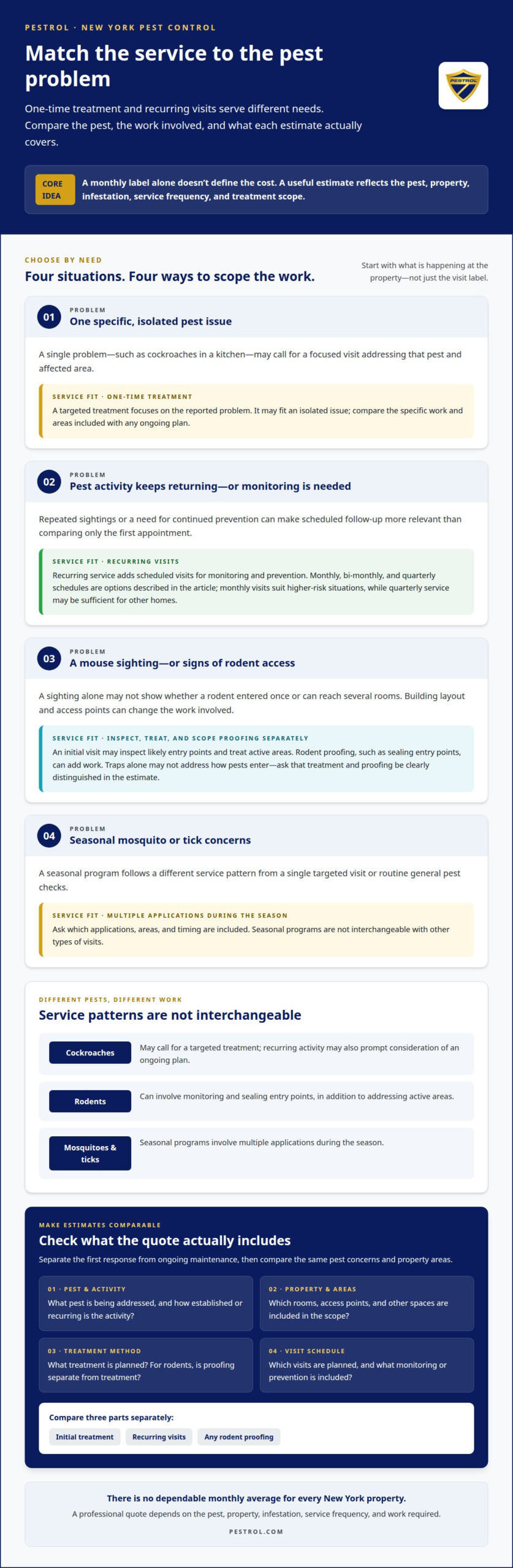
A one-time treatment focuses on a specific pest problem, such as cockroaches in a kitchen. Recurring service adds scheduled visits for monitoring and prevention. NYC maintenance plans may use monthly, bi-monthly, or quarterly schedules. Compare the full scope: a targeted visit addresses immediate activity, while ongoing pest management returns to check for changing conditions.
An initial visit may require more work than later maintenance. For example, a mouse problem can involve inspecting likely entry points, treating active areas, and deciding whether rodent proofing is needed. Traps alone may not address how pests enter. Sealing entry points can add work, so an estimate should distinguish treatment from proofing rather than combining them in one unclear line.
The treatment method also changes the service scope. A professional may use targeted treatment for cockroaches, while rodent control can involve monitoring and sealing entry points. Seasonal mosquito and tick programs involve multiple applications during the season. These are different service patterns, not interchangeable visits. Ask for a written estimate describing the pest, treatment method, included areas, and planned visit frequency.
Recurring service can suit homes with repeated pest activity or conditions that call for continued monitoring. Monthly visits suit higher-risk situations; quarterly service may be sufficient for other homes. A one-time visit can make sense for an isolated problem, but repeated sightings may call for a maintenance plan. Compare the expected visits and included work, not just the first appointment.
Commercial service is just as property-specific. A small office with activity near a break room has a different scope from a restaurant kitchen or a warehouse with loading areas. Provider-specific prices reflect the building, pest concerns, visit schedule, and treatment method. There isn’t one commercial price that applies to every business; the estimate is given after a quote request and depends on those factors.
For a useful comparison, separate the estimate into initial treatment, recurring visits, and any rodent proofing. Then check whether each option covers the same areas and pest concerns. A lower first-visit amount may cover less work than a recurring plan. The value depends on the service delivered over time, not the label attached to the plan.
If recurring activity keeps returning, consider professional pest management that matches the pest and property. That discussion can focus on whether a targeted visit or an ongoing schedule fits the problem.
3. Is a maintenance plan cheaper than one-time treatments?
A maintenance plan can make sense when the same pest keeps returning, but it isn’t automatically cheaper for every home. A one-time treatment may fit an isolated ant problem; repeated cockroach activity can call for inspection, treatment, and follow-up visits. Compare the work needed across the full service period, not just the first appointment.
For an existing infestation, treatment may begin with an intensive plan before routine visits start. For example, a mouse infestation can require attention to active areas and possible entry points. Preventive service then focuses on monitoring and addressing conditions that could bring activity back. Treating the active problem and preventing recurrence are distinct stages, so the plan should explain both.
Inspections help determine whether recurring visits are useful. A professional can assess evidence such as droppings, damaged packaging, or activity near a kitchen sink. In a multi-unit building, activity in shared spaces may affect which areas need attention. The visit schedule should reflect the pest, the building, and whether activity continues after initial treatment.
Some infestations need specialized treatment rather than general maintenance. Bed Bug Treatment, Termite Control, and Clothes Moth Treatment involve different inspection findings and approaches. A recurring general plan shouldn’t be treated as a substitute for a targeted response to bed bugs or termites. Seasonal pests such as mosquitoes and ticks may need treatment programs with several applications during the season.
Eco-friendly or organic options may use different treatment methods from traditional chemical approaches, and pricing can differ accordingly. The relevant comparison is the full service scope: which pest is being treated, where the treatment occurs, and whether follow-up visits are included. For example, a treatment approach for ants in a kitchen may not match the one used for a persistent mouse problem.
The price depends on the pest, infestation severity, property, treatment method, and visit frequency. The exact figure is provided in a quote for your case. For a fair comparison, check whether each plan includes inspection, treatment, monitoring, and any needed follow-up rather than assuming two plans cover the same work.
A preventive plan may be worthwhile when inspections show recurring activity or ongoing risk across a building. A one-time treatment may better suit a contained issue that doesn’t return. If the first service reveals a larger infestation, the professional may recommend addressing it before moving to regular maintenance. This keeps the plan aligned with the property’s actual needs.
5. What Professional Pest Control Includes Compared With DIY
Professional service starts by identifying the pest and where activity occurs. For roaches, that can mean assessing kitchen areas, plumbing openings, and signs near food storage. For mice, an inspection may focus on entry points and routes through the property. This assessment helps define treatment areas and whether follow-up visits or rodent proofing belong in the service scope.
DIY products can seem straightforward for a contained issue. A product may not address activity in other rooms or entry points. Pesticides should be used safely and according to the product label, including its directions and precautions.
Professional treatment offers a broader process than applying one product. It connects inspection findings with a treatment method, targeted areas, and ongoing monitoring where needed. For example, treating visible roaches without addressing the conditions around their activity may leave part of the problem untouched. A professional can explain what the treatment covers and how the next visit fits the plan.
Homeowners and property owners can compare quotes by checking the same details in each estimate. Look for the pest, affected areas, initial treatment, follow-up visits, and any entry-point work. A quote covering one room is not equivalent to one covering an entire building. Pest control costs depend on the pest, property, severity, and scope of work, so compare like with like.
Reliable pest control companies should have licensing, insurance, and relevant experience, and should explain treatments and pricing clearly. Those points help you understand who will perform the work and what the estimate includes. For a roach problem, the explanation should identify the treatment areas and any follow-up plan. For a mouse issue, it should clarify whether entry points are part of the proposed work.
Professional service is especially useful when activity persists, spreads, or involves pests requiring specialized treatment. Bed bugs, termites, and rodents can call for different inspection and treatment approaches. A DIY product may be a poor match if the pest has been misidentified or the affected area is larger than expected. A professional assessment connects the treatment to the actual pest problem.
Use the estimate to understand both the immediate response and any continuing service. Ask what the quoted work includes, which areas it covers, and how the professional will address inspection findings. That gives homeowners a clearer comparison between a single DIY purchase and a service plan designed around the building and its pest concerns.
5. What Affects Pest Control Pricing?
Location matters because property conditions and service needs vary across New York City and nearby communities. A Manhattan apartment and a home in the Bronx may have different layouts, access points, and pest concerns. Properties in Chester, Cornwall, Crawford, and Goshen also differ in size and structure. Geography helps frame an estimate, but the pest and treatment scope determine the work.
Monthly and quarterly schedules affect how often a professional visits and monitors activity. Monthly visits can suit recurring pest concerns, while quarterly service may fit properties with less frequent activity. Treatment for visible pests may involve different work from inspection and monitoring. The schedule should match the property’s needs.
Commercial pest control depends on how a business uses its space. An office, restaurant, and warehouse present different conditions. A restaurant kitchen requires attention to food preparation and storage areas, while a warehouse may require review of loading zones and stored goods. Those differences affect treatment areas and the visit plan.
Your estimate depends on the pest, property size, infestation severity, treatment method, location, and visit frequency. The price is provided in a quote based on those case-specific factors. For a useful comparison, match the property type, service schedule, and included work. This prevents an estimate for quarterly monitoring from being compared with one for active termite treatment.
A termite concern, recurring mouse activity, and seasonal mosquito control each call for different approaches. One service can involve more work than another, even at the same property. An inspection helps establish whether the plan needs treatment, monitoring, or attention to specific parts of the building.
Pestrol
Pestrol helps New York homeowners choose a practical next step after comparing recurring service with one-time treatment. For ongoing residential pest concerns, Home Pest Protection – Basic, Home Pest Protection – Plus, and Home Pest Protection – Premium offer tiered options. If bed bugs are the concern, Pestrol also provides Bed Bug Treatment.
The right service depends on the pest, the property, and whether you need help with an active problem or ongoing protection. Share what you’re seeing and where activity occurs so the service can be matched to your situation. Your quote reflects the specific work involved, not a general monthly estimate.
For help choosing an appropriate pest control approach, contact Pestrol.
Choose a plan that fits your next step
Use your estimate to decide what support would make the property easier to manage. If pests keep returning, consider whether an ongoing plan suits your needs. If you’re addressing a specific infestation, focus on the treatment required and the areas involved. The right choice starts with the problem you want solved, not simply the lowest monthly figure.
Understanding the pest control monthly cost in NY is most useful when it helps you plan service that matches your home. Pestrol offers Home Pest Protection – Basic, Home Pest Protection – Plus, and Home Pest Protection – Premium, giving you tiered options to consider. A quote for your situation can clarify the service scope and next step.
Take the next step with a clear view of what your home needs. A well-matched plan can help you feel more prepared to protect your space.
Frequently Asked Questions
What Is the Average Cost of Pest Control in NYC?
There isn’t one monthly average that fits every NYC home. A studio with occasional ant activity needs a different service scope from a multi-floor home with recurring mice. The pest control monthly cost in NY depends on the pest, property, severity, treatment method, and visit schedule. Treat general estimates as a starting point, then compare the actual areas and work included.
The Smart Solution: What Does Maintenance Pest Control Actually Include?
Maintenance pest control typically combines scheduled visits with preventive attention to a property’s pest concerns. A service plan may include monitoring and treatment for common household pests. The work can vary by building: a kitchen, basement, and shared hallway each present different conditions. Review the plan’s covered pests and areas to understand what its maintenance visits are designed to address.
What Affects Pest Control Pricing?
Pricing reflects the pest, extent of activity, property size, access, treatment approach, and visit frequency. A termite concern calls for a different assessment from seasonal mosquito activity. A restaurant kitchen also differs from a home because the spaces and pest pressures vary. To compare estimates clearly, match the pest, affected areas, visit schedule, and stated work.
What’s the Bottom Line on NYC Pest Control Costs in 2026?
For 2026, the useful takeaway is to budget according to the actual service scope rather than assume one citywide figure applies. A recurring plan and a targeted treatment cover different needs. An apartment with one contained issue is not equivalent to a larger building with persistent activity. Ask for an estimate that separates the property’s pest concern from the work included.
Can I bundle services?
Pestrol offers Home Pest Protection – Basic, Home Pest Protection – Plus, and Home Pest Protection – Premium as tiered residential plan options. These are distinct plans, not a promise that separate treatments can be combined into a bundle. If you’re considering help with multiple pest concerns, describe them together in your quote request so the service scope can address the situation.
How much does an exterminator cost?
An exterminator’s price depends on the pest, infestation severity, property, treatment method, and whether follow-up or rodent proofing is involved. Treating visible activity differs from investigating how mice enter a building. Pestrol provides a quote for your case, with the estimate clarifying which treatment areas and services it covers.
Is a maintenance plan cheaper than one-time treatments?
It depends on whether you need help with one isolated problem or repeated pest activity. A single contained issue may suit one treatment, while recurring sightings can make scheduled monitoring relevant. Consider the service over the period you need it, including inspections, treatment, and follow-up. Comparing the complete scope helps show whether ongoing service better matches your situation.
Should You Hire a Local NYC Company or a National Chain?
Choose a service that fits your property, pest concern, and location. Building layouts and pest activity vary across New York, so the proposed treatment should address the specific spaces involved. Pestrol serves New York City, Rockland County, Orange County, and Westchester County. A clear explanation of the treatment and estimate helps you understand what the service covers.