




Rodent treatment should leave you clear about what happens next, including whether you need to leave home. A guaranteed rodent removal service in Manhattan should explain the treatment plan and what its guarantee covers; whether you need to step out depends on the methods used and the areas being treated. Cost also varies with the infestation, access points, and work required.
Hearing scratching in a wall or finding signs of rodents at home is unsettling. You want the problem addressed thoroughly, without unnecessary disruption. This guide explains what affects rodent-control costs, where rats and mice commonly enter and nest, and how professionals select methods such as traps, bait stations, and wall-void treatment.
You’ll also learn what to expect during service and how to make an informed decision about professional help in Manhattan. With a clear picture of the process, you can take the next step with more confidence and know what questions the treatment plan should answer.
Key Takeaways
- Rodent-control costs depend on the infestation, access points, and treatment needed, so understand what the service plan covers before moving forward.
- Knowing where rodents enter and nest helps explain why treatment may involve more than addressing the spot where you first noticed signs.
- Traps, bait stations, and wall-void treatments serve different purposes; the right approach depends on the conditions in your home.
- Ask how the treatment will affect access to rooms and whether you’ll need to leave while work is underway.
- Professional rodent proofing can address entry points as part of a plan to reduce the chance of rodents returning.
Do you provide rodent control in Manhattan?
Guaranteed rodent removal in Manhattan starts with addressing both visible activity and the conditions that let rodents inside. Droppings beside a pantry, scratching near a pipe, or gnaw marks beneath a door can point to different routes and nesting areas. A professional assessment connects these signs to a treatment plan instead of treating one room as the whole problem. If activity appears in a kitchen and hallway, for example, the inspection should consider how those spaces connect.
New York City property owners are legally required to keep buildings rat-free and address conditions that attract rats. Tenants can report rat-related problems through 311. In multi-unit buildings, the landlord’s building-level responsibility matters because activity in shared spaces, such as basements or refuse areas, can affect several apartments. A report that identifies the affected unit or common area helps clarify where the problem is appearing.
Rats and mice are the rodents most commonly addressed in Manhattan apartments and buildings. Signs can appear in different places: mouse droppings may turn up near food storage, while rat activity may be noticed in a basement or refuse area. The location of the signs can help trace possible routes between apartments and shared spaces.
For urgent rodent concerns in New York City, the priority is a prompt assessment of active signs and where they appear. A quick appointment is not the same as a treatment result: the work still needs to account for entry points, nesting areas, and the building layout. A professional can use inspection findings to determine whether trapping, bait stations, or exclusion belongs in the plan. For example, a sighting beside a shared utility opening calls for attention to that opening, not just the room where the rodent appeared.
Treatment may combine traps or bait stations with sealing access points. Follow-up helps assess whether activity continues and whether additional control or proofing is needed. In a multi-unit property, a return visit can also review reported signs in connected areas. The treatment plan should state which areas were addressed and what follow-up is planned.
Comparing local pest-control providers means comparing the scope of their work, not just the initial visit. Look for a plan that considers inspection, treatment, entry-point control, and follow-up. The cost depends on the infestation’s extent, access to affected areas, treatment method, and whether rodent proofing or continued monitoring is needed. Pricing for a specific service depends on the case and is provided after a quote request. In a Manhattan building with activity across apartments, shared-space access and coordination can also affect the work involved.
How much does it cost for a pest control service?
Rodent-control costs in Manhattan depend on the work required, not simply the appointment date. The scope varies with the extent of activity, access to affected areas, treatment method, and whether proofing or continued monitoring is needed. A single mouse sighting in one room may call for a different approach than repeated activity across several floors. Appointment timing does not remove the need to assess these conditions.
For urgent requests, the first step is to describe the signs and locations clearly. A rodent seen near a kitchen cabinet differs from repeated scratching inside a shared wall or activity in a building’s basement. That information helps determine the inspection scope and the areas technicians need to access. Same-day and next-day appointments depend on scheduling and the work involved; neither appointment timing alone nor a quick first visit establishes that an infestation is resolved.
Rodent removal is different from animal removal more broadly. Rats and mice call for a rodent-control plan, while other animals may require different handling. In a Manhattan apartment building, rodents reported in a shared refuse room may involve access beyond one apartment. Identifying the animal and affected area helps define the appropriate scope instead of treating every animal issue as the same problem.
Ask what the service guarantee covers and how callbacks work. Clear terms identify the covered treatment, any applicable period, and what happens if signs return. A callback should take the original inspection findings into account rather than repeat treatment without reviewing new activity. For example, renewed droppings near a sealed opening may mean that location and the surrounding route need reassessment.
Service logistics in Manhattan depend on the address, building access, and affected areas. A technician may need access to an apartment, basement, or shared utility space to assess the problem fully. Mention any access limits or building-management coordination when describing the issue. These details help shape the visit and avoid overlooking connected spaces while treating one room.
Compare service plans by their scope: inspection, treatment, entry-point work, and follow-up. A plan focused only on one trap may not address a recurring infestation entering through a gap or shared area. The method and extent of follow-up should match the conditions found, not just a preferred appointment window. For a Manhattan property, rodent-control support can be the next step when activity calls for a professional assessment.
Rodent entry points and nesting areas
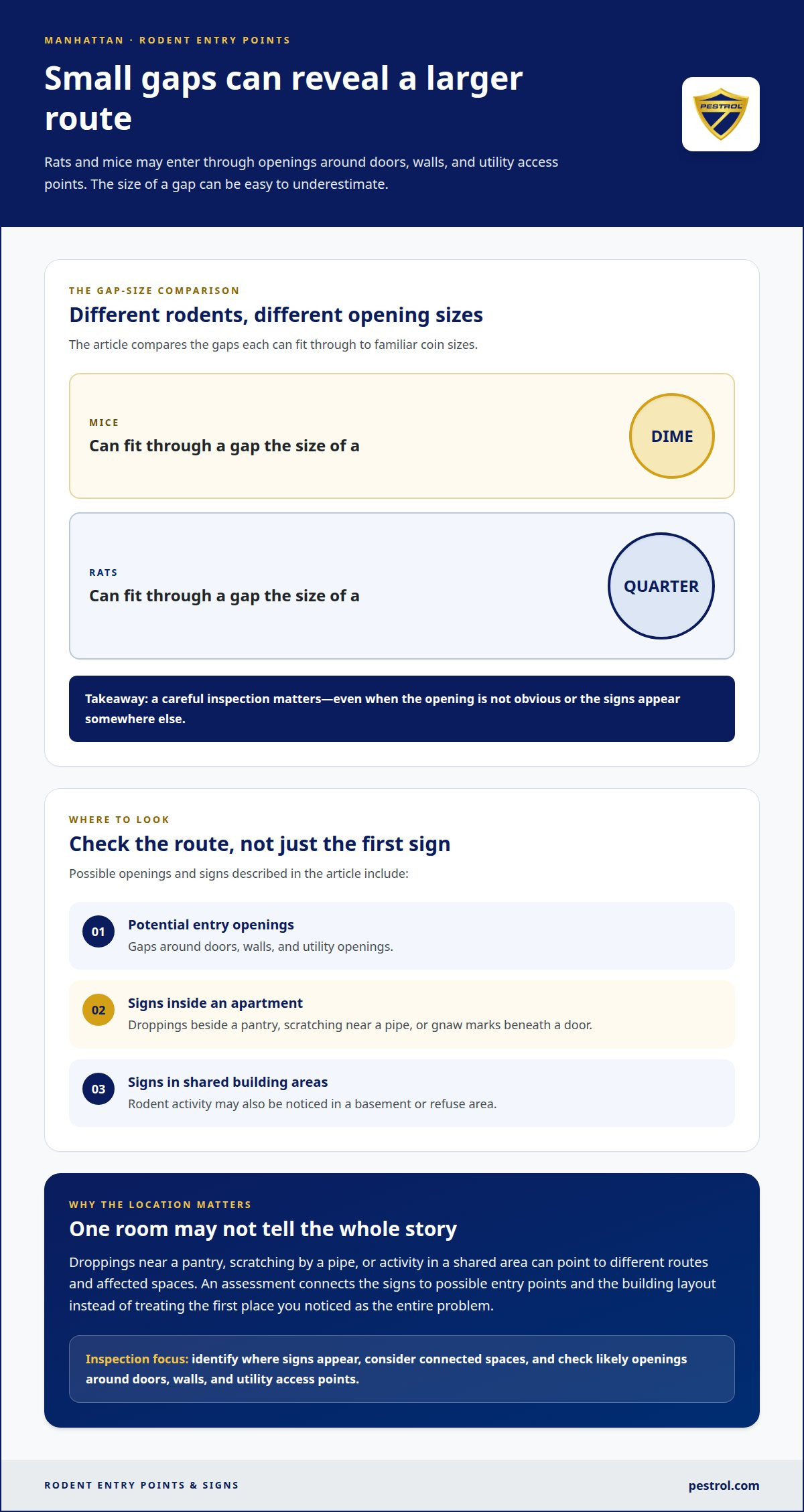
Rats and mice can enter Manhattan buildings through gaps around doors, walls, and utility openings. Mice can fit through gaps the size of a dime, while rats can fit through gaps the size of a quarter. These small openings make careful inspection important, especially when droppings appear far from an obvious exterior entrance. A technician traces likely routes between the signs, building openings, and possible nesting areas.
Professionals look beyond the room where activity first appears. A kitchen sighting may connect to a gap behind a cabinet or around a pipe, while scratching in a wall can point to a wall void. Basements, storage areas, and spaces near utilities can also offer sheltered nesting locations. In apartment buildings, the inspection may need to include shared areas as well as the affected unit.
Preventing rodents from returning means identifying entry points, sealing accessible gaps, and assessing whether activity remains indoors. Sealing alone does not address rodents already nesting inside, so technicians consider exclusion as part of the broader control plan. For example, if droppings appear beside a pipe opening, the inspection should assess that opening and nearby signs before deciding how to close the access point.
Sealing starts with locating and assessing gaps in walls, around doors, and at utility penetrations. Rodent-control providers seal entry points as small as a quarter-inch gap. A technician evaluates each opening’s location and condition, then selects an appropriate way to close it. The aim is to block access without overlooking connected openings that could provide another route into the building.
Entry-point exclusion should address the route rodents are using, not just the easiest visible crack. A door gap, a wall opening around a utility line, and a damaged exterior joint present different access conditions. A technician compares these points with indoor signs, then addresses openings that could allow re-entry. In multi-unit properties, access through shared spaces can also affect which openings need attention.
After sealing, professionals review the treated locations and look for signs of continued movement. New droppings near an opening, for example, may mean the inspection should revisit that route or a nearby nesting area. This follow-up connects exclusion with the rest of the treatment plan instead of treating a sealed gap as the only measure needed.
Traps, bait stations, and wall-void treatment
An inspection helps match treatment to the signs, location, and suspected route. A technician may consider traps for activity along a wall, bait stations for monitored placement, or wall-void treatment when signs point to a cavity. These methods serve different purposes, so the plan should explain which areas each one addresses. For example, scratching behind a kitchen wall may call for investigating that void, not placing equipment only in the open room.
New bait can take time to attract cautious rats. A single visit that declares success after 48 hours may not allow enough time for a neophobic rat colony to engage with the bait. That matters when assessing whether activity has stopped. Follow-up monitoring gives the technician a chance to review station activity, fresh signs, and whether the treatment needs adjustment.
Traps and bait stations differ in placement and monitoring. A technician chooses locations based on observed activity and access, then assesses whether the method suits the room and infestation. In a building with children or pets, tell the technician about household access before treatment begins. The technician can explain the placement, product precautions, and instructions for the specific treatment.
Wall-void treatment requires connecting indoor signs with a likely cavity or route. Scratching in one section of a wall, for instance, gives the technician a location to assess alongside nearby openings and other evidence. The treatment plan should identify the area being addressed and explain how activity will be monitored afterward. A sound alone does not prove the source or extent of an infestation.
Burrow treatment depends on finding active burrows and assessing the surrounding property. A technician considers where activity appears, how burrows relate to the building, and whether monitoring is needed after treatment. At a Manhattan property, an outdoor burrow near an entry point may call for a different plan from rodent signs inside a wall. Monitoring helps connect later signs to the original inspection and treatment area.
A complete process links inspection, treatment placement, and follow-up. The technician documents signs, selects a suitable method, and explains any treatment-specific precautions for household members. Later, the technician reviews new droppings or continued sounds against the original findings. For example, activity shifting from a bait station toward a wall opening may prompt reassessment of that route. This approach helps families and pet owners understand what happens during treatment and what monitoring comes next.
Finding rodent exterminators in Manhattan
Manhattan apartments may share walls, utility routes, basements, and refuse areas, so a rodent problem can extend beyond one room. A useful professional assessment connects reported signs with these building features. For example, droppings beside a kitchen pipe and scratching in an adjoining wall may point to related routes. The technician’s plan should describe the areas inspected and how the findings shape treatment.
Choose a service process that explains what happens from inspection through follow-up. The professional should identify signs, assess likely access points, and select methods suited to the conditions found. A plan that names only a trap placement leaves important questions unanswered if activity also appears near a shared utility space. A clear scope helps residents understand what the visit covers and what comes next.
Building coordination matters in multi-unit properties. If activity appears in an apartment and a shared basement, both locations may need assessment. Access arrangements can affect which spaces the technician inspects during a visit. A strong service plan records the affected areas and distinguishes apartment findings from common-area signs. This makes later monitoring more useful, especially when reports come from different residents.
Quality also depends on connecting treatment with exclusion. If technicians find a gap near a pipe, the plan should address that entry point alongside the indoor signs. Traps or bait stations may address active rodent movement, while sealing gaps can reduce access. Treating only the visible location may miss the route rodents used to enter the building.
Follow-up should build on the original inspection, not operate as an unrelated second visit. If fresh signs appear near a treated area, for example, the technician can compare them with the initial findings and reassess the route. A clear plan explains how monitoring will assess continued activity and when additional work may be appropriate. This matters in apartments where signs can shift between connected spaces.
Service terms should be as clear as treatment steps. A guarantee should define what it covers, its duration, and how a callback relates to the original service. The word “guaranteed” alone does not explain whether follow-up includes another inspection, treatment, or both. For a Manhattan building, the plan should also make clear whether shared spaces and affected apartments are included in the work.
Choose a service approach that links inspection, targeted treatment, entry-point work, and follow-up into one understandable plan. For rodent concerns that include recurring access through building openings, professional rodent proofing can address the structural side of control.
Pestrol: Rodent Proofing
Pestrol provides Rodent Proofing for Manhattan properties where entry points need attention alongside rodent treatment. This is a practical next step when an inspection identifies gaps around utility openings, doors, or other building access points. Sealing those routes can address conditions that allow rodents inside, while the broader treatment plan addresses signs of active activity.
For ongoing household pest needs, Pestrol also offers Home Pest Protection – Basic, Home Pest Protection – Plus, and Home Pest Protection – Premium. The appropriate service depends on the concerns affecting your home and the work required.
Contact Pestrol to discuss rodent proofing for your property.
Take the Next Step Toward a Rodent-Resistant Home
A search for guaranteed rodent removal in Manhattan should lead to a clear treatment scope, follow-up, and attention to the conditions that let rodents inside. Focus on addressing current activity and reducing the chance that the same access points cause problems again.
Pestrol provides Rodent Proofing for properties that need entry-point work. For broader household pest needs, Pestrol also offers Home Pest Protection – Basic, Home Pest Protection – Plus, and Home Pest Protection – Premium. The appropriate option depends on the concerns affecting your home and the service required.
With a clear plan in place, you can move forward with greater confidence and work toward a more comfortable home.
Frequently Asked Questions
Do I need to leave the house for pest control?
Whether you need to leave depends on the treatment and where technicians apply it. A plan using traps in accessible areas may involve different arrangements from treatment inside a wall void. Before work begins, the technician should explain the method, any product-specific precautions, and whether anyone needs to avoid a treated area. Share household details, such as children, pets, or rooms that need to remain accessible.
How do you get rid of rats in a Manhattan apartment or building?
Professionals inspect reported activity, identify likely routes, and select treatment for the affected spaces. In an apartment, a rat seen near a kitchen may lead technicians to assess connected utility openings or shared building areas. Treatment can involve traps or bait stations, along with exclusion when entry points are found. Monitoring helps assess later activity and whether the plan needs further attention.
How much does rat and mouse control cost in Manhattan?
The cost depends on the case, including the extent of activity, treatment method, access to affected areas, and whether proofing or monitoring is needed. A single accessible room may call for a different scope from a building with activity in apartments and shared spaces. Ask for a written scope that separates planned treatment from any additional work.
What does a guaranteed rodent removal service in Manhattan include?
A guarantee should describe the work it covers, its duration, and what happens if rodent signs return. A service plan may include inspection, treatment, entry-point work, and follow-up, but the word “guaranteed” alone does not define those details. Pestrol provides Rodent Proofing to address entry points. The service name by itself does not specify the terms of a guarantee.
Which Manhattan rodent removal companies offer written guarantees or warranties?
A written guarantee is defined by its service terms, not just a company’s name or general pest-control description. Pestrol provides Rodent Proofing. A useful written document identifies the treated property areas, covered work, guarantee period, and callback process. Those details distinguish a defined service commitment from a general statement about pest control.
What conditions and exclusions apply to rodent removal guarantees in Manhattan?
Conditions depend on the written terms. Check whether coverage applies to the treated unit, shared building areas, or both, and whether callbacks include inspection, retreatment, or additional proofing. Access to affected spaces and the scope of the original work can also matter. A clear agreement names its limits and explains how renewed rodent activity is assessed, rather than relying on broad wording alone.
How much does rodent extermination cost in Manhattan, including follow-up visits?
The total depends on the initial treatment scope and whether monitoring, return visits, or added proofing are needed. A building-wide infestation with signs across apartments can involve a different plan from activity confined to one accessible area. The price for a specific service depends on the case and is provided after a quote request. Review the proposed scope so you understand which follow-up work it includes.
How quickly can Manhattan pest control companies respond to a rodent infestation?
Response timing depends on appointment availability, building access, and the information available about the infestation. When requesting service, describe where signs appeared, whether activity affects an apartment or shared area, and any access limits. These details help determine the assessment needed. A prompt visit can begin inspection and planning, but the appointment time alone does not indicate when treatment is complete.