



What if a single 1/4-inch gap under your back door was the only thing standing between your restaurant and a business-killing health grade? Every NYC operator knows the pit in their stomach when a DOHMH inspector walks through the door. You’ve likely felt the frustration of hiring exterminators who rely on lazy baiting methods while the rats continue to find new ways into your storage room. Finding effective rat control for restaurants NYC isn’t just about avoiding a fine; it’s about protecting the reputation you’ve worked so hard to build.
We understand that the pressure is higher than ever with the implementation of Local Law 8 of 2026. This guide provides a clear roadmap to mastering the latest DOHMH compliance standards and securing your “A” grade. You’ll learn how to implement professional Integrated Pest Management (IPM) practices and structural rodent proofing that actually works. We are diving into the specific 2026 fine structures, mandatory inspection timelines, and the discreet service strategies that keep your dining room rodent-free without alarming your guests. It’s time to stop worrying about surprise inspections and start running your kitchen with total confidence.
Key Takeaways
- Learn how the DOHMH distinguishes between droppings and live sightings to help you secure a consistent “A” sanitary grade.
- Understand the unique urban challenges of Manhattan and the Bronx, including how outdoor dining structures impact local rodent populations.
- Discover why effective rat control for restaurants NYC requires a shift from temporary trapping to permanent structural exclusion using durable materials like copper mesh.
- Master the four pillars of Integrated Pest Management (IPM) to maintain a clean kitchen and monitor activity without alarming your guests.
- See why high-volume commercial kitchens need specialized, results-first protocols rather than standard residential pest control plans.
The Stakes of Rodent Activity: NYC DOHMH Compliance and Your “A” Grade
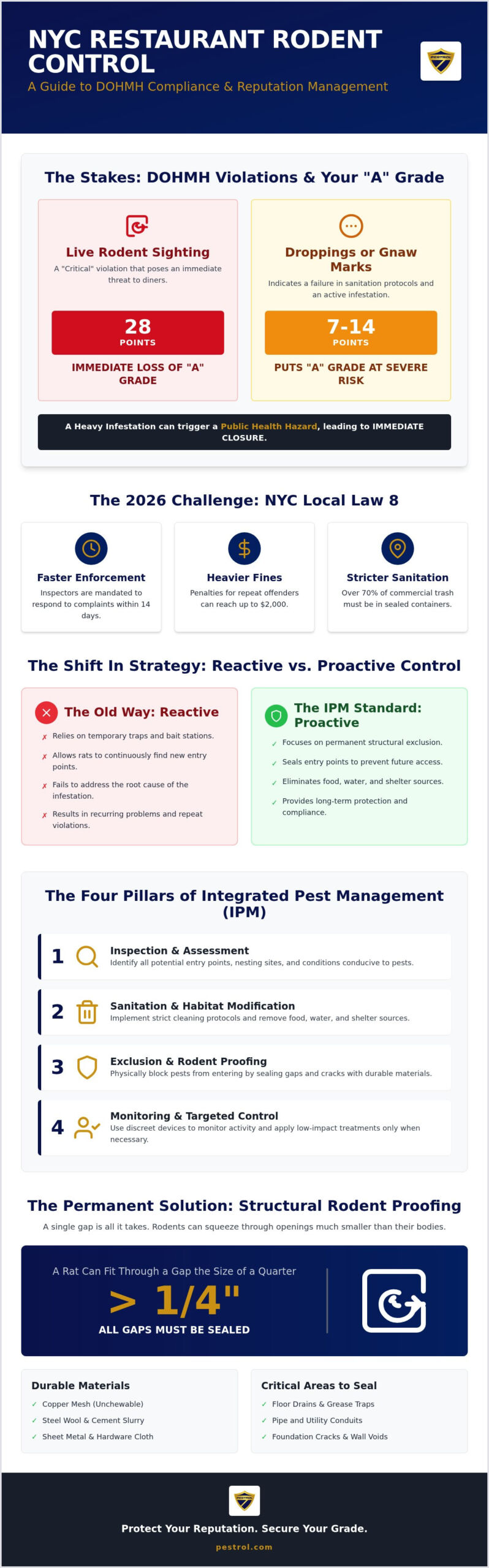
In New York City, your sanitary grade is your most valuable marketing tool. A single live rodent sighting during a DOHMH inspection triggers a 28-point violation. This immediately strips away your “A” grade. While fresh droppings or gnaw marks carry a lower point value, typically between 7 and 14 points, they still signal a failure in your sanitation protocols. Reliable rat control for restaurants NYC is the only way to ensure these points don’t stack up and force a “Grade Pending” or “Closed” sign onto your front window. These signs do more than just announce a violation; they act as a warning to every pedestrian in Manhattan and the Bronx.
As of August 2026, the city has tightened enforcement through Local Law 8. Inspectors now respond to complaints within 14 days, and repeat offenders face fines reaching $2,000. Additionally, new mandates require over 70% of residential and commercial trash to be in sealed containers to cut off food sources. To navigate these hurdles, the city requires Integrated Pest Management (IPM). This strategy moves beyond simple extermination to focus on long term prevention and structural integrity. It aligns with broader Nuisance wildlife management principles by removing the food and shelter that rats need to survive in an urban environment.
Understanding DOHMH Rodent Violations
DOHMH classifies rodent activity as a “Critical” violation. If an inspector finds a heavy infestation that poses an immediate threat to diners, they will declare a Public Health Hazard. This often leads to an immediate closure of your establishment. Having a licensed partner who provides detailed service logs is vital. These records prove to a tribunal that you are taking proactive steps. Detailed documentation of your rat control for restaurants NYC efforts can sometimes help mitigate the severity of penalties during a hearing.
Protecting Your Digital Reputation
The financial damage of a rodent problem extends far beyond the health department. One guest recording a mouse in your dining area can result in a viral video that reaches thousands of potential customers in hours. A comprehensive restaurant pest control NYC plan acts as a shield for your brand. Maintaining high sanitation standards and visible rodent proofing builds trust with your community. Diners want to know their favorite spots are safe and clean. Investing in professional prevention is always more affordable than trying to rebuild a broken reputation after a public scandal.
Why NYC Restaurants Are Magnet for Rats: The 2026 Urban Challenge
NYC restaurants operate in a high pressure environment where “clean enough” doesn’t exist. The city’s aging infrastructure creates a massive “Rat Reservoir.” Subway tunnels and centuries old plumbing act as subterranean highways for rodents. These pests move effortlessly from the street to your storage room through neglected conduits. Effective Integrated Pest Management (IPM) is required to disrupt these transit routes. Without a scientific approach, you’re fighting a losing battle against the city’s geography. Manhattan’s density means a single food source can support multiple colonies, making your kitchen a high value target.
The Infrastructure Factor: Basements and Sub-Basements
Most Manhattan and Bronx restaurant basements weren’t designed to be rodent proof. Century old foundations often feature cracks and gaps that serve as open invitations. Floor drains and grease traps are common entry points if not properly maintained. Rats are excellent swimmers. They can navigate plumbing to emerge in the heart of your prep area. Shared walls with neighboring businesses also complicate your defense. If the bakery next door has an issue, your kitchen is at risk. This is why professional rat control for restaurants NYC must include a comprehensive inspection of these hidden areas. We look for gaps larger than 1/4 inch, as even a small opening allows a young rat to squeeze through and establish a nest.
Outdoor Dining and Sidewalk Challenges
Permanent outdoor dining platforms and sidewalk sheds have changed the pest landscape. These structures provide perfect, undisturbed shelter for rat colonies. These “Rat Zones” are often inaccessible for standard cleaning, allowing organic debris to accumulate and attract pests. Managing this requires strict adherence to the 2026 DSNY containerization rules. You must move away from black bags and toward sealed, rodent proof bins for all trash staging. As of 2026, over 70% of city trash must be containerized to reduce the food supply for local populations. Perimeter defense is essential in high traffic corridors to stop rats before they reach your dining area. If you’re struggling to secure your exterior, our team provides expert rodent proofing to seal every vulnerability and protect your reputation.
Rodent Proofing: The Permanent Solution for NYC Kitchens
Many restaurant owners rely on a frustrating cycle of setting traps and clearing bodies. This reactive approach is a temporary fix that never addresses the root cause. To protect your business long term, you must shift to proactive exclusion. This means physically barring entry so the rats never get inside your prep or storage areas. It’s the only way to stop the “revolving door” of infestations that plagues aging buildings in Manhattan and the Bronx. Investing in professional rat control for restaurants NYC means looking at your building as a fortress that needs to be sealed tight.
Quality materials make all the difference in a commercial environment. Rats easily chew through wood, plastic, or standard expanding foam. We use professional grade steel wool and copper mesh because these materials are too abrasive for rodents to gnaw. Our rodent proofing services follow a strict protocol to identify every hidden breach in your kitchen’s armor. By sealing these entry points, you eliminate the need for constant, guest alarming trapping programs.
5 Critical Areas to Seal in a Commercial Kitchen
Focusing on these five high risk zones will significantly reduce your vulnerability to local rodent populations:
- Pipe penetrations: Seal the gaps around gas, water, and soda lines with metal escutcheon plates and copper mesh.
- Door sweeps: Eliminate any gap larger than 1/4 inch. A juvenile rat can fit through an opening the size of a pencil.
- Vents and air intakes: Install heavy-duty hardware cloth over roof and wall openings to block access while maintaining airflow.
- Floor-to-wall junctions: Repair cracked masonry and grout in prep areas where rodents often hide or travel behind equipment.
- Loading docks: Ensure heavy-duty seals are intact on delivery doors to prevent pests from wandering in during shipments.
The Limitations of DIY Proofing
Don’t waste your budget on hardware store “expanding foam.” Rats see this material as a minor inconvenience and will chew through it in minutes. Even worse, haphazard DIY sealing can trap rats inside your walls. Without a simultaneous professional trapping plan, these trapped rodents will die and create severe odor issues in your dining room. Rodent exclusion is a structural modification that requires professional expertise to ensure the building remains ventilated while staying completely pest free. This level of precision is essential for effective rat control for restaurants NYC and maintaining your DOHMH “A” grade.
Integrated Pest Management (IPM) for High-Volume Establishments
High-volume NYC kitchens operate under constant pressure. This environment makes Integrated Pest Management (IPM) the most effective strategy for long-term success. IPM isn’t a one-time treatment; it’s a comprehensive system built on four pillars: Inspection, Sanitation, Exclusion, and Monitoring. This science-based approach ensures that your rat control for restaurants NYC is proactive rather than reactive. By focusing on the environment that allows pests to thrive, we eliminate the problem at its source. We don’t just kill pests; we manage the conditions that attract them.
A significant part of this process involves data-driven decision-making. We maintain detailed service logs that document every finding and corrective action. These logs serve as your “due diligence” record when a DOHMH inspector arrives. They prove you are following a professional, consistent plan to maintain a sanitary environment. Rats are resourceful, but your management strategy should be even more so. This partnership between our experts and your team creates a barrier that pests simply can’t breach.
Sanitation as Pest Control
Your kitchen staff is your first line of defense. We help you implement a “Dry Kitchen” protocol to eliminate standing water, which is a primary attractant for rodents. Floor-drain “soups” and leaky prep sinks provide the hydration rats need to survive in an urban landscape. Transitioning all dry goods to rodent-proof, hard plastic containers is equally vital. We provide nightly cleaning checklists that target the specific areas where food debris accumulates. This ensures your prep area is a hostile environment for pests every night after the lights go out.
Professional Monitoring and Reporting
We use discreet monitoring stations rather than messy, visible traps in guest areas. These stations use non-toxic indicators to track rodent movement without the risk of chemical contamination or guest interference. There is a major difference between simple “bait stations” and professional monitoring. Monitoring allows us to identify exactly where pests are trying to enter before a full-blown infestation occurs. Our team strategically places these units in bars and dining rooms where they remain completely invisible to your customers. This level of professional oversight provides the documentation DOHMH requires while protecting your restaurant’s reputation and high-end atmosphere. Effective rat control for restaurants NYC must be invisible to your diners but obvious to your inspectors.
Partner with Pestrol for professional restaurant pest management
Pestrol’s Specialized Restaurant Rodent Protocols
A standard residential pest control plan is a recipe for failure in a commercial NYC kitchen. Homes don’t deal with 12-hour shifts, high-heat equipment, or the constant influx of deliveries that restaurants face daily. Pestrol provides specialized rat control for restaurants NYC that accounts for these extreme variables. We operate with a results-first mentality, focusing on Manhattan and Bronx establishments that need more than just a few bait stations. Our goal is to protect your business from the catastrophic costs of a DOHMH closure or a public relations nightmare.
We understand that timing is everything in the food service industry. Our teams coordinate customized service schedules that work around your prep times and service hours. This ensures our work remains discreet and never interferes with your guests’ experience. You get the protection of a seasoned expert who treats your facility with the same care as a family institution. We provide the persistence needed to maintain a rodent-free environment in the most challenging urban conditions. Our results-first mentality ensures your “A” grade remains secure. We offer the Pestrol guarantee of peace of mind; if you can’t afford a shutdown, you can’t afford to settle for mediocre service.
Tailored Commercial Protection
Customization is the core of our protocol. A small cafe in the West Village has vastly different structural risks than a large-scale catering facility in the Bronx. We identify the high-risk areas specific to your layout, such as walk-in coolers, compressor motors, and dry storage racks. Our technicians are local experts who know NYC building codes inside and out. This knowledge allows us to spot violations before an inspector does. We provide a protective barrier that keeps your kitchen compliant and your food safe from contamination. By focusing on these specific commercial vulnerabilities, we eliminate the hiding spots that residential plans often overlook.
Getting Started with a Commercial Evaluation
Your journey to a secure “A” grade begins with a comprehensive site audit. During this initial evaluation, we perform a deep dive into your building’s history and current pest pressure. We often take over programs that are failing due to “lazy” baiting methods from previous exterminators. Our transition process is seamless and focused on immediate resolution. We identify every unsealed hole and sanitation lapse that the previous company missed. This thoroughness is why Manhattan restaurateurs trust us for their rat control for restaurants NYC needs. We provide the clear, action-oriented steps you need to take control of your environment. Protect your restaurant with Pestrol’s commercial pest management today.
Secure Your “A” Grade and Your Future
Mastering DOHMH compliance in 2026 requires more than just reactive traps. It demands a structural shift toward permanent exclusion and data-driven Integrated Pest Management. By sealing entry points and training your staff on the “Dry Kitchen” protocol, you can eliminate the triggers for heavy fines and health department closures. Effective rat control for restaurants NYC is a long-term investment in your brand’s reputation and financial health.
As a family-owned local NYC service provider, we act as your specialized rodent exclusion specialists to ensure your facility remains a fortress against pests. Our team consists of experts in DOHMH compliance who understand how to keep your dining room guest-ready every single night. We are dedicated to your success and work tirelessly to protect the reputation you have built. You don’t have to face the health inspector alone.
We are here to help you maintain a clean, compliant, and thriving kitchen for years to come. Your peace of mind is our priority.
Frequently Asked Questions
How much does restaurant rat control cost in NYC?
Pricing for rat control for restaurants NYC depends on the square footage of your kitchen and the complexity of your building’s infrastructure. We provide customized plans that address specific vulnerabilities in Manhattan and Bronx facilities. While initial clean-out services have different requirements than monthly maintenance, the investment is always lower than the cost of DOHMH fines. We focus on long-term value through structural exclusion and preventative monitoring.
Can the DOHMH close my restaurant for one rat sighting?
A single live rodent sighting results in a 28-point violation, which automatically causes you to lose your “A” grade. While one rat doesn’t always trigger an immediate closure, it often leads to a “Grade Pending” status and a required re-inspection. If the inspector finds a widespread infestation or a “Public Health Hazard,” they have the authority to shut your doors until the issue is resolved and a follow-up inspection is passed.
What is the most effective way to get rid of rats in a commercial kitchen?
The most effective strategy is combining structural rodent proofing with a strict Integrated Pest Management protocol. Trapping alone is a temporary fix that fails to stop new pests from entering. You must seal every gap larger than 1/4 inch with durable materials like copper mesh or steel wool. This proactive exclusion stops the “revolving door” of infestations common in aging NYC commercial buildings and protects your food prep areas permanently.
How often should a restaurant have pest control service in NYC?
Most full-service restaurants in Manhattan and the Bronx require at least monthly pest control service to remain compliant with DOHMH standards. High-volume establishments or those in older buildings often benefit from twice-monthly visits. Consistent service allows for the detailed documentation and monitoring logs that inspectors look for during surprise visits. Regular checks catch small issues before they become 28-point violations that damage your business reputation.
Is professional rodent proofing worth the investment for a leased space?
Rodent proofing is a vital investment for leased spaces because you are responsible for health department fines and your brand’s reputation. Even if you don’t own the building, a “C” grade or a closure sign on your window can destroy your business. Structural exclusion provides a permanent barrier that saves you money on repeated extermination costs and prevents the loss of loyal customers who value a clean dining environment.
Do electronic rat repellents work in large restaurants?
Electronic rat repellents are generally ineffective in large commercial kitchens and dining rooms. These devices rely on sound waves that are easily blocked by appliances, furniture, and walls. They don’t address the root cause of an infestation, which is access to food and shelter. Professional rat control for restaurants NYC focuses on physical barriers and sanitation rather than unproven gadgets that fail to provide real protection.
How do I pass a NYC health inspection if I have a history of rodents?
To pass an inspection after a history of violations, you must show a consistent record of “due diligence.” This includes maintaining an on-site pest control log with service contracts and detailed corrective actions. Fix all structural issues, such as gaps under doors or around pipes. When an inspector sees professional exclusion and a clean kitchen, it builds confidence in your management and helps you secure a consistent “A” grade.
Will my customers see the traps or bait stations?
Your customers won’t see the monitoring stations or traps when you use a professional service. We use discreet placement strategies, tucking equipment behind bars, under equipment, and in storage areas where guests never look. Our goal is to maintain a sterile environment without alarming your diners. We focus on invisible protection that keeps your reputation intact while securing your sanitary grade and providing total peace of mind for your team.