



In the high-stakes world of New York dining, a single mouse sighting caught on a customer’s smartphone can do more damage to your brand than a month of slow sales. You’ve worked too hard building your reputation in Manhattan or the Bronx to let aging infrastructure or a tiny gap in a door sweep invite a health department shutdown. It’s exhausting to manage a busy kitchen while constantly worrying about the 28-point limit for a “C” grade or the public health hazard of a single live roach.
We understand that the pressure to stay compliant under NYC Health Code §81.25 is intense, especially when dealing with the unique challenges of local buildings. This guide helps you master the essential steps for rodent proofing for restaurants, giving you the professional-grade tools to maintain a pest-free environment. You’ll learn how to secure your facility and achieve the peace of mind that comes with a perfect health inspection score.
We will walk you through our 2026 comprehensive compliance checklist, covering everything from structural exclusion techniques like the 1/4 inch gap rule to the specific documentation health inspectors now demand. By the end of this article, you’ll have a clear, actionable plan to protect your kitchen, your staff, and your bottom line from unwanted intruders.
Key Takeaways
- Learn why Integrated Pest Management (IPM) is the gold standard for 2026 and how it prevents costly DOHMH fines.
- Discover the critical steps for rodent proofing for restaurants by identifying and sealing entry points as small as a dime.
- Find out how to spot hidden organic buildup in your kitchen that attracts pests and learn to implement a clean-as-you-go policy.
- Master specific tactics to eliminate the “Big Three”-roaches, flies, and rodents-before they impact your health inspection score.
- Evaluate how a professional pest management partnership serves as a vital insurance policy for your business’s reputation.
The High Stakes of Commercial Kitchen Pest Management
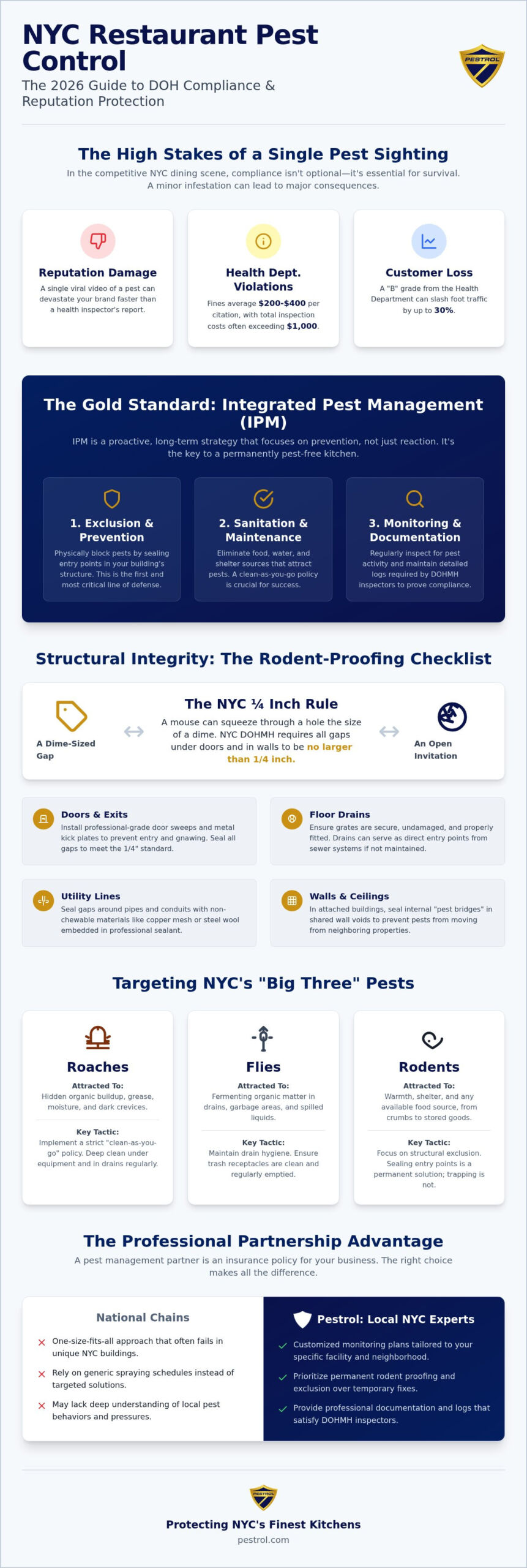
Commercial kitchens provide everything a pest needs: warmth, water, and endless food. This combination makes your facility a biological hot zone. In 2026, the industry standard for managing these risks is Integrated Pest Management (IPM). Rather than relying solely on reactive chemical treatments, IPM focuses on long-term prevention through structural repairs, sanitation, and constant monitoring. For NYC operators, rodent proofing for restaurants is no longer just a maintenance task; it’s a fundamental survival strategy for your brand.
The DOHMH takes a zero-tolerance approach to vermin. A single live cockroach or evidence of rodents in a food prep area can lead to immediate closure. Fines for pest violations typically range from $200 to $400 per citation, and a single inspection often results in total costs exceeding $1,000. Beyond the check you write to the city, the reputational damage is staggering. A “B” grade can slash your foot traffic by up to 30%. In the age of viral TikTok reviews, a single video of a pest can end a business faster than any government inspector.
NYC Health Code Compliance in 2026
Maintaining an “A” rating requires constant vigilance. Inspectors look for “critical violations” such as fly activity, rodent droppings, or signs of harborage. NYC structural requirements are incredibly specific; for instance, door sweeps must have gaps no larger than 1/4 inch to prevent entry. We help you stay ahead by providing the professional documentation inspectors demand. This includes current service contracts and detailed logs of every visit, finding, and corrective action taken to keep your kitchen compliant.
The Pestrol Difference in Food Service
National chains often use a one-size-fits-all approach that fails in the complex, aging infrastructure of Manhattan and the Bronx. As a family-owned local business, we understand the specific behaviors of NYC German roaches and mice. We don’t just follow a generic spraying schedule. We build customized monitoring plans and prioritize rodent proofing for restaurants to create a permanent barrier against pests. If you need a partner who understands the local stakes and your specific neighborhood challenges, explore our specialized restaurant pest control NYC services. We treat your business with the same protective care we give our own family.
Structural Integrity: The Rodent Proofing Checklist
Think like a mouse. To a rodent, a gap the size of a dime is an open invitation. In the cramped, interconnected buildings of Manhattan and the Bronx, these small openings are everywhere. Effective rodent proofing for restaurants starts with a rigorous structural audit that identifies every potential breach in your perimeter. If you don’t seal the building while you clean the floors, you’re fighting a battle you can’t win. We focus on the physical barriers that keep pests out of your prep areas for good.
Delivery bays and back-of-house exits are primary targets. These areas see constant traffic, and doors are often left propped open or have worn-out seals. Utility lines are another major vulnerability. Mice and rats use the spaces around gas pipes, water lines, and electrical conduits as private highways to move between floors and wall voids. Even your floor drains can become entry points if the grates are loose or damaged. A truly secure kitchen requires every pipe penetration to be sealed tight with professional-grade materials that stand up to constant kitchen moisture and heat.
Exclusion Strategies for Manhattan and Bronx Facilities
In NYC’s commercial rows, your restaurant isn’t an island. You’re part of a continuous structure where pests move freely through shared wall voids. We prioritize sealing these internal “pest bridges” between your space and the next. This involves more than just a bit of caulk. We install professional-grade door sweeps that adhere to the strict 1/4 inch DOHMH standard and reinforce doors with metal kick plates to prevent gnawing. By using non-chewable sealants like stainless steel wool or copper mesh embedded in specialized exclusion compounds, we ensure that once a hole is closed, it stays closed.
Rodent Proofing as a Permanent Investment
Many owners rely on snap traps or bait stations as their primary defense. While these tools manage existing populations, they don’t stop new intruders from arriving. In high-density urban areas, trapping alone is a losing battle. Investing in professional rodent proofing services shifts your strategy from reactive to proactive. This structural fix often pays for itself by reducing the need for emergency treatments and protecting you from the heavy costs of a failed inspection. If you’re tired of the endless cycle of sightings, our team can help you secure your facility once and for all with a customized exclusion plan.
Sanitation and Deep Cleaning: A Combined Strategy
Structural barriers are only half the battle. If your kitchen provides a feast of organic buildup, pests will be relentless in their attempts to breach your defenses. An “Organic Buildup audit” identifies hidden grease and food particles, often found behind heavy equipment or inside floor cracks, where roaches and larvae thrive. While structural rodent proofing for restaurants keeps new intruders out, a strict sanitation schedule, such as the high standards set by Athena Team Cleaning, ensures that any pest that manages to slip in finds nothing to eat.
Implementing a clean-as-you-go policy for your staff is the most effective way to prevent the accumulation of food debris. This isn’t just about appearances; it’s about eliminating the pheromone trails that lead pests to food sources. You must also manage your trash cycle strictly. Food waste should never sit in prep area bins overnight. Move it to outdoor dumpsters that are kept tightly closed and positioned away from the building’s exterior walls to prevent attracting rodents to your perimeter. For professional waste management, Book Your Dumpster USA provides roll-off containers that help keep your facility’s exterior clean and secure.
Finally, neutralize the kitchen microclimate. Pests love heat and high humidity. Ensure your ventilation system is working efficiently to reduce moisture levels. By controlling the temperature and dampness in your storage areas, you make your facility far less hospitable to infestations.
Consistency is key to a pest-free kitchen. Your team should follow these steps every shift:
- Clear food debris: Pull out light equipment and use long-handled brushes to reach under heavy appliances where crumbs collect.
- Sanitize floor drains: Use bio-enzymatic cleaners daily to break down the organic slime that serves as a breeding ground for drain flies.
- Follow the 6-inch rule: Store all food, including dry goods and sealed containers, at least 6 inches off the floor on wire shelving to allow for easy inspection and cleaning.
Weekly Deep Clean Protocols
Some areas require more intensive care to stay compliant. Schedule these tasks weekly to protect your reputation:
- Degrease exhaust hoods: Clean ventilation systems thoroughly. German roaches often hide in the warm, greasy recesses of hoods and fan motors.
- Inspect dry storage: Look for signs of pantry pests or moisture buildup. Rotate your stock using the First-In, First-Out (FIFO) method to ensure old products don’t become harborages.
- Clean refrigeration components: Dust and grime on refrigeration coils and motors create warmth and cover. Clean behind and beneath these units to remove the heat-seeking pests that love these spots.
Targeting the Big Three: Roaches, Flies, and Rodents
Every commercial kitchen in New York faces three primary biological threats. While structural rodent proofing for restaurants blocks the front door, you must also address the pests that arrive as “hitchhikers” or are already established. German cockroaches, flies, and rodents operate with vastly different behaviors. One approach always fails. You’ll need a targeted strategy for each specific pest to ensure your kitchen remains a safe environment and stays compliant with local health codes.
German cockroaches are the most persistent kitchen invaders. They don’t just walk in; they’re often carried in on vendor deliveries or tucked into the folds of corrugated cardboard. Cardboard is a magnet. Once inside, they seek out heat and darkness, making electrical boxes and equipment motor housings their preferred real estate. Successful rodent proofing for restaurants depends on recognizing that mice are curious nibblers while rats are suspicious of anything new. This behavioral difference dictates whether we use a curious approach for mice or a slow-play strategy for rats. Understanding the full scope of pest control for food industry facilities, including the latest 2026 safety standards, helps you build a more comprehensive defense against all three of these threats.
Eliminating Cockroach Harborage
Professionals focus on electrical panels and the warm undersides of prep tables to find roach nests. Avoid over-the-counter bug bombs. These products often use “flushing agents” that scatter the population into deeper wall voids. This makes the problem harder to solve. Instead, we use precision baiting that the roaches carry back to the colony. We also monitor for oothecae, or egg cases, to stop the next generation. Egg cases must go. For a deeper look at the disciplined protocols needed to eliminate roaches permanently, our 2026 guide to cockroach control for restaurants outlines the essential strategies that address root causes before an inspector walks through your door.
Advanced Fly Management
If you’re seeing flies, the real work happens in the drains. Flies are more than a nuisance; they’re a major health code violation. Drain flies breed in the organic film inside your plumbing, while fruit flies are attracted to fermenting organic matter. Strategic placement of UV fly lights, or Insect Light Traps, helps manage adult populations. These should be placed away from windows to avoid attracting outside insects. Managing the fruit fly season requires localized monitoring and regular drain maintenance to eliminate the larvae and break the breeding cycle for good.
Schedule a specialized restaurant pest inspection today
Building a Professional Pest Management Partnership
A successful Integrated Pest Management (IPM) program also relies on your team. Even the best rodent proofing for restaurants can be undermined by a door propped open during a late-night delivery or a missed cleaning task. We prioritize staff training as a core component of our partnership. When your kitchen crew understands how to identify early warning signs and maintain the barriers we’ve installed, you transition from reactive extermination to proactive prevention. This shift saves you money and eliminates the anxiety of surprise inspections.
Our initial commercial audit is a high-standard, comprehensive inspection designed to uncover every hidden vulnerability in your facility. We perform a methodical, step-by-step walkthrough of your entire space, from the basement storage areas to the rooftop ventilation units. We look for the tiny entry points and organic buildup zones that national providers often overlook.
Once the audit is complete, we customize a service plan that fits your specific needs, mirroring the tiered structure of our Home Pest Protection levels. We don’t believe in one-size-fits-all solutions for NYC’s unique infrastructure. Every visit is meticulously documented in a digital log that meets all DOHMH requirements. This ensures that when an inspector walks through your front door, you have a professional paper trail ready to prove your commitment to a sanitary, pest-free environment.
Next Steps for Your Kitchen
Don’t wait for a pest sighting to jeopardize your “A” rating. Protecting your bottom line starts with securing your perimeter and training your staff. By choosing a local, family-owned partner, you gain an ally who understands the specific challenges of Manhattan and Bronx commercial spaces. We have the expertise to implement permanent rodent proofing for restaurants and the persistence to see every task through to completion. Take control of your kitchen’s future and gain the peace of mind that comes with professional-grade management.
Take Control of Your Kitchen’s Reputation
Maintaining a pest-free environment in the heart of New York requires a relentless focus on both structural integrity and daily sanitation. You’ve learned that sealing even the smallest gaps and implementing a strict clean-as-you-go policy are essential steps for long-term success. By prioritizing rodent proofing for restaurants and maintaining detailed documentation, you ensure your facility is always ready for a surprise DOHMH inspection.
As a local, family-owned business, we understand the specific challenges of Manhattan and Bronx infrastructure. We provide the expert rodent proofing and comprehensive DOHMH compliance support you need to protect your “A” rating. You can focus on your craft while we handle the complexities of pest management with the protective care your business deserves.
You don’t have to manage these high stakes alone. We’re here to be your knowledgeable ally, ensuring your kitchen remains safe, sanitary, and successful for years to come.
Frequently Asked Questions
How often should a commercial kitchen receive pest control service?
Most full-service restaurants in NYC require monthly service to maintain compliance and prevent infestations. High-volume kitchens or those in older buildings often benefit from bi-weekly visits. Regular inspections ensure that small issues don’t escalate into critical health code violations. We customize the frequency based on your specific risk factors and history. Consistent monitoring is the only way to guarantee a pest-free environment and protect your reputation from sudden sightings.
Can pest control chemicals be safely used in food prep areas?
Professionals use targeted applications that are safe for food-handling environments when applied correctly. We prioritize non-chemical methods like rodent proofing for restaurants and sanitation first. When treatments are necessary, we use gel baits and enclosed stations rather than broad spraying. This approach eliminates pests while preventing any risk of food contamination. Our technicians follow strict safety protocols to ensure your kitchen remains a healthy place for both staff and customers.
What are the most common signs of a rodent infestation in a restaurant?
Look for small, dark droppings along baseboards or behind equipment. You might also notice gnaw marks on food packaging or greasy rub marks along walls where rodents frequently travel. Unusual noises in the walls or the discovery of shredded paper and insulation also indicate nesting activity. If you see even one mouse, it’s a sign of a larger problem. Immediate action is required to prevent a failed health inspection and protect your brand.
How do I get rid of fruit flies in my kitchen drains for good?
Eliminating fruit flies requires removing the organic film inside your plumbing where they breed. Use bio-enzymatic drain cleaners daily to break down this slime and stop the larvae from developing. You must also address any fermenting organic matter under prep tables or in floor cracks. Simply using bleach or hot water won’t solve the problem for good. A professional program combines these sanitation steps with localized monitoring to break the breeding cycle completely.
What should I do if a health inspector finds evidence of pests?
Address the inspector’s findings immediately and without argument. Show them your current pest control contract and service logs to demonstrate you have a professional management plan in place. Contact us right away to perform an emergency audit and resolve the specific issue. We provide the required documentation and corrective actions needed to clear the violation. Taking decisive, professional steps shows the city that you take food safety and public health seriously.
Is rodent proofing worth the cost for an older Manhattan building?
Investing in rodent proofing for restaurants is the most cost-effective decision for owners in aging NYC infrastructure. While monthly treatments manage existing pests, structural exclusion provides a permanent barrier against new intruders. This prevents the heavy fines and potential closures associated with recurring infestations. By sealing entry points as small as a dime, you protect your bottom line from the high costs of emergency extermination and long-term reputation damage.
How does professional pest control help with DOH compliance?
We provide the professional documentation and service logs that NYC health inspectors require during every visit. Our technicians are experts in local health codes, ensuring your facility meets specific structural standards like the 1/4 inch door sweep rule. We identify critical violations before an inspector does, allowing you to fix issues proactively. This partnership ensures you maintain your “A” rating and avoid the financial penalties associated with pest-related citations.
Can I handle restaurant pest control myself with DIY products?
DIY methods are often ineffective and can actually make infestations worse by scattering pests into wall voids. Consumer-grade products lack the potency of professional treatments and don’t provide the required documentation for health department compliance. Most importantly, improper use of chemicals in a kitchen poses a significant food safety risk. Trusting a professional partner ensures the job is done safely and thoroughly while protecting you from the legal and financial risks of non-compliance.