



Did you know that slipping from an “A” to a “B” grade on your NYC health inspection can slash your foot traffic by up to 30 percent? For a restaurant owner, a single negative Yelp review mentioning a pest sighting is more than an eyesore; it’s a direct threat to your livelihood. You understand that maintaining a spotless kitchen is a 24/7 job, yet traditional DIY methods often fail to keep up with the demands of a high-volume NYC establishment. Successfully preventing pest infestations in restaurants requires more than just luck or a bottle of store-bought spray. It demands a proactive, professional strategy tailored to the unique challenges of our local urban environment.
We know the anxiety that comes with an unexpected DOH visit and the frustration of seeing your hard work jeopardized by structural gaps or persistent rodents. This guide provides the expert roadmap you need to protect your reputation and secure your investment. You’ll learn how to implement the latest 2026 food safety protocols, master structural exclusion, and build a pest-free environment that earns a consistent “A” rating every time the inspector walks through your door. We’ve simplified the complex world of compliance into actionable steps that give you back your peace of mind.
Key Takeaways
- Master the proactive environmental strategies required to navigate New York’s heightened 2026 health inspection standards.
- Identify the specific structural vulnerabilities and entry points essential for preventing pest infestations in restaurants.
- Learn why professional exclusion and sealing your building’s envelope provide more reliable protection than cleaning routines alone.
- Implement staff training protocols and “First-In, First-Out” (FIFO) systems to create a culture of constant vigilance in your kitchen.
- Discover the benefits of a customized Integrated Pest Management (IPM) approach designed specifically for the unique infrastructure of NYC commercial spaces.
The High Stakes of Restaurant Pest Prevention in New York (2026)
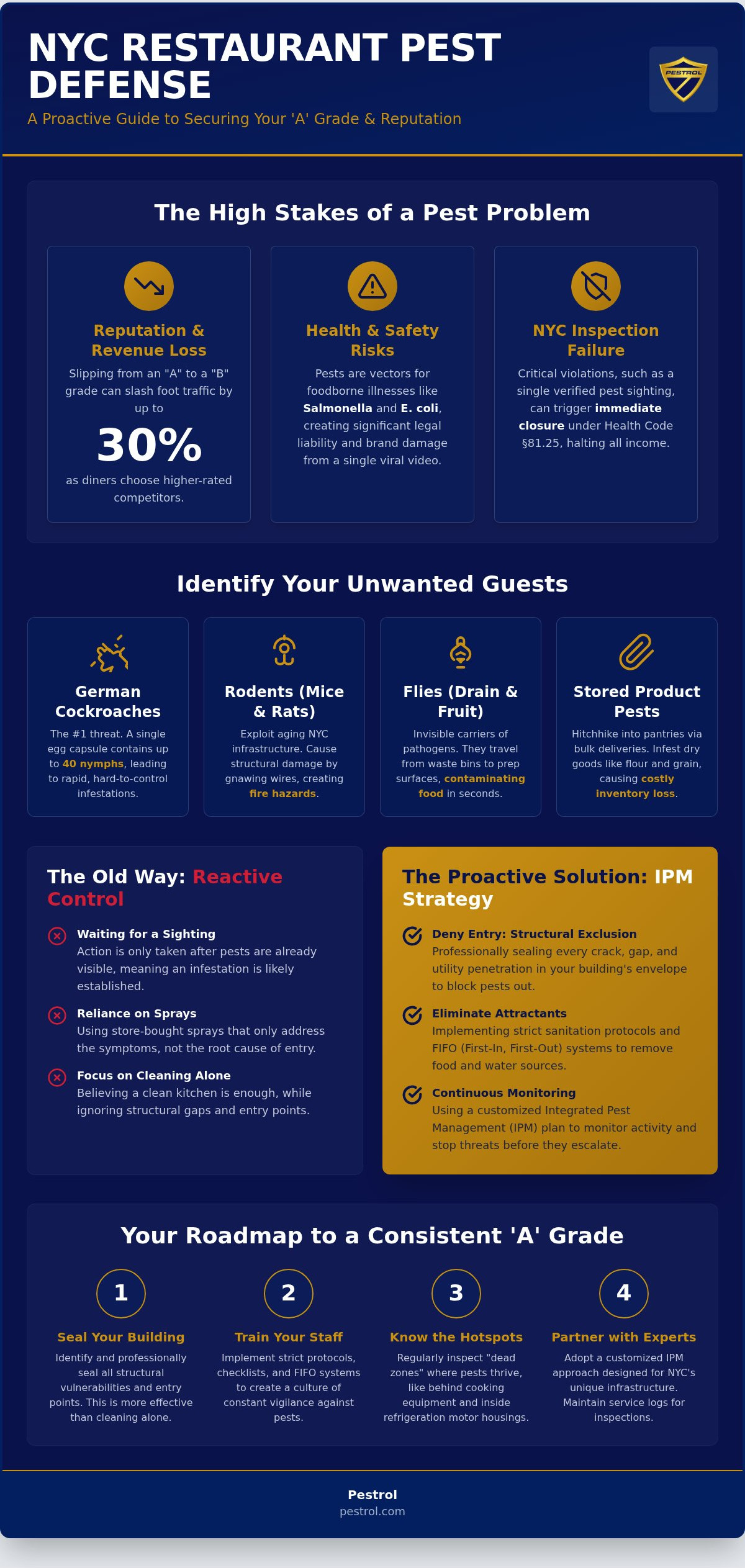
Pest prevention isn’t just about reacting when you see a mouse; it’s the proactive management of your entire environment. To succeed, you must deny pests the three things they crave: food, water, and entry. In a city as dense as New York, this is a constant battle. Shared walls, aging infrastructure, and high-volume foot traffic create a perfect storm for unwanted guests. Successfully preventing pest infestations in restaurants requires a shift from old-school reactive spraying to a comprehensive Integrated Pest Management (IPM) strategy that seals your building’s envelope and monitors for activity before it becomes a crisis.
The risks go far beyond a simple nuisance. Pests are primary vectors for foodborne illnesses like Salmonella and E. coli, which can lead to devastating outbreaks and legal liability. Understanding these risks often involves rigorous laboratory study, where companies like ReadyPep provide essential tools for the research community. In 2026, the speed of information makes a single sighting catastrophic. A ten-second video of a cockroach on a dining room floor can go viral on social media before your dinner shift even ends. This immediate public exposure causes permanent brand damage that a deep clean can’t fix. You aren’t just fighting pests; you’re protecting your reputation in a digital-first world where diners check scores before they book a table.
Navigating NYC Health Department Regulations
The NYC Health Department uses a strict point system to determine your letter grade. Points are your enemy. Lower scores lead to an “A,” while higher scores result in a “B” or “C” that must be posted prominently in your window. Live cockroaches, filth flies, or rodent evidence in food prep areas are considered critical violations that carry heavy point values. Under current 2026 regulations, inspectors have the authority to trigger an immediate closure under Health Code §81.25 if they find a single verified sighting. You must also maintain detailed service logs and professional contracts on-site. If you can’t produce these records during an inspection, you’re looking at a violation regardless of how clean your kitchen looks.
The Hidden Financial Impact of Infestations
The true cost of a pest problem isn’t just the fine; it’s the lost revenue. Industry data shows that a “B” grade can slash your foot traffic by 20 to 30 percent as diners choose the “A” rated establishment next door. If the Health Department hangs a “Closed” sign on your door, your income stops instantly while your rent and payroll continue to pile up. You also face the immediate expense of discarding contaminated inventory and dry goods, which can cost thousands in a single night. Rebuilding trust after a public incident requires a massive marketing spend that often outweighs the cost of professional prevention. Protecting your kitchen is an investment in your bottom line.
Identifying Common Restaurant Pests and Their Entry Points
Understanding your enemy is the first step in protecting your kitchen. In the high-pressure environment of New York food service, four main categories of pests cause the most trouble. German cockroaches remain the top threat to food safety. These resilient insects breed at an alarming rate; a single egg capsule can contain up to 40 nymphs, making an infestation difficult to control without professional intervention. You can learn more about these Common Restaurant Pests and their behaviors to better prepare your team for daily monitoring.
Rodents, specifically mice and rats, leverage New York’s aging infrastructure to find their way into your storage rooms. Unlike cockroaches, rodents cause structural damage by gnawing through wires and insulation, which can lead to fire hazards. Flies, including drain and fruit flies, act as invisible carriers of pathogens, moving from waste bins to clean prep surfaces in seconds. Finally, stored product pests like Indian meal moths often hitchhike into your pantry via bulk deliveries, hiding inside flour or grain bags. Effective Restaurant Pest Control starts with identifying these threats before they reach your customers’ plates.
Kitchen Hotspots: Where Pests Hide
Pests don’t live in the middle of your floor; they seek out “dead zones” where staff rarely look. Heavy cooking equipment is a primary culprit. Grease and food debris often accumulate behind ranges and fryers, providing a feast for roaches. Refrigeration units are another favorite. The warmth from motor housings and compressor compartments creates a perfect breeding ground for German cockroaches. Even your dishwashing station isn’t safe. The constant moisture around floor drains and leaky pipes provides the water source pests need to survive and thrive. Monitoring these specific zones is a core part of preventing pest infestations in restaurants.
Entry Points: How They Get Inside
Preventing pest infestations in restaurants requires a “building envelope” mindset. In older Manhattan or Bronx buildings, utility lines and electrical conduits are often the main highways for pests. Small gaps around these pipes allow mice to move freely between units. Door sweeps are another common failure point. If you can slide a pencil under your back door, a mouse can squeeze through. Finally, don’t overlook your floors. Cracked tiles and missing grout trap organic matter and moisture, creating microscopic habitats that harbor fly larvae and bacteria. Regular inspections of these physical barriers are essential for long-term compliance and peace of mind.
Beyond Cleaning: The Power of Structural Rodent Proofing and Exclusion
Many restaurant owners believe that if they scrub every surface, the pests will disappear. This is a dangerous misconception. While sanitation is vital, it’s only half the battle. If your building’s “envelope” is compromised, you’re essentially inviting pests into a clean house. Successfully preventing pest infestations in restaurants requires a shift in focus toward structural integrity. In the dense urban landscape of Manhattan and the Bronx, shared walls and aging masonry create hidden “pest highways” that bypass your nightly cleaning crew entirely.
Professional exclusion is the process of physically sealing your establishment to deny pests entry in the first place. It’s not just a best practice; it’s a core component of federal requirements for pest control that mandate food facilities be maintained to prevent contamination. When you seal the building, you break the survival triangle of food, water, and shelter. Without a way to get inside, even the most persistent NYC rodents can’t threaten your “A” rating or your reputation.
Sanitation vs. Structural Integrity
Sanitation removes the attractant, but exclusion removes the access. You can have the cleanest kitchen in Orange County, but a single structural defect like a gap around a gas line can lead to a recurring mouse problem. We prioritize specialized Rodent Proofing because it addresses the root cause of the issue. Moisture control is equally important. Fixing a slow drip under a prep sink or a leaky walk-in cooler removes the water source that pests need to thrive. By focusing on these structural fixes, we create a long-term solution that doesn’t rely solely on chemical treatments.
Professional Exclusion Techniques
Effective exclusion requires industrial-grade materials. Common DIY fixes like steel wool or standard caulk are useless against commercial rats; they can chew through these materials in minutes. Instead, we use hardware cloth and specialized sealants that stand up to constant pressure. We also focus on high-traffic entryways where pests often slip in unnoticed. This includes:
- Door Sweeps: Installing heavy-duty sweeps to ensure gaps are no larger than 1/4 inch, as mandated by NYC health standards.
- Utility Penetrations: Sealing gaps around pipes, vents, and electrical conduits with rodent-proof masonry.
- Drain Security: Using specialized grates to stop sewer-dwelling pests from entering through floor drains.
For high-volume kitchens with constant deliveries, we often recommend air curtains and fly lights. Air curtains create a powerful barrier of downward-moving air that prevents flying insects from entering through open loading docks. Fly lights, positioned strategically away from food prep areas, act as a final line of defense to capture any pests that manage to slip through. These structural layers are essential for preventing pest infestations in restaurants and ensuring your investment remains protected.
Creating a Culture of Prevention: Staff Protocols and Checklists
Professional treatments only go so far if your team isn’t on board. In a busy NYC kitchen, every staff member must act as a “pest scout.” This means training your line cooks, dishwashers, and porters to recognize the early signs of trouble. A single sighting reported immediately can prevent a full-blown infestation. We recommend implementing a formal pest sighting log. This document is vital for your technician to review during scheduled visits, as it provides a map of where activity is occurring in real-time. It’s a proactive way to stay ahead of the curve.
Managing inventory is another critical step in preventing pest infestations in restaurants. Adopting a strict “First-In, First-Out” (FIFO) system ensures that older stock doesn’t sit in dark corners of your dry storage for months. Pests like beetles and moths thrive on undisturbed food sources. By rotating your stock, you eliminate the stable environment they need to breed. It’s a simple habit that protects your inventory and your bottom line.
Daily Sanitation Habits for Commercial Kitchens
Cleanliness is your first line of defense against unwanted guests. Deep cleaning under heavy line equipment must happen every night without exception. Grease that builds up behind a fryer is a five-star meal for a German cockroach. Trash management is equally vital. Ensure all bins have tight-fitting lids and schedule regular power-washing for your exterior dumpsters. This prevents them from becoming a neighborhood rodent magnet. Finally, eliminate standing water. Pests can survive for weeks without food, but they won’t last long without moisture. Squeegee floors and dry out sinks before you lock up for the night.
Receiving and Storage Best Practices
The receiving area is the most common entry point for “hitchhiking” pests. Roaches and their egg cases love to hide in the corrugated layers of cardboard boxes. Your team should inspect every delivery before it enters the kitchen. Once items are checked, break down and remove cardboard immediately. Never store food directly on the floor. NYC health codes require all food to be elevated at least 6 inches off the ground. Using wire shelving instead of solid wood also improves airflow. This makes it much easier for your team to spot droppings or gnaw marks during their daily rounds.
Schedule a professional consultation for your restaurant today
Partnering with Pestrol: Custom Integrated Pest Management (IPM)
Generic pest control plans often treat a Manhattan bistro the same as a suburban warehouse. In the complex New York food scene, this one-size-fits-all approach is a recipe for failure. Your restaurant isn’t just a kitchen; it’s a unique ecosystem with specific structural challenges and high-volume demands. Successfully preventing pest infestations in restaurants requires a partner who understands local building types in the Bronx, Manhattan, and Orange County. Our Integrated Pest Management (IPM) strategy moves beyond the old “spray and pray” method. It focuses on long-term prevention by combining biological, mechanical, and cultural controls. This approach reduces the use of harsh chemicals while significantly increasing the effectiveness of every treatment.
By choosing an IPM-based plan, you get total peace of mind through rigorous documentation. We provide timestamped digital logs and detailed service reports that DOH inspectors expect to see in 2026. This transparency ensures you’re always prepared for an unannounced visit. We don’t just solve the problem; we document the solution to protect your “A” rating. Consistent monitoring is your most powerful tool for preventing pest infestations in restaurants over the long term.
The Pestrol Advantage for Restaurants
We tailor our treatment cycles to your specific needs. A high-volume kitchen in Manhattan requires a different frequency of monitoring than a smaller café in Orange County. Our team focuses on specialized Rodent Proofing and exclusion services that generic national chains often overlook. Because we’re a family-owned institution, we treat your business with the same personal care we’d give our own. We act as a protective guardian for your reputation. This ensures that your investment is safe from the financial and social fallout of a pest incident.
Next Steps for a Pest-Free Kitchen
Taking control of your environment starts with a clear plan. Don’t wait for a sighting to trigger a call. Start by scheduling a comprehensive professional inspection of your entire facility. We’ll identify the hidden hotspots and entry points discussed earlier in this guide. If you’ve had a recent health inspection, we can review that report with you to address specific concerns raised by the DOH. Implementing a recurring protection plan is the only way to stay ahead of seasonal pest pressures. Whether it’s the winter rodent influx or summer fly surges, a consistent schedule keeps your kitchen compliant. Learn more about our Restaurant Pest Control services and how we can help you maintain a spotless reputation in the New York food industry. Peace of mind is just one consultation away.
Secure Your Restaurant’s Future with Proactive Prevention
Maintaining a pest-free environment in the competitive New York market isn’t a matter of chance; it’s a matter of strategy. You’ve learned that structural exclusion and professional rodent proofing are the true foundations of success. By sealing your building’s envelope and training your staff to be vigilant scouts, you create a multilayered defense that generic services simply can’t match. Successfully preventing pest infestations in restaurants requires this level of dedication to both daily sanitation and long-term structural integrity.
As health department regulations continue to tighten, having a customized Integrated Pest Management plan ensures you’re always ready for an inspection. Our family-owned team brings specialized local expertise to Manhattan, the Bronx, and Orange County kitchens. We focus on the results that keep your “A” rating in the window and your reputation intact. We’re here to act as the protective guardian your investment deserves. Similarly, for those who value this level of professional oversight for property investments in other regions, you can learn more about ALPN Vacations and their premier rental management in Southwest Colorado.
Take the first step toward total peace of mind today. Your hard work deserves a kitchen that’s as safe as it is successful. We’re ready to help you secure your space and keep your doors open with confidence.
Frequently Asked Questions
How often should a restaurant have professional pest control service?
Most New York restaurants require at least monthly service visits to remain compliant with state and local health codes. However, high-volume kitchens or establishments in older buildings often need bi-weekly or even weekly inspections to manage high pest pressure. Regular visits allow your technician to check monitoring stations and catch small issues before they trigger a violation during an unannounced Department of Health visit.
Can a single cockroach sighting cause a restaurant to fail a health inspection?
Yes, a single verified sighting of a live cockroach in a food preparation area can lead to an immediate closure. Under NYC Health Code §81.25, inspectors have the authority to shut down an establishment if they find active pest activity. Even if you aren’t closed, the point deductions for pest evidence can instantly drop your letter grade from an “A” to a “B” or “C.”
Why do I have pests even though my kitchen is professionally cleaned every night?
Sanitation is vital, but cleaning alone can’t stop pests from entering through structural gaps or shared walls. You may have a spotless kitchen, but rodents and roaches find shelter inside equipment motor housings or behind walls where cleaners don’t reach. This is why preventing pest infestations in restaurants requires a combination of deep cleaning and professional structural exclusion to seal entry points.
What are the most common entry points for rodents in New York restaurants?
Rodents typically enter through gaps around utility pipes, worn door sweeps, and unscreened floor drains. In dense urban areas like Manhattan or the Bronx, mice can squeeze through openings as small as a dime. NYC regulations require that door sweeps have gaps no larger than 1/4 inch to deny entry. Sealing these physical “pest highways” is the only way to ensure long-term protection.
Is Integrated Pest Management (IPM) safe for use in food preparation areas?
IPM is the safest and most effective method for food service environments. It’s a proactive approach that prioritizes non-chemical strategies like structural sealing, sanitation reviews, and constant monitoring. By focusing on these physical barriers first, we minimize the need for chemical treatments near prep surfaces. This comprehensive strategy is the gold standard for maintaining a healthy, compliant kitchen in 2026.
What should I do if a customer reports a pest sighting?
Address the report immediately by moving the customer and documenting the sighting in your professional pest log. Note the exact time, date, and location of the incident to share with your technician. Don’t use retail sprays, as these can contaminate surfaces and scatter pests. Instead, call your licensed provider to perform a targeted inspection and show that you are taking corrective action.
Do cardboard boxes really attract cockroaches in a restaurant?
Cardboard is a major attractant because the corrugated layers provide the warmth and tight spaces cockroaches need for nesting. Roaches also use these boxes to hitchhike into your kitchen during deliveries. To protect your storage areas, you should break down all cardboard and remove it from the building immediately. Never store food in original shipping boxes if you want to keep your kitchen pest-free.
What documents do I need to show a health inspector regarding pest control?
You must produce a current service contract with a licensed professional and a detailed service log. This log must include visit dates, findings, treatment records, and any corrective actions your staff has taken. Inspectors look for these records to verify that you are consistently preventing pest infestations in restaurants. Missing or incomplete documentation is a common violation that can lead to significant fines and point deductions.