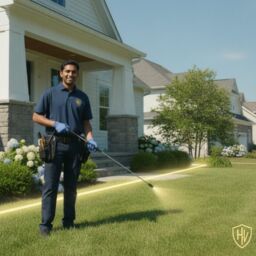




What if the most effective way to protect your family from pests has nothing to do with heavy chemicals? Most people think a quick spray is the only solution, but the reality is that traditional methods often fail to address why pests entered your home in the first place. If you’re tired of seeing mice in the kitchen or finding moth holes in your favorite sweaters despite previous treatments, you aren’t alone. We know how stressful it is to balance a pest-free environment with the safety of your children and pets.
By mastering integrated pest management for homeowners, you can stop the cycle of recurring infestations and create a home that is biologically incompatible with intruders. This professional approach moves beyond reactive treatments to focus on long-term prevention through exclusion and monitoring. In this guide, we’ll show you how to implement these expert strategies specifically for New York residences. You’ll learn how to navigate 2026 pesticide regulations, meet NYC Local Law 55 standards, and build a protective shield around your property that lowers costs and provides lasting peace of mind.
Key Takeaways
- Understand why integrated pest management for homeowners provides a more permanent, safer solution than traditional reactive spraying.
- Learn how to identify the four pillars of a successful program, starting with professional inspection and precise pest identification.
- Discover actionable sanitation and exclusion techniques to eliminate food sources and seal entry points before pests get inside.
- Stay informed about 2026 New York pesticide regulations and how IPM principles help you maintain compliance with NYC Local Law 55.
- Explore how tiered Home Pest Protection plans provide a proactive shield that manages the heavy lifting of structural pest defense for you.
What is Integrated Pest Management (IPM) for Homeowners?
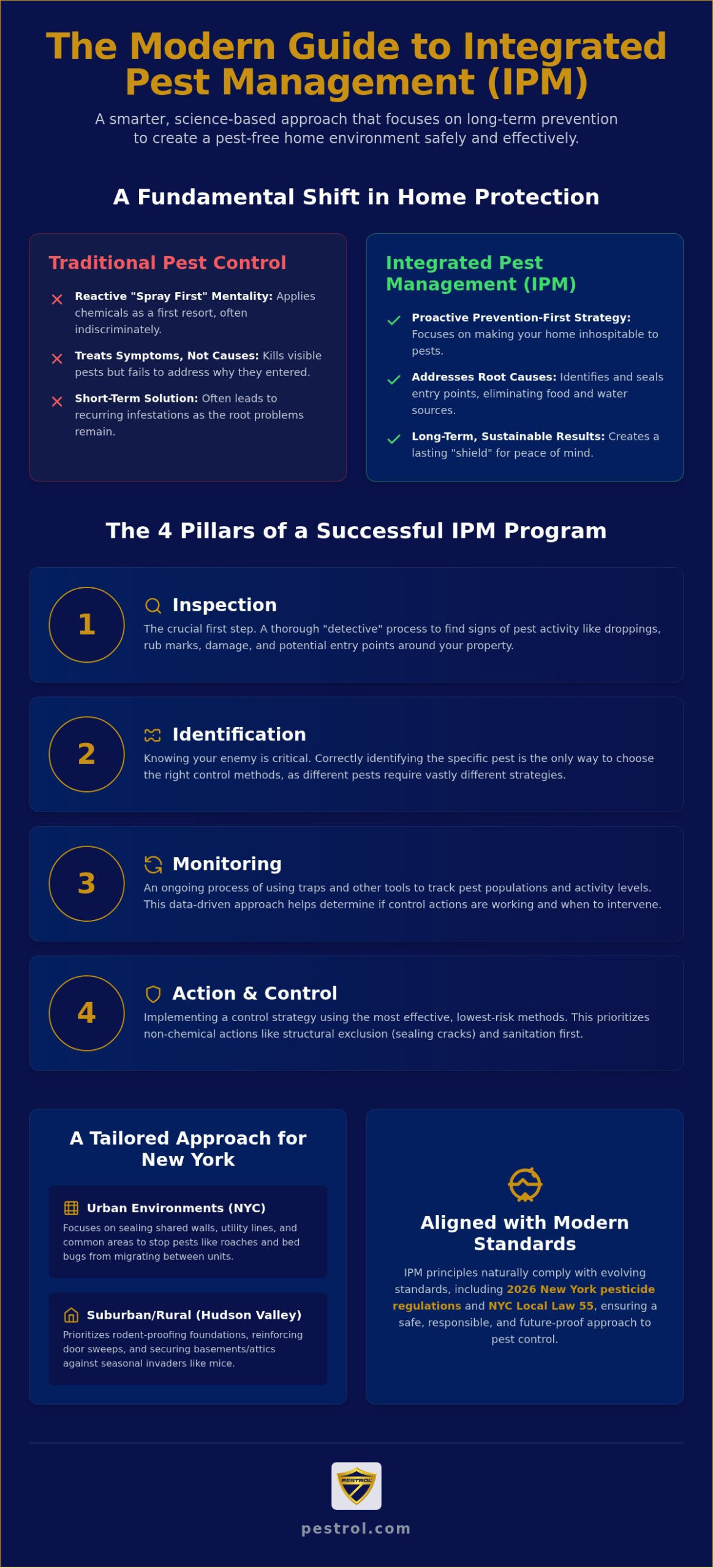
Integrated Pest Management is a smart, science-based approach to keeping your living space secure. Instead of relying on a “spray first” mentality, this strategy focuses on long-term prevention and targeted solutions. Think of it as a structural defense system rather than a chemical band-aid. By understanding the biology and behavior of pests, we can create an environment where they simply cannot survive. What is Integrated Pest Management (IPM)? It’s the gold standard for modern pest control because it prioritizes your family’s health while delivering better results than traditional methods.
In 2026, the industry has shifted away from indiscriminate “baseboard spraying.” This old-school method only treats the symptoms of an infestation. If you have roaches, mice, or clothing moths, spraying might kill the ones you see, but it won’t stop the next generation from moving in. Using integrated pest management for homeowners allows us to treat the root cause. We look for the gaps, cracks, and habits that invite pests inside. This shift is partly driven by new regulations, like the 2026 New York ban on certain neonicotinoid pesticides, which encourages us to be more precise and thoughtful about the products we use indoors.
The Core Philosophy: Prevention Over Cure
Pests aren’t targeting your home out of malice; they’re looking for three basic survival needs: food, water, and shelter. If your home provides these, it’s an open invitation. The philosophy of IPM is to systematically remove these invitations. This means sealing a leaky pipe under the sink to eliminate a water source for roaches or using airtight containers to hide food from mice. You’re the first line of defense. By maintaining a clean, dry, and sealed environment, you make it nearly impossible for pests to establish a colony. Our role is to provide the expert identification and structural “heavy lifting” to finish the job.
Why New York Homes Need a Specialized IPM Approach
Pest management isn’t a one-size-fits-all service, especially in a state as diverse as New York. If you live in a high-density area like the Bronx or Manhattan, you face unique challenges. Shared walls and utility lines act as highways for bed bugs and roaches. In these settings, IPM focuses on rigorous exclusion and cooperation between neighbors to stop pests from migrating between units. It’s about creating a seal that keeps your neighbor’s problems out of your living room.
Contrast this with the Hudson Valley. In places like Newburgh and Woodbury, the pressure is different. Large properties and proximity to nature mean seasonal rodent pressure is a major concern as temperatures drop. Homeowners in Orange County often deal with mice and clothing moths that find their way into basements and attics. A specialized approach for these homes involves reinforced door sweeps, professional-grade caulking, and monitoring systems tailored to the local landscape. Whether you’re in a city apartment or a suburban house, integrated pest management for homeowners provides a customized shield for your specific environment.
The 4 Pillars of a Successful Home IPM Program
Success in pest defense isn’t about how much product you apply. It’s about how well you understand the environment you’re protecting. Implementing The 4 Pillars of a Successful Home IPM Program ensures your approach is methodical, scientific, and effective. These pillars create a cycle of protection that evolves with your home’s needs. When you follow this framework, you move away from guesswork and toward a strategy that actually delivers results.
- Pillar 1: Inspection. This is the detective work where you look for signs like droppings, rub marks, or entry points.
- Pillar 2: Identification. Knowing exactly which pest is present determines the treatment protocol.
- Pillar 3: Monitoring. Using tools to track activity levels and pest movement over time.
- Pillar 4: Action and Control. Selecting the right intervention, such as structural sealing or targeted treatment.
Inspection and Identification: Know Your Enemy
Pest identification is the catalyst for choosing the correct treatment protocol. Misidentifying an intruder means your entire strategy will fail. For instance, clothing moths and pantry moths look similar but require completely different management techniques. If you treat the kitchen for a pest that is actually living in your wool closet, the infestation won’t stop. Homeowners in Warwick or Goshen often see roach look-alikes that require different responses. German roaches need aggressive indoor management, while wood roaches are often just accidental visitors from the yard. Professional expertise ensures you identify the species accurately before any action is taken.
Monitoring and Thresholds: When to Take Action
One of the most important parts of integrated pest management for homeowners is setting action thresholds. This means deciding how many pests constitute a problem that requires intervention. Seeing a single ant might just require a quick wipe-down with soapy water. However, an established trail leading to a food source indicates a breach that needs attention. Monitoring tools like glue boards and pheromone traps are your best friends here. Don’t think of them just as killers; they are data collection devices. They tell you where pests move and how many are present, preventing unnecessary chemical applications. If you need help setting up a defense system, Pestrol offers professional monitoring as part of our tiered protection plans.
IPM vs. Traditional Pest Control: Why the Shift Matters
Traditional pest control is often a cycle of reaction. You see a bug, you call someone, they spray, and the bug disappears for a few weeks. Then it returns. This “monthly service” model relies on high volumes of broad-spectrum chemicals applied to your baseboards. While it might seem cheaper in the short term, you’re essentially paying for a temporary fix that never addresses how the pests are getting in. It’s a treadmill that keeps you spending money year after year without ever solving the root problem.
Choosing integrated pest management for homeowners changes the math. Instead of high-volume spraying, we focus on structural sealing and targeted interventions. This proactive approach aims for permanent results. Over a five-year period, the cost of IPM is often lower than monthly traditional spraying because you’re fixing the house, not just killing the current intruders. You gain peace of mind and a healthier indoor environment. This shift is essential in New York, where new 2026 regulations have already prohibited several common outdoor pesticides, signaling a broader move toward more responsible, precise treatments.
Reducing the Chemical Footprint in Your Home
One of the biggest advantages of IPM is the “Least-Toxic First” hierarchy. We don’t start with broad-spectrum aerosols that linger in the air. Instead, we use targeted baits and gels placed exactly where pests live and travel. This strategy significantly improves indoor air quality and protects the most vulnerable members of your household, including children and pets. Our technicians are trained to apply these professional solutions with surgical precision. By following an Actionable IPM Checklist for Homeowners, we ensure that every intervention is as low-impact as possible while remaining highly effective.
Sustainability and Long-Term Effectiveness
Standard sprays have a major flaw: pests can develop resistance. Roaches and bed bugs are notorious for “learning” to survive common chemicals, leading to “super-infestations” that traditional methods can’t touch. IPM bypasses this issue by focusing on physical barriers. If a mouse can’t get through a door sweep, it doesn’t matter if it’s resistant to a product. Our specialized Rodent Proofing and structural exclusion techniques stop the cycle of re-infestation by making your home a fortress. For a deeper look at how these strategies evolve with New York’s specific climate challenges, read our 2026 Guide: Home Pest Protection for New Yorkers. This structural approach ensures your home stays pest-free for the long haul, not just until the next rainstorm.
Actionable IPM Checklist for NY Homeowners
Practical application is where the theoretical pillars of defense become a reality. For most people, integrated pest management for homeowners starts with a simple, tactical walkthrough of the property to identify vulnerabilities. Begin with sanitation. A single leaky pipe under a kitchen sink provides enough water for a roach colony to thrive. Crumbs in the toaster or pet food left out overnight are neon signs for ants and mice. Wipe down surfaces daily and store dry goods in airtight glass or heavy plastic containers to remove these easy food sources.
Exclusion Strategies for Rodents and Insects
Rodent proofing is the most effective way to stop an infestation before it begins. Mice can squeeze through gaps as small as 1/4 inch, which is roughly the width of a pencil. Inspect your foundation and the areas around utility pipes with a flashlight. Use professional-grade materials like copper mesh, which rodents cannot chew through, and seal it with high-quality caulk. In Bronx apartments, focus on the voids behind ovens and under sinks where shared plumbing creates easy travel routes between units. Installing heavy-duty door sweeps can also block insects from crawling under entry points during the night.
Sanitation and Habitat Modification
Habitat modification involves removing the shelter that pests need to survive. In the Hudson Valley, moisture control in basements is critical. High humidity creates a perfect breeding ground for silverfish and roaches. Use a dehumidifier to keep levels below 50% to make the environment less hospitable. If you’re dealing with clothing moths, vacuum the crevices in your closets and dry-clean woolens before seasonal storage. Moth larvae thrive on organic spills, so even a small, invisible stain can attract them to your clothing.
Landscaping also plays a major role in your home’s defense. If you live in Orange County or areas like Montgomery, keep mulch and shrubs at least 12 inches away from your foundation. Overgrown vegetation acts as a bridge for ants and ticks to reach your siding. Finally, perform seasonal maintenance checks. If you’re in New Windsor or Tuxedo, inspect your door sweeps and weather stripping every autumn. Cold air isn’t the only thing trying to get into your home when the temperature drops. A well-maintained exterior is your most reliable defense against the local pest pressure of 2026. By following this integrated pest management for homeowners checklist, you take the power back from pests.
How Pestrol Integrates IPM into Your Home Protection Plan
While the daily habits of sanitation and monitoring fall on the homeowner, the technical execution of a high-level defense requires professional expertise. Pestrol bridges this gap by applying integrated pest management for homeowners through a structured, “Results-First” framework. We don’t just show up to spray; we arrive to inspect, identify, and fortify. As a family-owned business rooted in New York, we understand that a pre-war apartment in Manhattan faces different biological pressures than a farmhouse in Warwick. We treat every home with the personal care and persistence required to achieve a permanent reduction in pest activity.
Our Tiered Defense: Basic to Premium
We’ve organized our services into tiered Home Pest Protection plans to ensure you get the exact level of coverage your property needs. This structured approach allows us to move beyond reactive treatments and maintain a proactive shield around your family. Every plan is customized to your specific location and the unique architectural challenges of your residence.
- Home Pest Protection – Basic: This plan provides essential seasonal security. It focuses on common household invaders like ants, spiders, and roaches, ensuring your home remains a sanctuary throughout the year.
- Home Pest Protection – Plus: This tier builds on the basics by adding specialized Rodent Proofing and Mouse Control. It’s ideal for homes in the Hudson Valley where seasonal rodent pressure is a constant threat.
- Home Pest Protection – Premium: Our most comprehensive plan includes targeted protocols for Clothing Moth Control and Bed Bug Treatment. It’s designed for homeowners who want total peace of mind and protection against the most destructive and invasive pests in NY.
The Pestrol Difference: Professional IPM in Action
National chains often use a “one-size-fits-all” model that relies on high-volume chemical applications. At Pestrol, our technicians are trained in specialized pest elimination protocols that prioritize long-term structural defense. We handle the heavy lifting of IPM, from professional-grade exclusion to precise pest identification. Whether we’re performing Roach Control in a high-density building or Rodent Proofing a suburban basement, our goal is to eliminate the root cause of the problem. This commitment to persistence ensures that we don’t just manage pests; we see every task through to completion.
Scheduled, proactive maintenance is the only way to stay ahead of the evolving pest trends of 2026. By choosing a local partner who understands the specific regulations and environmental challenges of the Hudson Valley and NYC, you’re investing in the long-term health and safety of your home. We’re here to act as your protective guardian, providing the expert care your property deserves.
Securing Your Home for the Long Term
You now have the tools to move beyond temporary fixes and embrace a more sustainable approach to pest defense. By focusing on the four pillars of inspection, identification, monitoring, and control, you can address the root causes of infestations rather than just the symptoms. Whether you’re sealing gaps in a Bronx apartment or managing moisture in a Hudson Valley basement, integrated pest management for homeowners provides a science-based path to a safer, healthier environment. This strategy effectively reduces chemical exposure while providing more permanent results than traditional reactive spraying.
As a family-owned business specialized in the unique challenges of NYC and the Hudson Valley, Pestrol is here to handle the heavy lifting for you. Our tiered Home Pest Protection plans are designed to fit your specific needs and budget, offering proactive maintenance that national chains simply can’t match. You deserve the peace of mind that comes with a professionally protected home.
We’re ready to partner with you to keep your living space secure and pest-free for years to come. Take the first step toward a more resilient home today.
Frequently Asked Questions
Is Integrated Pest Management actually effective against heavy roach infestations?
Yes, IPM is highly effective against heavy roach infestations because it removes the food and water sources they need to survive. Instead of just killing the roaches you see, this method uses targeted baits and structural sealing to collapse the colony from the inside out. It’s a more permanent solution than standard spraying because it addresses the environmental factors that allowed the population to grow in the first place.
Does IPM mean I will never use pesticides in my home again?
No, but pesticides are used as a targeted, last-resort intervention rather than a primary defense. The goal is to use the least-toxic products first, such as gels or baits placed deep into cracks and crevices where pests hide. This strategy reduces the overall volume of chemicals in your living space while ensuring the treatment remains highly effective against specific intruders.
How often should an IPM inspection be performed for a New York home?
You should schedule a professional inspection at least twice a year to keep up with New York’s intense seasonal pest cycles. Spring inspections focus on emerging insects like ants, while fall assessments prioritize rodent proofing as temperatures drop in the Hudson Valley. NYC property owners should also remember that Local Law 55 requires annual inspections for indoor allergen hazards like mice and roaches.
Can I do Integrated Pest Management myself, or do I need a professional?
Homeowners are the first line of defense for sanitation, but a professional is essential for high-level identification and structural exclusion. Successfully implementing integrated pest management for homeowners requires specialized tools and the ability to spot subtle entry points that the untrained eye misses. A technician ensures your structural defenses are built to last and meet professional protocols.
What is the most important step in an IPM program for rodents?
Structural exclusion is the most critical step for managing rodents. You must seal every gap larger than 1/4 inch with professional-grade materials like copper mesh or steel wool that mice cannot chew through. if you don’t physically block their entry points, you’ll deal with recurring infestations regardless of how many traps you set or how much bait you use.
Is IPM more expensive than traditional pest control services?
IPM is generally more cost-effective over a multi-year period than traditional reactive services. While the upfront cost for structural sealing and exclusion might be higher, it prevents the need for monthly, high-volume chemical treatments. You’re investing in a long-term defense system that lowers your total maintenance expenses and provides a permanent reduction in pest activity.
How does IPM protect my pets and children differently than standard spraying?
It prioritizes indoor air quality and targeted product placement to minimize exposure. By using non-volatile baits in areas where kids and pets cannot reach them, we eliminate the need for broad-spectrum aerosols that linger in the air. This approach creates a significantly safer living environment while still providing professional-grade protection against disease-carrying pests.
What should I look for in a pest control company that claims to use IPM?
Look for a company that prioritizes thorough inspection and structural recommendations over immediate chemical application. A reputable provider will offer tiered protection, such as our Home Pest Protection – Basic, Plus, or Premium plans, and focus on long-term monitoring. They should be able to explain the specific biology of the pest and the “why” behind every intervention they suggest.