



A single mouse can squeeze through a gap the size of a pencil, but for a New York business owner, that tiny opening represents a massive threat to your bottom line. Professional commercial rodent exclusion is the only way to stop these invaders before they ever step foot inside your facility. You’ve likely spent years cycling through the same frustrating routine of setting traps and clearing away evidence, only to find fresh damage to your inventory or wiring the very next morning. It’s exhausting to live in constant fear of a surprise health inspection or a negative customer review that could tarnish your hard-earned reputation overnight. We understand that you want a solution that actually lasts, rather than a temporary fix that leaves you vulnerable.
By focusing on structural integrity rather than just reactive trapping, you can finally gain the upper hand and protect your investment. In this guide, we’ll explain how professional rodent proofing secures your business assets, ensures strict health code compliance, and provides a permanent alternative to endless extermination cycles. You’ll discover the specific materials and methods that create a “results-first” defense, giving your staff and customers the peace of mind they deserve.
Key Takeaways
- Protect your business reputation and avoid the heavy penalties of a “C” health grade by addressing rodent issues at their source.
- Discover how professional commercial rodent exclusion blocks entry points as small as a dime, providing a permanent shield for your facility.
- Identify high-risk structural vulnerabilities unique to New York architecture, including sidewalk vaults, basement grates, and loading dock gaps.
- Learn why moving from reactive trapping to proactive structural proofing is the most cost-effective way to secure your assets long-term.
- See how a customized structural audit and fortification plan can be tailored to the specific operational needs of your restaurant or warehouse.
Why Commercial Rodent Exclusion is Vital for Your NY Business
New York City’s business environment is uniquely challenging. Between the dense urban layout and aging infrastructure, rats and mice aren’t just a nuisance; they’re a direct threat to your operating license. In Manhattan and the Bronx, pre-war masonry and hollow sidewalk vaults provide direct highways into your basement. Relying on traps alone is like trying to empty the ocean with a bucket. You need a permanent barrier. Professional commercial rodent exclusion provides that barrier, stopping infestations before they start.
Protecting your reputation is just as vital as protecting your inventory. A single viral video of a rodent in your dining room can destroy years of brand building. Beyond the PR nightmare, the financial hit from contaminated food is staggering. Rats can chew through cinder blocks and conduit lines, leading to expensive repairs and even electrical fires. With NYC’s strict trash containerization rules now in full effect, rodents are more desperate to find indoor food sources. It’s much cheaper to seal the building than to replace damaged assets.
Health Code Compliance and Regulatory Standards
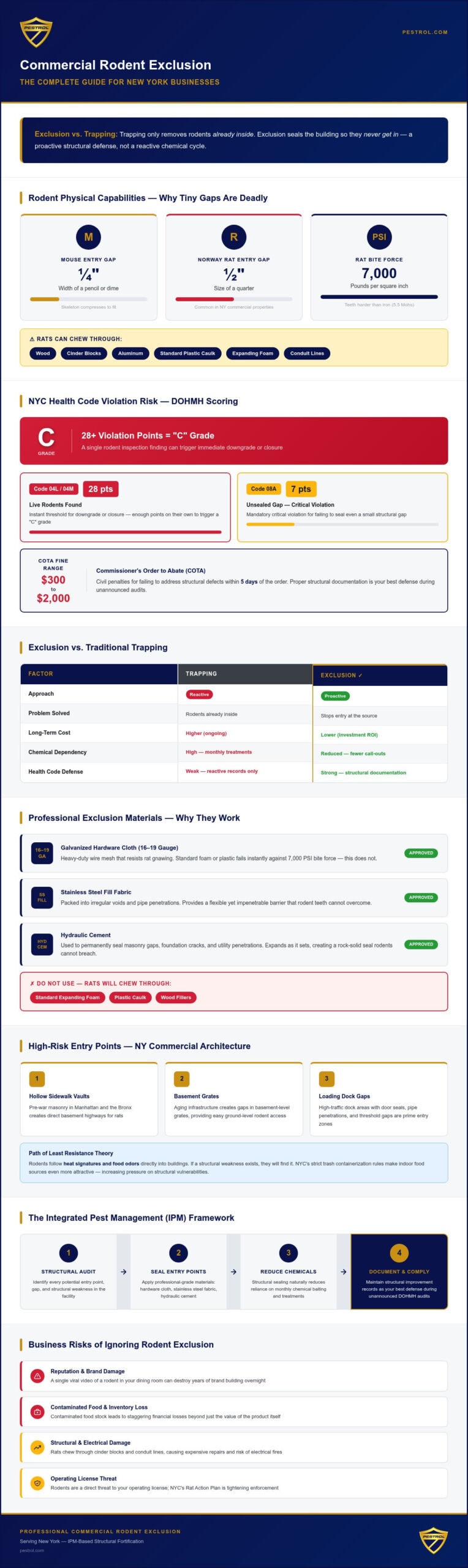
The NYC Department of Health and Mental Hygiene (DOHMH) doesn’t just look for cleanliness; they look for structural integrity. Under the current scoring system, 28 or more violation points result in a “C” grade. If an inspector finds live rodents under Codes 04L or 04M, you could face up to 28 points immediately. This is enough to trigger a downgrade or immediate closure. Even failing to seal a small gap under Code 08A carries a mandatory 7-point critical violation. Implementing a professional integrated pest management framework ensures these entry points are sealed for good. Proper documentation of these structural improvements is your best defense during an unannounced audit, especially as the city tightens enforcement through the Rat Action Plan.
Long-Term Cost Savings vs. Recurring Extermination
Many business owners view pest control as a monthly expense for baiting and trapping. However, commercial rodent exclusion is an investment in your building’s future. While trapping is reactive, exclusion is proactive. Rats maintain a bite force of approximately 7,000 pounds per square inch, allowing them to gnaw through standard building materials like wood and plastic. By sealing penetrations with 16-to-19-gauge galvanized hardware cloth and hydraulic cement, you reduce the need for recurring chemical treatments. This shift leads to significant long-term ROI. You’ll spend less on emergency call-outs and avoid the massive fines associated with the Commissioner’s Order to Abate (COTA). These civil penalties can range from $300 to $2,000 if you fail to address structural defects within five days.
Understanding the Science of Commercial Rodent Proofing
Effective commercial rodent exclusion is an engineering challenge, not a chemical one. It involves the physical sealing of a building’s envelope to prevent pests from ever gaining access. While many businesses rely on a cycle of trapping and baiting, these methods only address the rodents already inside. Exclusion stops the problem at the source. It’s a proactive discipline that requires a deep understanding of rodent biology and urban architecture. If a building has a structural weakness, rodents will find it through the “Path of Least Resistance” theory. They are opportunistic survivors that follow heat signatures and food odors directly into your facility.
The physical capabilities of these pests are often underestimated. Mice can compress their skeletons to fit through a 1/4-inch gap, which is roughly the width of a pencil or a dime. Norway rats only need a 1/2-inch opening, about the size of a quarter, to enter. These tiny vulnerabilities are common in New York’s commercial properties. Following the CDC rodent exclusion guidelines is essential for identifying these entry points. Using the right materials is equally critical. Standard expanding foam or plastic caulk won’t work because rats have a bite force of 7,000 pounds per square inch. Their teeth are harder than iron, measuring 5.5 on the Mohs scale. They can chew through wood, cinder blocks, and aluminum. True protection requires heavy-duty materials like 19-gauge galvanized hardware cloth, stainless steel fill fabric, and hydraulic cement.
The Integrated Pest Management (IPM) Framework
Structural fortification is the foundation of a successful IPM plan. By sealing entry points, you naturally reduce the need for monthly chemical treatments. This approach is better for the environment and safer for your staff. It combines consistent monitoring with high-level sanitation and physical barriers. When you eliminate the “open door” policy of your building, you make your facility significantly less attractive to local colonies. If you’re ready to secure your facility, professional rodent proofing offers a permanent solution that traps alone can’t provide.
Rodent Biology and Urban Adaptation
New York rodents are highly adapted to commercial heating and plumbing systems. They follow pheromone trails, or “rub marks,” left by previous generations. These greasy streaks act as a map for new colonies to find old entry points. Seasonal migration also plays a huge role in local infestations. As the Hudson Valley winter approaches, rodents move away from outdoor burrows and seek the warmth of commercial basements and kitchens. Professional commercial rodent exclusion ensures that when the temperature drops, your building remains a fortress rather than a refuge.
Rodent Exclusion vs. Traditional Trapping: Which Wins for Businesses?
Traditional trapping has been the industry standard for decades. It’s often the first thing a business owner thinks of when they spot a mouse. However, trapping is a fundamentally reactive strategy. It only addresses the rodents that have already breached your perimeter and entered your workspace. Professional commercial rodent exclusion shifts the focus from population management to total prevention. Instead of clearing traps every morning, you’re fixing the structural flaws that allow the problem to exist in the first place. This proactive approach targets the root cause, making it the only permanent solution for a high-traffic New York facility.
Think about the ongoing labor costs of a trap-heavy program. Your staff or a technician must constantly monitor, bait, and clear those devices. It’s a never-ending cycle that drains resources and never actually finishes the job. Federal guidelines now emphasize that structural barriers are the most effective way to manage urban pests. According to EPA rodent prevention standards, sealing entry points and improving sanitation are the primary defenses against infestation. Relying solely on traps or poisons creates unnecessary environmental risks and fails to provide the long-term security your business needs.
Efficacy and Speed of Results
Trapping alone frequently leads to “re-infestation cycles.” You might catch five mice this week, but if the gap behind your walk-in cooler remains open, five more will take their place by Monday. The real results happen when you combine a targeted initial trap-out with immediate structural fortification. This synergy clears the current indoor population while ensuring that no new colonies can follow the pheromone trails back inside. It’s a faster way to reach a “zero-sighting” status and stay there, especially during the peak migration months in the Hudson Valley.
Impact on Business Operations
Discretion is a major advantage of structural work. Most commercial rodent exclusion happens in areas invisible to your customers, such as behind stainless steel prep lines, around utility risers, and at foundation levels. This eliminates the “ick factor” associated with visible snap traps or bait stations in public view. For restaurants and retail spaces, maintaining a clean, professional image is non-negotiable. If you want to dive deeper into protecting your brand from the fallout of pest sightings, check out our guide to Restaurant Pest Control NYC. We focus on results that keep your customers happy and your staff focused on their work, not on pests.
Common Commercial Entry Points in NY Architecture
New York architecture is iconic, but it’s also incredibly porous. In Manhattan and the Bronx, sidewalk vaults and basement grates act as open invitations. These structures often connect directly to the street sewer lines, giving rodents a subterranean highway into your building. If your foundation walls are made of old rubble masonry, mortar decay creates gaps that rats easily exploit. Commercial rodent exclusion requires a deep understanding of these local structural quirks. You can’t just seal the front door; you have to secure the entire building envelope from the sidewalk to the roof.
Loading docks and bay doors are the number one vulnerability for warehouses and distribution centers. Large doors are rarely perfectly flush with the ground. A gap of just 1/2 inch is enough for a Norway rat to squeeze through. In newer Orange County developments, we often see issues with roof-line gaps and HVAC conduits. Rodents are excellent climbers. They follow the warmth of utility lines and enter through unsealed penetrations on the roof or upper floors. Multi-tenant commercial spaces face an additional challenge: shared walls. These “utility highways” allow pests to travel between units, making it vital to seal every point where pipes or wires enter your specific space.
The ‘Invisible’ Entry Points
Some of the most dangerous vulnerabilities are the ones you never see. Floor drains and sewer line gaps in commercial kitchens are frequent entry points for rats. They are capable swimmers and can enter through unsealed lines or broken drain covers. Expansion joints in concrete slabs and foundation cracks also provide access to the sub-level voids beneath your facility. Under NYC Health Code Article 81, these are critical violations. Pests frequently nest behind heavy kitchen equipment and walk-in coolers where they’re shielded from daily activity. A thorough structural audit is the only way to find these hidden breaches.
Vulnerabilities by Industry
Retail businesses often struggle with front door sweeps and display window gaps. If your door sweep is worn or missing, you’re essentially leaving the door open for mice, which only need a 1/4-inch opening to enter. In the hospitality sector, laundry chutes and utility penetrations in guest rooms are common trouble spots. These vertical shafts allow pests to move between floors with ease. For those managing mixed-use properties or smaller commercial offices, our Rodent Proofing Services offer structural tips that apply to both residential and professional environments. Identifying these industry-specific risks is the first step toward a permanent solution.
Pestrol’s Professional Rodent Exclusion Process
We don’t just set traps; we rebuild your building’s defenses. Our approach to commercial rodent exclusion begins with a meticulous structural audit. Our technicians are trained to think like rodents, identifying every dime-sized vulnerability that could lead to a breach. We look beyond the obvious holes, checking for grease marks along baseboards, monitoring utility penetrations, and inspecting the integrity of your foundation. This comprehensive assessment ensures that no entry point is overlooked, no matter how small or hidden it may be.
Once we’ve mapped your facility’s weaknesses, we develop a customized fortification plan. Every industry has unique needs, and a warehouse in Middletown requires a different strategy than a restaurant in Manhattan. We use only industrial-grade, gnaw-proof materials that stand up to the relentless pressure of urban pests. This includes 19-gauge galvanized hardware cloth, stainless steel fill fabric, and specialized hydraulic cement. After the sealing is complete, we transition to post-exclusion monitoring. This critical step ensures that the initial indoor population is fully eliminated and that your new barriers remain uncompromised.
Our Tiered Commercial Protection Plans
We believe in providing options that fit your specific operational scale. Our Home Pest Protection plans-Basic, Plus, and Premium-are easily adapted to serve local businesses with the same level of care we bring to residential clients. These plans integrate commercial rodent exclusion as a core component, ensuring your facility is protected year-round. We are deeply rooted in the local community, serving businesses in Newburgh, Middletown, and Warwick with a commitment to persistence. We don’t stop until the problem is solved, providing you with the “results-first” mentality you expect from a professional partner.
Getting Started: The Path to a Rodent-Free Business
Taking the first step toward a permanent solution is simple. When you schedule your initial facility inspection, we perform a deep dive into your commercial kitchen or storage areas. During the implementation phase, our team works with speed and discretion to minimize any impact on your daily operations. You won’t have to worry about unsightly devices or messy applications. We handle the heavy lifting so you can focus on serving your customers. If you’re tired of the endless cycle of reactive pest control, it’s time to invest in a solution that actually lasts.
Take Control of Your Building’s Future Today
Transitioning from reactive trapping to a permanent structural defense is the most effective way to secure your commercial space in New York. You’ve learned how identifying specific architectural entry points and using industrial-grade, chew-proof materials can stop infestations before they ever start. As a family-owned local institution, we specialize in helping businesses maintain strict NY restaurant health code compliance through professional commercial rodent exclusion. Whether you operate a small retail shop or a large warehouse facility, our tiered protection plans are designed to scale with your specific needs and provide the lasting peace of mind you deserve.
Don’t let recurring pest issues threaten your professional reputation or your bottom line. Our team of seasoned experts is ready to fortify your facility with persistent, results-first care that addresses the root cause of the problem. We treat every client with a high degree of personal respect and dedication.
We look forward to serving as your knowledgeable ally in creating a healthy, compliant, and rodent-free environment for your staff and customers.
Frequently Asked Questions
What is the difference between rodent control and rodent exclusion?
Rodent control is a broad term that often includes reactive measures like trapping and baiting to manage existing populations. In contrast, commercial rodent exclusion is a proactive engineering solution focused on sealing a building’s physical envelope. While control kills the pests already inside, exclusion prevents new ones from entering by closing gaps in masonry, utility lines, and foundations. It’s the foundation of a long-term pest management strategy rather than a temporary fix.
How long does a commercial rodent exclusion project typically take?
The timeline for a project depends on the size and complexity of your facility. A standard restaurant in Manhattan might take one to two days for a full structural audit and fortification. Larger warehouses or multi-unit commercial buildings in the Bronx may require more time to secure extensive loading docks and utility highways. We work with speed and discretion to ensure your daily business operations continue with minimal interruption during the implementation phase.
Is rodent exclusion safe for food service environments and commercial kitchens?
Yes, rodent exclusion is one of the safest methods for food service environments because it focuses on physical barriers rather than chemical applications. By sealing entry points behind stainless steel prep lines and walk-in coolers, we reduce the need for pesticides in sensitive areas. This approach helps New York establishments maintain high sanitation standards and comply with health code regulations, protecting your staff and customers from exposure to unwanted substances.
Can rodent exclusion be done in very old New York buildings?
Absolutely, though older buildings require specialized expertise in pre-war architecture. Many properties in Manhattan and the Bronx have unique vulnerabilities like rubble masonry foundations and hollow sidewalk vaults. Our team uses industrial-grade materials like hydraulic cement and galvanized hardware cloth to bridge these gaps. We specialize in retrofitting historic structures with modern, gnaw-proof defenses that respect the building’s integrity while providing a permanent shield against persistent urban pests.
Will exclusion work if my neighboring business has a rodent problem?
Exclusion is specifically designed to protect your space even when neighboring units are infested. In multi-tenant commercial buildings, we focus on sealing “utility highways” and shared wall penetrations. By hardening your specific building envelope, you eliminate the path of least resistance that pests follow. Even if a neighboring business in Newburgh or Warwick has an active issue, your facility remains a fortress that rodents simply cannot breach, giving your staff total peace of mind.
What materials are used in professional rodent proofing for businesses?
We use heavy-duty, industrial-grade materials that rodents cannot chew through. This includes 16-to-19-gauge galvanized hardware cloth, stainless steel fill fabric, and specialized hydraulic cement. For doors, we install commercial-grade sweeps with internal steel barriers. Standard materials like expanding foam or plastic caulk fail because rats have an incredible bite force. Our gnaw-proof selections ensure your commercial rodent exclusion project stands up to the toughest New York pests and provides long-term value.
Does commercial rodent exclusion come with a guarantee or warranty?
At Pestrol, we pride ourselves on a results-first mentality and a tireless work ethic. We are committed to seeing every task through to completion and maintaining long-term relationships with our local business partners. Our tiered protection plans provide ongoing monitoring to ensure your defenses remain intact. We offer a persistence guarantee, which means we’ll continue to work until your rodent problem is completely resolved and your building is secure against future invaders.
How much does commercial rodent exclusion cost compared to monthly service?
While the initial investment in exclusion is higher than a single monthly visit, it offers significant long-term savings. Monthly services often focus on reactive trapping, which is a never-ending expense. Exclusion is a proactive fortification that reduces the need for emergency call-outs and recurring chemical treatments. By preventing expensive health code fines and inventory loss, exclusion typically pays for itself through improved operational efficiency and permanent protection for your local facility.