



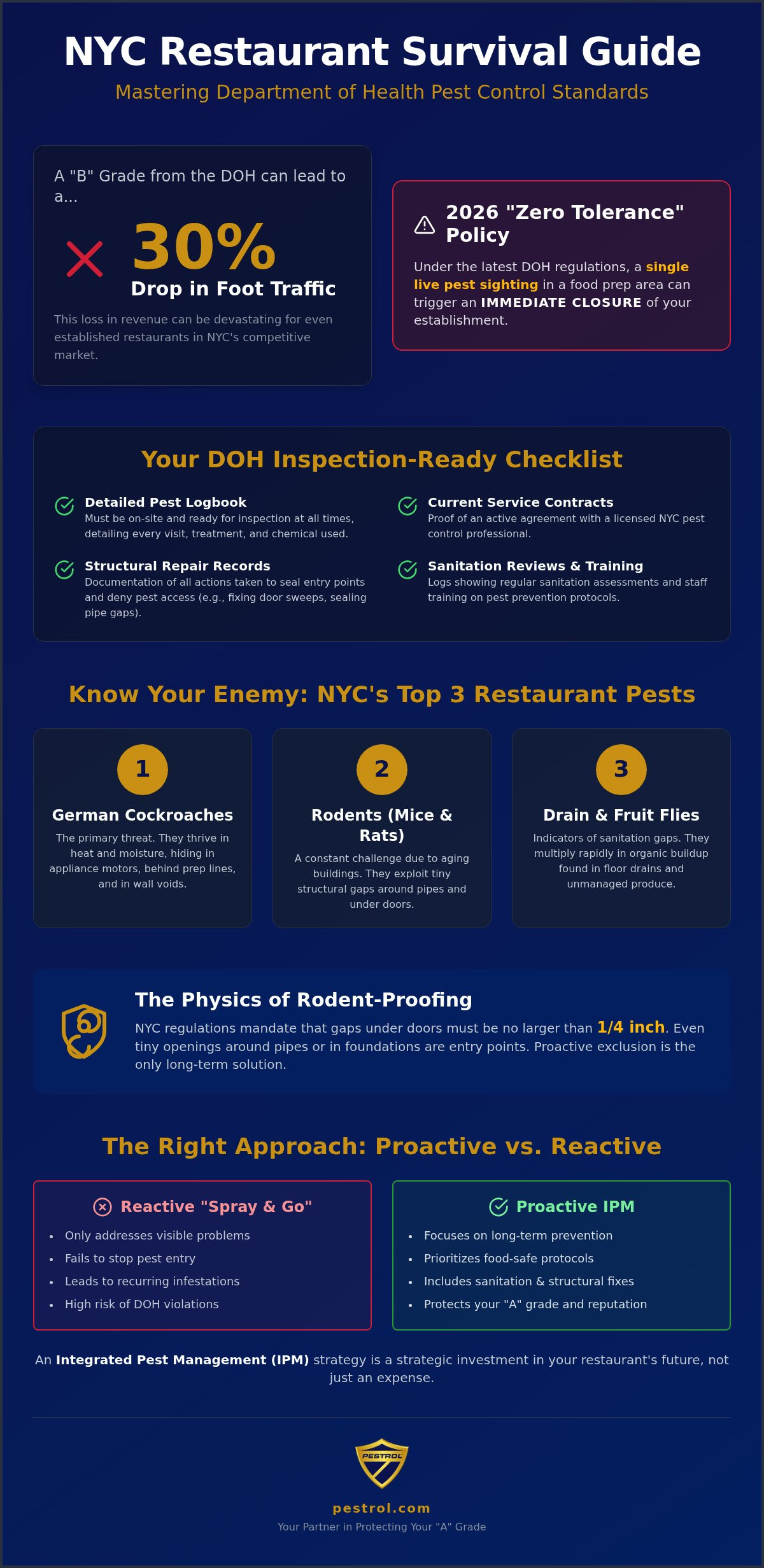
Did you know that a “B” grade from the Department of Health can slash your restaurant’s foot traffic by up to 30% overnight? In the high stakes world of New York City dining, a single violation isn’t just a fine; it’s a direct hit to your reputation and your revenue. Under 2026 regulations, even one live sighting in a food prep area can trigger an immediate closure, leaving your doors locked and your staff sidelined while your Yelp reviews take a permanent hit.
You’ve worked too hard on your menu and your brand to let a tiny gap under a back door or a missed log entry lead to a public disaster. We understand the anxiety of unannounced inspections and the frustration of unreliable national chains that treat your kitchen like a generic warehouse. You need a partner who knows that restaurant pest control NYC is about protecting your bottom line as much as it’s about hygiene.
This guide will show you how to master the latest DOH compliance standards and implement a proactive defense strategy. We’ll walk through the essential documentation inspectors demand, the specific physics of NYC rodent proofing, and the tiered protection plans that keep your “A” grade exactly where it belongs: in the front window.
Key Takeaways
- Understand the 2026 DOH inspection standards where a single pest sighting can trigger immediate closure and learn how to maintain your “A” grade.
- Discover why specialized restaurant pest control NYC is a strategic investment that safeguards your reputation against negative reviews and inspection fines.
- Learn the critical role of documentation and how to maintain a service log that satisfies even the strictest health inspectors during unannounced visits.
- Identify structural vulnerabilities common in Manhattan and Bronx buildings and the precise physical barriers needed to stop rodent entry before it starts.
- Shift from ineffective “spray-and-go” services to an Integrated Pest Management (IPM) approach that prioritizes food-safe protocols and long-term sanitation.
The High Stakes of Restaurant Pest Control in NYC’s 2026 Market
In the high-pressure world of New York City dining, professional pest management has evolved from a back-of-house chore into a critical pillar of business operations. It’s no longer enough to react to a problem after a sighting. Successful operators treat restaurant pest control NYC as an ongoing investment in their brand’s health and longevity. In 2026, the margin for error has disappeared. A “DOH-Ready” kitchen is one where every crack is sealed, every floor drain is scrubbed, and every delivery is inspected before it crosses the threshold. We’re here to help you build that fortress. Just as many top-tier NYC venues trust Regal Security for their corporate and executive protection, a professional pest management strategy ensures your internal environment remains just as secure.
NYC Health Department (DOH) Expectations for 2026
The NYC Department of Health and Mental Hygiene (DOH) uses a strict point system where fewer points result in a better grade. Pest violations are among the most heavily weighted infractions an inspector can cite. Under NYC Health Code §81.25, inspectors have the authority to trigger an immediate closure if they find a single live cockroach or evidence of rodents in food preparation areas. This “zero tolerance” baseline means that even “evidence of activity,” like droppings or egg cases, is enough to strip away your “A” grade. Understanding the full scope of pest control for food industry facilities under the 2026 safety standards is essential for every operator who wants to stay ahead of these requirements.
Inspectors now look for more than just physical pests; they scrutinize your documentation to ensure you’re being proactive. You must maintain a detailed pest logbook on-site and have it ready for inspection at any time. This log should include:
- Current service contracts with licensed pest control professionals.
- Detailed records of every visit, treatment, and chemical used.
- Reports of structural repairs made to prevent pest entry.
- Sanitation reviews and staff training logs.
The Financial Impact of Non-Compliance
The damage from a failed inspection extends far beyond the initial fines. A “Grade Pending” or “Closed by DOH” sign in your window acts as a warning to every potential customer who walks by. Research shows that a “B” grade can lead to a 20-30% drop in foot traffic almost instantly. In our city’s competitive market, that’s a loss most independent spots can’t survive for long. Maintaining an “A” grade requires a proactive partnership for restaurant pest control NYC that addresses the unique challenges of shared urban spaces.
In the age of viral social media, a single photo of a pest shared on Instagram or TikTok can cause permanent reputation damage that no marketing budget can fix. While specific fines vary based on the scale of violations, the true cost lies in lost revenue and the high price of emergency remediation. The total financial impact of a DOH-mandated closure often reaches thousands of dollars per day when factoring in lost sales, labor costs, and discarded inventory.
Identifying Common NYC Restaurant Pests: From Prep Lines to Curb
NYC kitchens aren’t just workspaces; they’re complex ecosystems. The combination of high-heat cooking equipment and high-moisture dish stations creates a perfect habitat for survival. Because many Manhattan and Bronx restaurants share walls with neighbors, an infestation next door can quickly become your problem through shared utility lines and floor voids. This cross-contamination makes restaurant pest control NYC a community-wide challenge that requires a localized, expert approach to manage effectively.
The “Big Three”: Roaches, Rodents, and Flies
German cockroaches are the primary threat in the food service industry. They thrive in environments above 80 degrees, making the interior of refrigerator motor housings and grease-caked corners behind prep lines their favorite hiding spots. Their small size allows them to tuck into gaps that staff rarely see during nightly cleanings. Because these pests have developed resistance to many common treatments, professional roach removal using advanced, targeted protocols is often the only reliable path to total elimination in a commercial kitchen environment.
Rodents remain a perennial NYC challenge due to aging infrastructure. NYC regulations mandate that door sweeps must have gaps no larger than 1/4 inch to prevent entry. Even a tiny opening around a gas line or a slightly warped basement door is an invitation for mice and rats to enter your storage areas. Once inside, they leave behind evidence that triggers immediate DOH violations.
Drain flies and fruit flies serve as hidden indicators of sanitation gaps. While they don’t carry the same immediate “closure” stigma as a rat, they signal a buildup of organic biofilm in floor drains or poorly rotated produce. These pests multiply rapidly in the humid air of a busy kitchen, often becoming a visible nuisance to customers in the dining room.
Stored Product Pests: Protecting Your Inventory
Inventory management is your first line of defense against beetles and moths. Flour beetles and Indian meal moths can arrive in your kitchen via bulk dry goods like grains, spices, or pasta. Once established, they can contaminate thousands of dollars in inventory in a matter of days. This is why DOH standards require all food to be stored in sealed containers at least 6 inches off the floor.
Implementing a strict “First In, First Out” (FIFO) system is essential for more than just food freshness. Older stock that sits in the back of a shelf provides a stable, undisturbed environment for pests to breed. Professional monitoring catches these infestations in their early stages, often before they’re visible to the naked eye. If you’re concerned about your current storage safety, a specialized restaurant pest control NYC assessment can help identify vulnerabilities in your supply chain.
Seasonal shifts also play a major role in pest pressure. As temperatures drop in the fall, rodents push harder to get indoors. Conversely, the high humidity of NYC summers accelerates the life cycles of roaches and flies. Professional elimination focuses on these cycles, adjusting treatment protocols to match the specific threats of the season.
Evaluating NYC Commercial Pest Partners: Compliance vs. Convenience
Choosing a partner for restaurant pest control NYC isn’t just about ticking a box for the health inspector. It’s about finding a seasoned expert who understands the unique rhythm of a New York kitchen. Many national chains rely on call centers and “spray-and-go” technicians who lack the local knowledge needed to handle the complex infrastructure of Manhattan or the Bronx. You need a partner who offers after-hours flexibility, ensuring service happens when your dining room is empty and your prep lines are clear. A family-owned provider brings a level of personal care and accountability that a corporate giant simply can’t match.
What to Look for in a Service Contract
A high-quality service agreement should be as unique as your menu. High-volume establishments often require bi-weekly visits to stay ahead of pest pressure, while smaller cafes might find monthly service sufficient. Transparency is non-negotiable in 2026. Your provider must offer digital reporting and real-time alerts so you’re never surprised by a technician’s findings. This documentation is your primary defense during an unannounced DOH visit.
- Customized Frequency: A Michelin-star bistro has different sanitation risks and traffic patterns than a high-turnover deli.
- Digital Service Logs: Instant access to treatment records and chemical usage is essential for compliance.
- Integrated Pest Management (IPM): Look for a focus on long-term prevention rather than just reactive chemical applications. Providers well-versed in pest control for food industry environments will align their IPM strategies with the latest FSMA and DOH regulatory requirements.
The Role of Rodent Proofing in Commercial Contracts
In a city where rats are a constant threat, your contract must distinguish between simple trapping and true exclusion. Trapping is a temporary fix that deals with the symptoms; exclusion is the cure that addresses the cause. High-quality restaurant pest control NYC providers prioritize sealing entry points, such as gaps around utility lines and damaged door sweeps, to keep pests out of your building entirely.
Investing in permanent structural fixes is far more cost-effective than paying for endless baiting programs. Our specialized rodent proofing services focus on these technical exclusion methods, using durable materials that stand up to the rigors of a commercial kitchen. By stopping rodents at the foundation, you protect your inventory and your reputation from the devastating impact of a single sighting. It’s about building a fortress around your business so you can focus on the food, not the floorboards.
The Pestrol Process: Strategic Pest Management for Food Industry Pros
Effective restaurant pest control NYC requires more than just a monthly visit from a technician. It demands a strategic partnership where the pest expert acts as a protective guardian of your reputation. Our process is designed to integrate seamlessly with your existing cleaning crew’s workflow, ensuring that our food-safe treatment protocols never disrupt your service hours. We don’t just exterminate; we consult with your team to create a fortress against infestations, focusing on long-term prevention over quick chemical fixes.
Step 1: The Comprehensive Kitchen Audit
Every engagement begins with a deep dive into your facility’s specific vulnerabilities. We look beyond the obvious areas, focusing on “vulnerable zones” that staff often overlook during nightly resets. This audit establishes a baseline sanitation report that helps ownership understand exactly where risks reside.
- Refrigeration and Motor Housings: Inspecting the high-heat areas where German cockroaches congregate.
- Under-Sink Voids: Checking for moisture buildup and small plumbing gaps.
- Drop Ceilings and Vents: Identifying the “pest highways” that allow rodents to travel between shared NYC building walls.
Step 2: Tiered Treatment and Exclusion
Once we identify the threats, we deploy targeted treatments that prioritize safety in food-handling environments. Unlike generic services that rely on routine spraying, we emphasize structural exclusion. We use professional-grade materials to seal entry points, ensuring that once a pest is gone, its path back inside is permanently blocked. Our service scales to fit your specific needs, offering Home Pest Protection – Basic, Plus, and Premium tiers that we adapt for commercial environments of any size, from intimate bistros to high-volume Bronx kitchens.
Step 3: Ongoing Compliance and Monitoring
Maintaining your “A” grade requires meticulous record-keeping. We handle the heavy lifting of DOH-required documentation by maintaining your on-site logbook with precision. This includes detailed service records, chemical usage logs, and structural repair reports that inspectors expect to see. We also perform quarterly reviews to stay ahead of seasonal shifts, such as the increased rodent pressure that occurs every winter. By empowering your staff through basic training on early warning signs, we ensure your kitchen remains “DOH-Ready” every single day. For a complete breakdown of what inspectors look for, our commercial kitchen pest control compliance checklist gives you a step-by-step framework to stay ahead of every unannounced visit.
Why NYC Restauranteurs Choose Pestrol for Peace of Mind
In a city dominated by faceless national corporations, Pestrol stands apart as a family-owned and operated institution. We don’t just work in New York; we live here. We understand that your restaurant is your life’s work, and we treat it with the same level of personal care and respect we’d give our own neighbors. Our commitment to the local community means we’re personally invested in seeing your business thrive, free from the stress of DOH fines or negative reviews. When you partner with us, you’re gaining a knowledgeable ally who treats every kitchen like it’s our own.
Local Expertise in Manhattan and the Bronx
Every neighborhood has its own unique pest pressures. A basement kitchen in a historic Manhattan brownstone faces different structural challenges than a high-volume commissary in the Bronx. We bring a tireless work ethic to the city that never sleeps, ensuring your space is protected around the clock. Being your neighbor makes us a better partner because we’re already familiar with the local infrastructure and the specific rodent pathways that define your block. We don’t need a map to understand why pests are targeting your building; we’ve likely solved the same problem for the shop next door. This local insight allows us to move quickly from identifying a need to offering a decisive, action-oriented resolution.
Protecting Your Reputation and Your Bottom Line
We’ve taken the proven logic of our home protection from pests and adapted it for the high-stakes commercial world. By offering tiered plans like Basic, Plus, and Premium, we ensure that every restauranteur has access to high-quality care that fits their budget. This tiered approach provides a structured, efficient solution to a complex problem. You get the benefit of a seasoned expert who acts as a protective guardian for your brand. This allows you to focus on your menu while we handle the documentation, structural exclusion, and DOH-compliant monitoring that keeps your doors open.
The long-term ROI of preventative pest management is clear. You save money on discarded inventory, avoid the staggering costs of DOH closures, and protect the hard-earned trust of your customers. Our results-first mentality means we don’t stop until the job is done. Your reputation is too valuable to leave to chance or unreliable national chains. Protecting your bottom line starts with a single, professional inspection from a team that knows the city better than anyone else.
Take Control of Your Restaurant’s Future Today
Success in the New York City dining scene requires more than a great menu; it demands a relentless commitment to hygiene and compliance. We’ve explored how the 2026 DOH standards leave no room for error, making specialized rodent proofing for restaurants far more valuable than reactive spraying. By prioritizing structural exclusion and maintaining meticulous service logs, you’re not just passing an inspection. You’re building a fortress that protects your brand’s reputation from the viral impact of a single negative review.
Our team provides the DOH-compliant documentation you need to face unannounced visits with absolute confidence. As a family-owned and locally operated partner, we understand the unique pressures of Manhattan and Bronx kitchens. We treat your business with the personal care it deserves, ensuring your “A” grade stays in the window where it belongs. Choosing the right restaurant pest control NYC partner is the most effective way to secure your bottom line and your peace of mind.
You’ve built something incredible in the world’s greatest city. We’re here to make sure it stays protected for years to come.
Frequently Asked Questions
How often does a restaurant in NYC need pest control service?
Most high-volume establishments require weekly or bi-weekly service to maintain an “A” grade. NYC health inspectors look for a pattern of ongoing, professional management rather than reactive fixes. Monthly visits are often insufficient for businesses with high foot traffic or shared building walls. We customize your schedule based on your kitchen’s specific risk factors and the seasonal pest pressures in your neighborhood.
What happens if my restaurant fails a DOH pest inspection?
Failing an inspection can result in heavy fines, a “Grade Pending” sign, or immediate closure under NYC Health Code §81.25. If an inspector finds live pests or significant evidence like rodent droppings, they can shut you down on the spot. You’ll need to pay inspection fees and clear a follow-up visit before reopening. This public “Closed by DOH” sign causes lasting damage to your reputation.
Is the pest control treatment safe to use around food preparation areas?
Yes, professional restaurant pest control NYC utilizes food-safe protocols and targeted treatments designed specifically for commercial kitchens. We prioritize non-chemical strategies like structural sealing and monitoring. When treatments are necessary, we use products approved for food-handling environments. Our technicians focus on cracks, crevices, and motor housings rather than broadcast spraying. This approach keeps your staff and customers safe while effectively eliminating pests.
Do I need to close my restaurant during a pest control treatment?
No, we schedule our services during your off-hours to ensure there’s zero disruption to your kitchen operations. Our technicians work around your specific dining schedule, often arriving late at night or early in the morning. This allows us to perform thorough inspections and treatments when the kitchen is clear of staff and active food prep. You don’t have to lose a single hour of revenue.
What is the difference between extermination and rodent proofing?
Extermination kills the pests currently inside, while rodent proofing creates a permanent physical barrier to keep them out. Standard extermination relies on baits and traps to manage symptoms. Rodent proofing is a structural solution that involves sealing gaps around utility lines and installing professional-grade door sweeps. By closing entry points larger than 1/4 inch, we address the root cause of the problem for long-term protection.
Can my staff handle pest control with retail products?
No, NYC regulations mandate that only licensed professionals apply pesticides in commercial food service environments. Using retail products is not only ineffective but also a violation of DOH requirements. Inspectors expect to see a service contract with a certified professional and a detailed logbook of all treatments. Professional-grade solutions are more durable and safer for high-heat kitchen environments than anything found in a retail store.
How do I maintain a DOH-compliant pest logbook?
You must keep a current service contract and a detailed log of every visit, treatment, and structural repair on-site. The logbook should include the technician’s name, license number, and a list of all products used. It also needs to track your own sanitation reviews and staff training records. We handle the heavy lifting of this documentation for you, ensuring you’re always ready for an unannounced inspection.
Why are cockroaches so common in NYC commercial kitchens?
NYC’s high-heat kitchens and shared building infrastructure provide the warmth, moisture, and “highways” German cockroaches need to thrive. These pests love the interior of refrigerator motor housings and the grease buildup behind heavy equipment. Because NYC buildings often share walls, roaches travel through utility lines from neighboring properties. For operators dealing with persistent infestations, understanding the full scope of professional roach removal in New York is essential to breaking this cycle for good. Specialized restaurant pest control NYC is essential to break this cycle by focusing on these hidden hiding spots.