



What if termite bait stations are only the beginning of treatment? A termite baiting system New York homeowners consider is a monitored program, not a one-time device. Termites must find the bait, and the system needs follow-up monitoring, so results may take time.
It’s understandable to worry about damage you can’t see or wonder whether bait stations can protect your home as well as liquid treatment. The right approach depends on the inspection findings and property conditions, including the layout of an attached home or brownstone.
This guide explains how baiting works, how it compares with liquid treatments, and what to expect from monitoring visits. You’ll also learn how New York property conditions can shape treatment decisions and why an inspection is a sensible first step when you suspect termite activity. Pestrol provides professional termite control in New York to help homeowners understand their options through a locally informed, property-focused approach.
Key Takeaways
- Termites can stay hidden while damage develops, so an inspection helps clarify whether activity is present and what the property needs.
- A termite baiting system New York homeowners consider relies on strategically placed stations and ongoing monitoring, not a one-time visit.
- Baiting and liquid treatments work differently. Site conditions and monitoring needs help shape which approach may fit.
- Prepare for treatment by sharing sightings and property history, noting moisture concerns, and keeping stations undisturbed.
- Pestrol’s professional termite control can help you assess your property and choose a suitable next step.
Termite Baiting Systems in New York: What They Are & Do
Termites can remain out of sight while damage develops behind walls, beneath floors, or in other hard-to-see parts of a home. That uncertainty can make treatment choices feel difficult. A termite baiting system New York homeowners may encounter is best understood as a monitored treatment program, not simply a set of devices placed around the property.
Concise definition: A termite baiting system uses strategically placed stations that are checked over time. Treatment decisions are guided by termite activity and the property’s conditions.
What is a termite bait station?
A station is a point in the ground or another designated location where a professional can check for termite activity. Depending on the system and plan, it may be used for monitoring, to hold bait, or for both purposes. Monitoring helps reveal activity at selected locations. It doesn’t, by itself, mean termites have been treated. Systems differ in their design and how the bait works. For general background on one example, see the Sentricon Termite Colony Elimination System.
That distinction matters. A station with no detected activity is not proof that every part of a structure is termite-free. Once termites are found, a baiting program may involve continued checks rather than an instant result. Bait stations aren’t a standalone guarantee against damage. Their role and placement should be considered alongside a professional inspection and the full treatment plan.
Why New York property conditions matter
The Eastern subterranean termite, a primary termite species of concern in New York, lives underground and forages for food. That behavior helps explain why professionals may assess soil and foundation conditions as well as visible signs inside the home. Moisture, wood or other materials touching soil, foundation access, and landscaping can all affect where activity may be found and whether station placement is practical.
Conditions vary from one property to another. An attached home, a detached house, and a property with extensive planting or limited foundation access can present different inspection considerations. Downstate New York, including New York City and the Hudson Valley, has higher termite risk than colder upstate areas. That doesn’t mean every home has the same exposure. Local climate and individual site conditions should inform the assessment, not assumptions based on location alone.
A thorough inspection connects these factors to a sensible next step. Pestrol provides professional termite control in New York, with a property-focused approach to understanding activity and treatment options.
How a Termite Baiting System Works from Inspection to Monitoring
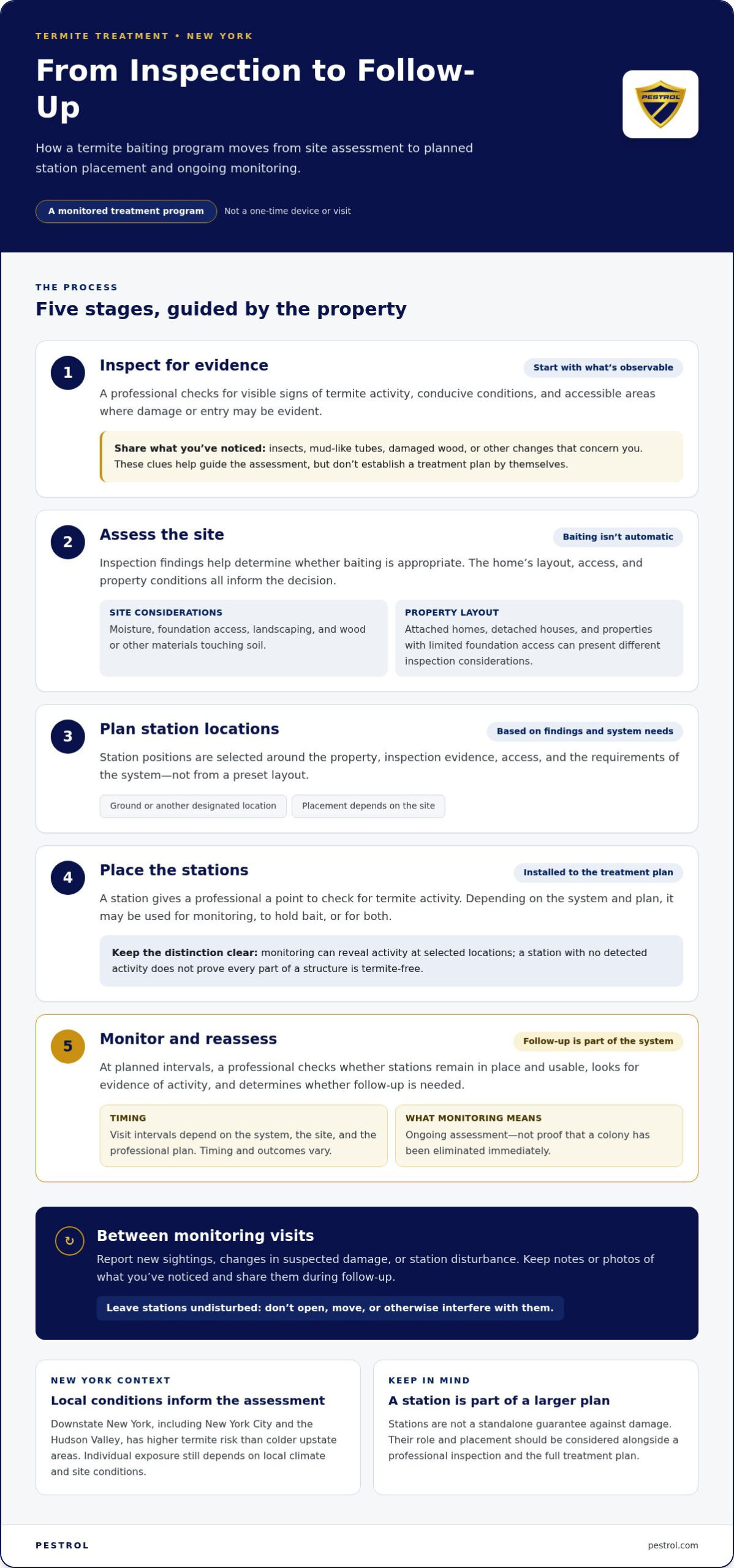
A baiting program starts with evidence, not a preset station layout. An inspection helps determine whether termites are active and whether baiting is appropriate for the property. A termite baiting program moves from inspection and site assessment to planned station placement and ongoing monitoring.
What happens during a termite inspection?
A professional looks for visible signs of termite activity, conditions that may support it, and accessible areas of the structure where damage or entry may be evident. Your observations matter too. Share where you’ve seen insects, mud-like tubes, damaged wood, or other changes that concern you. These clues help guide the assessment, but they don’t establish a treatment plan on their own.
Inspection findings inform the next step. Baiting may be considered, but it isn’t automatically suitable for every property or situation. The University of Kentucky Termite Baits Guide offers further background on how bait systems work and how they differ.
From assessment to follow-up
After the site has been assessed, station placement and service frequency can be planned around the property’s conditions and the inspection findings. A typical sequence includes:
- 1. Inspect: Look for signs of activity, conducive conditions, and accessible structural concerns.
- 2. Assess the site: Consider the home’s layout, access, and relevant findings to determine whether baiting fits.
- 3. Plan station locations: Select positions based on the site, inspection evidence, and system requirements.
- 4. Place stations: Install them in the selected locations according to the treatment plan.
- 5. Monitor and reassess: Return at planned intervals to check station condition and evidence of activity, then determine whether follow-up is needed.
Why monitoring and follow-up are part of the system
Stations are useful only as part of a plan that includes follow-up. During service visits, a professional assesses whether stations remain in place and usable, and whether they show activity. Monitoring is an ongoing assessment, not proof that a colony has been eliminated immediately. Visit intervals depend on the system, the site, and the professional plan. Timing and outcomes vary.
Between visits, report new sightings, changes in suspected damage, or station disturbance. Don’t open, move, or otherwise interfere with stations. Keep notes or photos of what you’ve noticed and share them during follow-up. Pestrol’s professional termite control service can help New York homeowners understand their treatment options.
Bait Stations vs. Other Termite Treatments: How New York Homeowners Can Compare
Baiting and liquid soil treatments take different approaches. A termite baiting system New York homeowners are considering should be compared with the property’s inspection findings, access, and follow-up needs, not judged by a one-size-fits-all rule. Attached homes, limited foundation access, landscaping, and construction details can all shape what’s practical.
When might a baiting approach be considered?
Bait stations may be considered when a professional determines that monitoring and targeted placement suit the site. Their locations and follow-up needs depend on the inspection and property constraints. Baiting can feel slow because it involves checking stations over time. A professional should interpret timing and signs of progress. A few quiet visits alone don’t establish whether treatment has succeeded.
How does baiting differ from liquid treatment?
In broad terms, bait systems use stations that termites encounter, with the bait intended to affect termite activity. Liquid soil treatments apply a termiticide to soil in areas selected as part of a treatment plan. Specific products and application details vary, so these descriptions aren’t a substitute for a site assessment.
| Comparison point | Bait stations | Liquid soil treatment |
|---|---|---|
| Mechanism | Stations provide monitored locations where termites may encounter bait. | Treatment is applied to soil to create a treated area around selected parts of a structure. |
| Monitoring needs | Ongoing checks are part of the approach. Visit intervals depend on the system and plan. | Follow-up and inspection needs depend on the product, site, and treatment plan. |
| Site considerations | Placement may be affected by access around the foundation, landscaping, and conditions found during inspection. | Application may depend on soil access, construction, and any preparation needed at the property. |
| Questions for a professional | Where would stations go, what will monitoring assess, and how should activity be reported? | Which areas would be treated, what access or preparation is needed, and what follow-up is planned? |
Use these differences to guide a discussion, not to diagnose the home yourself. For example, a narrow planting strip beside a foundation or a hard-to-reach section may affect where stations or soil treatment can be applied. Evidence of activity, the building’s construction, and site access all matter. A professional may recommend one approach, another, or a plan informed by the full inspection. There’s no universal winner. The goal is a treatment plan that fits the findings and can be properly carried out and monitored.
What New York Homeowners Should Do Before and During Termite Treatment
Preparing for an inspection doesn’t require special equipment. Clear access and useful observations help the professional understand what’s happening at your property and plan the next step. If a termite baiting system New York homeowners are considering is part of the plan, ongoing communication also helps make follow-up visits more informative.
How to prepare your property for an inspection
Before the visit, make accessible areas easier to inspect and gather notes about termite sightings or previous treatments. Point out concerns rather than trying to investigate hidden spaces yourself. Use this checklist:
- Share what you’ve seen: Note where and when you spotted insects, possible mud tubes, damaged wood, or other changes. Photos can help show what you observed.
- Flag moisture concerns: Mention leaks, damp areas, or places where water tends to collect.
- Point out soil and wood contact: Identify visible wood touching soil and landscaping close to the foundation.
- Explain access limits: Note areas that are difficult to reach, such as blocked storage spaces or sections of the foundation covered by plantings.
- Share property history: Provide details about earlier termite concerns, inspections, treatments, or relevant repairs.
Leave suspected evidence in place for inspection unless it creates an immediate safety concern. If you must move something, take a photo first and explain what changed. This preserves useful context without asking you to disturb a potential termite area.
What to expect while bait stations are monitored
During follow-up, a service professional checks the stations and considers what they show alongside any changes at the property. Those observations may inform the next step, but the number and timing of visits depend on the site and treatment plan. There’s no fixed resolution date that applies to every home.
Between visits, report new sightings, changes in suspected damage, repairs, landscaping work, or moisture conditions that have changed. Don’t open, move, or disturb stations. Follow the service professional’s instructions for the treatment plan. Keep a brief record of dates, locations, and photos of new signs so the information is clear at follow-up.
Pestrol provides termite control in Manhattan, the Bronx, and listed Orange County communities. For broader prevention ideas, explore home pest protection for New Yorkers.
Professional Termite Control in New York: Choose a Clear Next Step
Uncertainty about termites doesn’t have to leave you guessing. Start by confirming whether there’s activity, assessing the property, and choosing a professional treatment plan based on the findings. If you’re weighing a termite baiting system New York homeowners may use against another approach, an inspection grounds the decision in your home’s conditions rather than assumptions.
How professional termite control supports a considered decision
An inspection gives a professional a chance to review visible evidence, accessible structural areas, and site conditions that may affect treatment planning. Share where you’ve noticed activity, any past termite concerns or treatments, and changes such as repairs or moisture problems. Those details help shape an assessment of the property.
Clear communication matters at the next stage. You should understand what the inspection found, what treatment approach is recommended, and what follow-up may involve. Recommendations can differ because homes vary in construction, access, and evidence of activity. A baiting program may include ongoing monitoring, while other approaches have their own site and follow-up considerations. The aim is a plan that reflects the inspection, with expectations explained along the way.
Take the next step with Pestrol
Pestrol provides professional termite control in New York. As a family-owned and operated company, Pestrol takes a locally focused approach to helping homeowners understand their concerns and treatment options. Service areas include Manhattan, the Bronx, and multiple Orange County communities.
If you’ve seen signs that concern you, note where and when they appeared and arrange a professional assessment. You don’t need to determine the treatment method yourself. A thorough evaluation can help clarify what’s happening and guide a suitable plan, including whether baiting makes sense for the property. Pestrol can help you move from uncertainty to an informed next step, with communication focused on the inspection findings and the plan for your home.
Concerned about termite activity? Request professional termite control from Pestrol and take the next step toward understanding your home’s needs.
Take the Next Step Toward a Termite-Free Home
A termite baiting system New York homeowners consider should fit the inspection findings and the property, not be chosen by default. Bait stations are part of a monitored program, so follow-up matters and results aren’t instant. Liquid treatments work differently, and access, construction, and site conditions help shape a professional recommendation.
Start by confirming whether termite activity is present. Share your observations and property history, then review the assessment and treatment plan. Clear communication about monitoring and follow-up can help you understand what to expect and what to report.
Pestrol provides termite control in Manhattan, the Bronx, and listed Orange County communities. The communities served include Chester, Cornwall, Crawford, Goshen, Greenville, Highlands, Minisink, Monroe, Montgomery, Mount Hope, New Windsor, Newburgh, Palm Tree, Tuxedo, Wallkill, Warwick, Wawayanda, and Woodbury. If you’re concerned about possible termite activity, a professional assessment is a practical next step.
Frequently Asked Questions
How does a termite baiting system work?
A termite baiting system uses stations placed at selected locations and monitored over time. Depending on the system, stations may help detect termite activity, contain bait, or serve both purposes. When termites encounter bait, its active ingredients are intended to affect the colony, but the process requires follow-up assessment. Station placement and monitoring depend on the property, inspection findings, and treatment plan.
Are termite bait stations effective in New York?
They can be part of an effective treatment plan when inspection findings and property conditions make baiting suitable. The Eastern subterranean termite is a primary species of concern in New York, and its underground foraging behavior can make it susceptible to baiting. However, no approach fits every home. A professional should assess activity, access, and site conditions before recommending a termite baiting system in New York.
How long does a termite baiting system take to work?
There’s no single timeline that applies to every baiting program. Termites need to encounter the stations, and a professional must monitor activity and interpret what the stations show. The system, site conditions, and inspection findings can all affect the process. Baiting isn’t an instant fix, so ask for clear expectations about monitoring and follow-up, and report any new signs between visits.
Are termite bait stations better than liquid treatment?
Not universally. Bait stations rely on strategically placed stations and ongoing monitoring, while liquid soil treatments apply termiticide to selected areas of soil. Access, construction, landscaping, evidence of activity, and preparation needs can influence which approach is suitable. A professional assessment helps compare the options for your property. Focus on how each plan addresses the findings and what follow-up it involves.
Can I install termite bait stations myself?
Don’t assume a professional baiting system is a do-it-yourself project. Station placement, monitoring, and product directions matter, and New York regulates commercial pesticide application. Some general-use pesticides may be applied by homeowners, but professional-grade termite methods require commercial application by a properly licensed professional. For suspected activity, avoid installing or moving stations yourself and arrange a professional inspection to determine the appropriate next step.
What should I do if I find termites near my New York home?
Note where and when you saw them, take a photo if practical, and avoid disturbing possible evidence unless needed for safety. Arrange a professional assessment and share any past termite concerns, moisture issues, or repairs. Pestrol provides termite control in Manhattan, the Bronx, and Orange County communities including Chester, Cornwall, Crawford, Goshen, Greenville, Highlands, Minisink, Monroe, Montgomery, Mount Hope, New Windsor, Newburgh, Palm Tree, Tuxedo, Wallkill, Warwick, Wawayanda, and Woodbury.