




Could those tiny brown moths in your closet be harmless visitors, or are they putting your clothes at risk? A search for “tiny brown moths in closet Chester” often starts with that worry, especially when stored fabrics have unexplained holes or worn patches.
Pause before treating the whole closet. Adult moths can be difficult to identify at a glance, and it is the larvae, not the flying adults, that damage natural fibers such as wool and silk. Start by looking for supporting clues and possible sources.
This guide explains how to distinguish clothing moths from other small moths, where to check for larvae, cases, and fabric damage, and how to reduce likely sources in your closet. You’ll also learn when cleaning may be a useful first step and when persistent signs or an unclear source call for professional assessment. Pestrol serves Chester and offers specialized clothing moth control, so you can understand your options without jumping to conclusions.
Key Takeaways
- For tiny brown moths in a closet in Chester, use location and supporting clues rather than color alone to narrow down what you’ve found.
- Compare evidence in closets with signs around stored food to help distinguish clothing moths from pantry moths.
- Inspect undisturbed textiles, seams, folds, storage containers, and closet corners without emptying your entire home.
- Record what you find, check nearby materials, clean carefully, and monitor for further signs. Follow care labels before laundering or dry-cleaning fabrics.
- Repeated sightings, ongoing fabric damage, or an unknown source may be reasons to seek a professional assessment. Photos and notes about affected areas can help prepare for the conversation.
Tiny Brown Moths in a Closet in Chester: What the Sighting May Mean
Finding a small brown moth near your clothes can be unsettling, but its size and color alone can’t confirm that it’s a clothing moth. If you’re searching for “tiny brown moths in closet Chester,” treat the sighting as a clue, not a diagnosis. Different species can look similar, and a moth may have flown into the closet without breeding there.
Clothing moth larvae can feed on animal-based fibers. Adult moths don’t chew holes in clothing; their larvae do. Wool, silk, fur, and feathers can be at risk, so fabric damage or larvae provide more useful evidence than one adult moth flying past.
Reliable identification combines appearance, location, and evidence rather than relying on color alone. One sighting without fabric damage or larvae doesn’t establish an infestation. Repeated sightings, especially alongside holes, threadbare patches, or small cases on stored items, are stronger reasons to inspect carefully.
Which clues help identify a small brown moth?
Look closely at the wings, markings, and where the moth was resting, while keeping in mind that small moth species can resemble one another. The common clothes moth, for example, is described as having golden-buff wings and a reddish tuft of hair on its head. These details can guide a closer check, but they don’t identify every moth found in a closet.
If you can do so without handling it, take a clear photograph beside a familiar size reference, such as a coin placed nearby. A photo can support identification, but it can’t prove by itself that moths are breeding in your home or damaging clothing.
Why does the closet location matter?
Closets often hold wool garments, fur, feathers, and other animal-based materials that clothing moth larvae may feed on. That makes the area worth checking, but a moth near clothing doesn’t prove it developed there. It could have come from elsewhere in the home.
Before considering any pest treatment, examine nearby fabrics for damage and check for larvae or small cases. Focus on evidence linked to stored materials rather than reacting to a single adult moth. This measured first step can help you decide whether you’ve found an isolated visitor or a problem that needs closer attention.
Clothing Moths or Another Small Brown Moth? Check the Evidence
A small brown moth isn’t enough to identify the source. Compare where you see it with what’s nearby and whether there are signs of feeding. Pantry moths are more often associated with stored food, while clothing moth larvae can feed on certain textiles.
| Possibility | Where to look | Appearance and evidence |
|---|---|---|
| Clothing moth | Closets, stored garments, rugs, blankets, and other textiles | Some species are plain and buff-colored; others may have darker markings. Check for fabric damage, larvae, silk-like webbing, or small cases. |
| Pantry moth | Stored dry foods, such as grains or pantry goods | Look for signs around food storage, including webbing or larvae in food containers. A sighting near the pantry is more informative than color alone. |
| Other small moth | Windows, doors, lights, or areas away from stored fabrics and food | An adult may have entered from outdoors or be drawn to indoor light. Without more evidence, a general color description can’t confirm its species. |
An adult moth sighting shows that a moth is present; it doesn’t show that larvae are feeding on your fabrics. To check for possible clothing moth activity, inspect seldom-disturbed natural-fiber garments, rugs, blankets, and stored textiles. Look along seams and folds for irregular damage, larvae, fine silk-like material, or small cases. Treat each sign as a clue, not proof on its own. Fabric damage can have other causes, so consider its location and any related evidence nearby.
Could the moths be coming from somewhere else?
Check whether sightings cluster around dry-food storage, windows, doors, or lights, as well as the closet. An adult moth near clothing may have entered the room rather than developed among the garments. Note where you spot moths, then compare those observations with evidence on fabrics or near food. The University of California Agriculture and Natural Resources offers practical guidance on managing clothes moth problems, including inspection and control considerations.
If signs point toward clothing moths but the source remains unclear, Pestrol serves Chester and offers specialized clothing moth control. A professional assessment can help clarify what the evidence suggests before you decide what to do next.
Where to Look for Moth Larvae and Closet Damage in Your Chester Home
If you’ve spotted tiny brown moths in a closet in Chester, inspect nearby storage areas in a focused way. You don’t need to empty every room. Start with the closet where you saw the moth, then check textiles and containers that have stayed undisturbed. Your household’s own clues matter more than assuming a particular moth is common across Chester.
How should you inspect clothes and stored fabrics?
Use good lighting and check vulnerable items one at a time, especially wool, silk, fur, feathers, and other natural-fiber materials. Look along seams, hems, folds, and tucked-away edges. Inspect blankets, rugs, and stored garments too, then check container seams and closet corners. Maine’s guidance on identifying clothes moth damage can help you understand why suspected fabric damage deserves a closer look.
- Begin with items that have been stored or rarely handled.
- Look for irregular holes, worn patches, larvae, silk-like material, or small cases.
- Set any item with suspected damage aside for closer assessment. Don’t shake it near other stored fabrics.
- Follow the item’s care label before laundering or dry-cleaning it.
Damage alone doesn’t confirm moth activity. Note where it appears and check for other clues before drawing a conclusion.
What should you record before taking action?
Keep a simple record as you inspect. Note where you saw each moth, how often sightings occur, and which fabrics or storage areas show possible signs. Photograph the moth and any suspected damage in clear light. Include a familiar size reference beside the insect without handling it. Photos can help you compare observations or share details during a professional review.
- Record the room and approximate date of each sighting.
- List affected materials and where they were stored.
- Note recent changes, such as moving stored items or cleaning a closet, without assuming they caused the problem.
- Recheck the same locations to see whether signs are continuing.
Keep the inspection contained. Start where you saw the moth, then move to nearby closets or storage areas only if your observations point that way. This makes it easier to spot a pattern, preserve useful details, and choose a next step without disrupting the whole home.
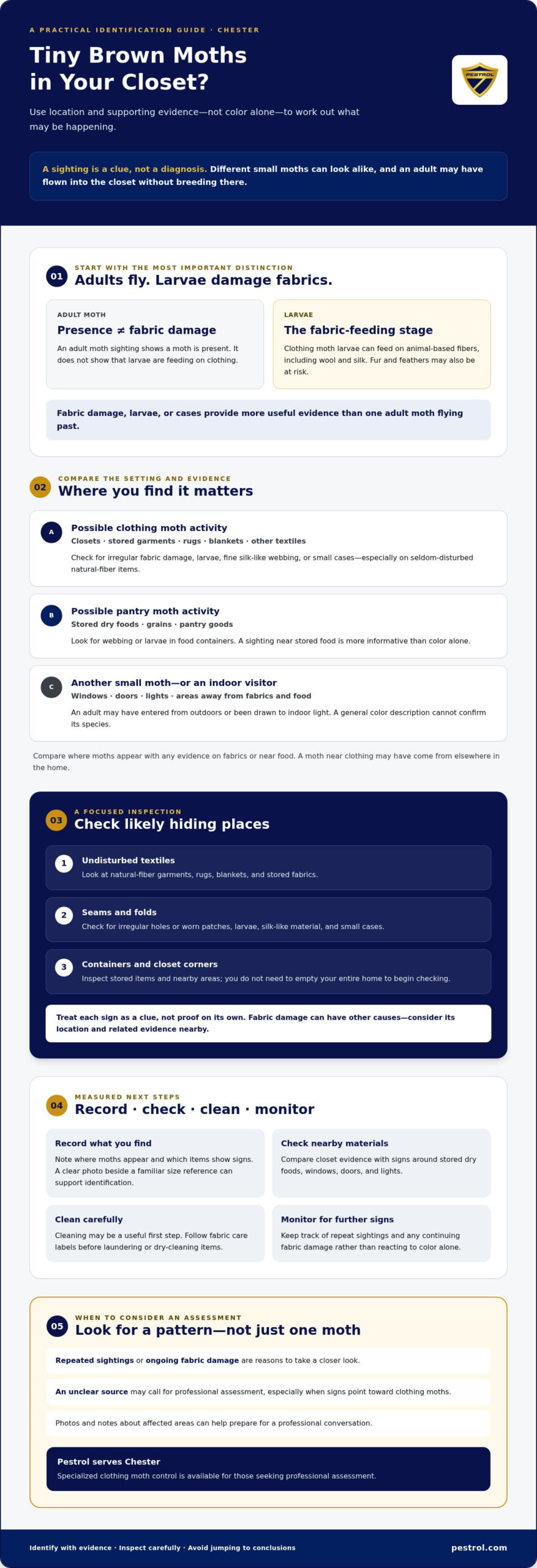
What to Do After Finding Tiny Brown Moths in a Closet
If you’ve found tiny brown moths in a closet in Chester, take a measured approach. Record what you saw, check nearby fabrics for related signs, clean appropriate areas, and monitor for changes. This sequence helps you respond to evidence without treating the whole home based on one moth.
- Document the clues. Note where and when you saw the moth, and photograph it or any suspected fabric damage. Record which materials or storage areas appear affected.
- Check nearby items. Inspect the closet contents and adjacent storage for larvae, cases, webbing, or new damage. Handle suspect textiles gently and keep them separate from other fabrics while you assess them.
- Clean suitable areas. Vacuum closet corners, shelf edges, and other appropriate surfaces. Empty the vacuum contents into a bag, seal it, and dispose of it promptly.
- Monitor the area. Keep track of further sightings or damage. Recheck the same locations to see whether signs are continuing.
Which first steps can you take safely?
For washable items, follow the care label and avoid shaking suspect fabrics near stored clothes. Launder or dry-clean affected items only if the label allows it. For valuable rugs or delicate furnishings that cannot easily be washed at home, professional textile care specialists such as Darcy Bespoke Cleaning demonstrate how expert deep-cleaning methods safely preserve vulnerable fibers. Clean shelves and storage surfaces using methods suitable for their materials. Once cleaned textiles are fully dry, place them in clean, closed containers to help protect them during storage.
When should you avoid a do-it-yourself treatment?
Don’t use an unidentified spray or apply any pesticide to clothing or storage areas unless its label specifically permits that use. Follow all label directions. One adult moth alone isn’t a reason to treat every room. If evidence persists, spreads to other storage areas, or remains difficult to identify, pause and seek professional guidance rather than escalating treatment based on guesswork.
If signs continue or you can’t locate the source, a professional assessment may help clarify what’s happening before you decide on next steps. Pestrol offers specialized clothing moth control and serves Chester.
When Chester Homeowners Should Call a Clothing Moth Professional
A professional assessment may help if moths keep appearing, fabric damage continues after careful cleaning, or you can’t locate the source. One moth alone may not indicate an infestation. Repeated signs around stored textiles, or uncertainty about whether the evidence points to clothing moths, can make expert guidance a practical next step. Pestrol serves Chester and offers specialized clothing moth control.
Before arranging a service conversation, gather photos of moths and suspected damage, the rooms and storage areas where you’ve seen signs, the materials affected, and what you’ve already cleaned or moved. These details give the professional a clearer starting point. You can also review guidance on choosing professional clothing moth exterminators as you consider what to ask.
What should you ask during a professional assessment?
Ask how the inspection will identify likely moth activity and determine which areas or materials may be affected. Find out what preparation is needed and whether any items require special handling. Before agreeing to proposed treatment, request a clear explanation of the approach, any follow-up that may be appropriate, and relevant safety directions. The conversation should help you understand the evidence and your options without assuming every moth sighting has the same cause.
How can you reduce the chance of another closet problem?
Store textiles clean and fully dry, and periodically check long-stored garments, blankets, and other vulnerable items. If you find signs again, focus on confirming and addressing the source rather than relying on a repellent or repeating a cleaning step without checking the results. Notes about where activity appears can help you spot a pattern early.
For broader prevention ideas, see this home pest protection guidance for New Yorkers. It offers a wider household perspective, while your own closet inspection should guide decisions about a possible clothing moth issue in Chester.
If tiny brown moths in closet Chester sightings continue, or the source remains unclear, contact Pestrol to discuss clothing moth control in Chester and what a professional assessment may involve.
Take the Next Step Toward a Moth-Free Closet
A moth’s size and color can’t confirm what it is. If you’re dealing with tiny brown moths in closet Chester, use the evidence around the sighting: check fabrics and storage areas for larvae, cases, webbing, or damage, and consider whether the moths may be coming from elsewhere. Clean carefully, follow garment care labels, and monitor the same areas for new signs.
Repeated sightings, continuing fabric damage, or a source you can’t identify are good reasons to consider a professional assessment. Sharing photos, affected materials, sighting locations, and cleaning steps can make that conversation more useful. Pestrol serves Chester and nearby communities, and offers specialized clothing moth control.
With a careful inspection and the right next step, you can protect stored fabrics and feel more confident about what’s happening in your home.
Frequently Asked Questions
Are tiny brown moths in my closet clothing moths?
Not necessarily. A small brown appearance alone can’t confirm the species. Check where the moths appear and inspect nearby fabrics for holes, larvae, or silk-like material. A clear photograph can support identification, but it doesn’t prove an infestation. The phrase “tiny brown moths in closet Chester” describes a concern, not a confirmed identification. Repeated sightings, fabric damage, or unclear signs are reasons to consider a professional assessment.
Can clothing moths damage clothes in a closet?
Yes, clothing moth larvae can damage susceptible materials, especially animal-based fibers such as wool, fur, and feathers. Adult moths are a visible clue, but larvae are the stage associated with feeding. Inspect stored garments and textiles for possible damage or other signs, but don’t assume every small moth has caused harm. If you clean a suspected item, follow its care label and use only a suitable laundering or dry-cleaning method.
How do I tell clothing moths from pantry moths?
Look at where you find the moths and which materials show signs. Clothing moth concerns are linked to susceptible textiles, while pantry moths are more often associated with stored dry foods. Their appearance can overlap, so color alone isn’t enough to identify them. Check nearby closets and cupboards for relevant evidence, then photograph the moth and any suspected damage. This gives you a clearer basis for deciding what to inspect or do next.
What should I do first if I find moths in my closet?
Photograph a moth if you can, note where and how often it appears, then inspect nearby stored fabrics for damage or possible larvae. Clean suitable closet surfaces, and handle suspect clothing according to its care label. Don’t spray garments or use a pest control product in a way its label doesn’t permit. If signs continue or you can’t locate the source, seek professional guidance before expanding your response.
Can I get rid of closet moths by washing my clothes?
Washing may help with some affected items, but a single wash isn’t a guaranteed solution for every fabric or situation. Check each care label and use an appropriate laundering or dry-cleaning method. Also inspect nearby textiles and storage areas for signs that may point to an ongoing source. If moth sightings or fabric damage continue after cleaning, consider a professional assessment to help identify the issue and discuss possible next steps.
When should I call a moth exterminator in Chester?
Consider professional help if sightings recur, fabric damage continues, or the source remains unclear after inspection. Before calling, gather photographs, note where moths appear, and list affected materials and cleaning steps. Pestrol offers specialized clothing moth control and serves Chester, Manhattan, Bronx, Cornwall, Crawford, Goshen, Greenville, Highlands, Minisink, Monroe, Montgomery, Mount Hope, New Windsor, Newburgh, Palm Tree, Tuxedo, Wallkill, Warwick, Wawayanda, and Woodbury.