




Could a room feel intensely hot and still leave bed bugs behind? Yes. Eggs or insects may be tucked into places that are hard to reach, so effective bed bug heat treatment depends on more than raising the temperature. Coverage, preparation, and follow-through all matter.
If you’re concerned about what to move, how to manage pets and belongings, or whether treatment will disrupt your home, a clear plan can help. This guide explains how heat treatment works, what can affect its effectiveness, and what to expect before and after professional treatment. You’ll also learn what heat can and can’t do, and why follow-up steps matter if activity continues or bed bugs are introduced later.
For New York residents, a suspected infestation is easier to address with a practical plan. Pestrol provides specialized bed bug treatment in Manhattan, the Bronx, and communities including Chester, Cornwall, Crawford, Goshen, Greenville, Highlands, Minisink, Monroe, Montgomery, Mount Hope, New Windsor, Newburgh, Palm Tree, Tuxedo, Wallkill, Warwick, Wawayanda, and Woodbury. Read on to understand the treatment considerations and decide on a sensible next step.
Key Takeaways
- Effective bed bug heat treatment depends on reaching treatment conditions throughout the target area, including places pests may hide.
- Room layout, clutter, and concealed hiding places can affect coverage, so assessment and preparation matter.
- Heat and other professional approaches have different preparation needs and limitations. The right plan depends on inspection findings and property conditions.
- Follow the treatment plan for clearing access, organizing belongings, and coordinating pets and household members.
- If signs persist or you’re unsure what you’re seeing, a professional assessment can help clarify the next step. Pestrol provides specialized bed bug treatment in Manhattan, the Bronx, and communities across its local service area.
What makes effective bed bug heat treatment different from ordinary heating?
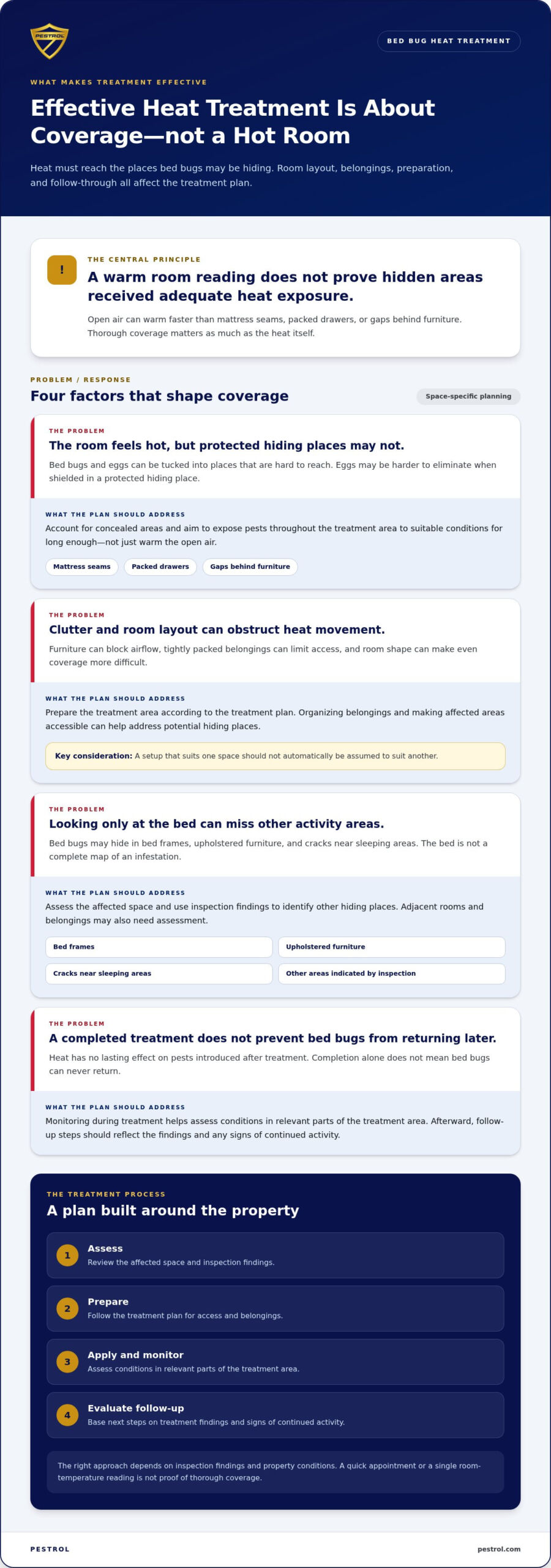
Turning up a thermostat or using a space heater warms a room, but it doesn’t create a controlled bed bug treatment. Professional heat treatment is a planned process that applies and checks heat across the areas where bed bugs may be hiding, rather than simply making a room feel hot. The aim is to expose pests throughout the treatment area to suitable conditions for long enough, including in places heat may not reach easily.
That distinction matters in a bedroom, where open air can warm faster than a mattress seam, packed drawer, or gap behind furniture. A warm room reading can’t show that every concealed spot received adequate exposure. Background on professional heat treatments describes building heat treatment as one approach among several. Its effectiveness depends on how the process is carried out in the specific space.
How heat affects bed bugs at different life stages
Bed bugs and their eggs may not respond identically to heat exposure. Eggs can be harder to eliminate when shielded in a protected hiding place, so heating an open area alone may not be enough. Treatment needs to account for likely hiding places, such as mattress seams, furniture joints, and cracks near sleeping areas. Coverage matters as much as the heat itself.
What “effective” means beyond a fast appointment
A quick appointment isn’t proof of a thorough result. Effectiveness depends on understanding the affected space, reaching relevant areas, and deciding whether further action is appropriate. Clutter, room layout, and items that block airflow can affect how heat moves. Preparation makes the treatment area more accessible, while professional judgment helps account for conditions that differ from home to home.
Completion also doesn’t mean bed bugs can never return. Heat has no lasting effect on pests introduced after treatment, so follow-up guidance and attention to signs of activity are part of a responsible plan. A fixed timeline or absolute promise can be misleading because conditions vary and new bugs may enter a treated space later.
How professional bed bug heat treatment reaches hidden infestation areas
Heat needs to reach the places bed bugs occupy, not just the open center of a room. A professional process generally starts with assessing the affected space, then preparing it, applying the selected treatment, and evaluating whether follow-up is appropriate. The plan should reflect the property and inspection findings. A compact bedroom, a cluttered apartment, and a multiroom home can present different coverage challenges.
Thorough coverage matters more than a quick room-temperature reading, because air can warm before heat reaches concealed hiding places. Furniture can block airflow, tightly packed belongings can limit access, and room shape can make even coverage more difficult. These conditions affect how heat moves, so the same setup shouldn’t be assumed to suit every infestation.
Where bed bugs may hide during treatment
Common places to consider include mattress seams, bed frames, upholstered furniture, and cracks near sleeping areas. These examples aren’t a complete list. Inspection findings may point to other hiding places or show that adjacent rooms and belongings also need assessment. Looking beyond the bed can help build a more complete picture of where activity may be occurring.
Why preparation and monitoring affect heat coverage
Excess clutter can obstruct access to potential hiding places and make it harder for heat to reach items and surfaces. Follow the treatment plan for organizing belongings and making affected areas accessible. The U.S. Environmental Protection Agency offers guidance on properly preparing your home; use it as a general reference alongside the instructions for your property and treatment.
Monitoring during treatment helps assess conditions in relevant parts of the treatment area instead of relying only on how warm the room feels. How that assessment is carried out depends on the treatment plan, so don’t assume a particular device or reading confirms coverage everywhere. Afterward, next steps should reflect the findings and any signs of continued activity.
Careful assessment and property-specific planning are central to effective bed bug heat treatment. Pestrol provides specialized bed bug treatment in Manhattan, the Bronx, and communities including Chester, Cornwall, Crawford, Goshen, Greenville, Highlands, Minisink, Monroe, Montgomery, Mount Hope, New Windsor, Newburgh, Palm Tree, Tuxedo, Wallkill, Warwick, Wawayanda, and Woodbury. Read about Pestrol’s bed bug treatment to learn more.
Heat treatment versus other bed bug treatments: what should you weigh?
Heat is one professional option, not a universal answer. It may be considered when a broad area needs treatment, while other plans may use targeted applications, repeat visits, or a combination of methods. The right approach depends on inspection findings and property conditions, including the extent of activity, room layout, and belongings that may need special handling.
Use this comparison to understand the trade-offs. These are general distinctions, not guarantees of a particular result.
| Approach | General considerations | What it does not guarantee |
|---|---|---|
| Professional heat treatment | Applies heat across a treatment area. Preparation and coverage matter, and belongings or property conditions may affect the plan. | It doesn’t prevent bed bugs from entering again or guarantee that untreated areas and later introductions are addressed. |
| Other professional treatments | May use targeted applications and may require follow-up visits. The plan depends on inspection results and where activity is found. | A treatment label or completed visit alone doesn’t prove every hiding place or future introduction has been handled. |
| Combined approach | Some plans may pair heat with another treatment or follow-up steps when the findings call for it. | Combining methods isn’t an automatic guarantee; the plan still needs to fit the property and infestation. |
When heat treatment may be a suitable option
Treatment of a broad area may be considered when inspection findings suggest activity across multiple areas. Suitability still depends on the property: room layout can affect coverage, belongings may need preparation, and the extent of the infestation can change which areas require attention. An effective bed bug heat treatment plan is specific to the situation, not a preset solution applied the same way in every home.
What heat treatment cannot promise on its own
Heat doesn’t create lasting protection against bed bugs brought into a property later. Treating one area also doesn’t automatically resolve activity in an adjacent room that wasn’t included. In apartments and shared buildings, nearby spaces may warrant attention based on inspection findings. Follow-up helps assess whether activity remains and whether additional steps are appropriate.
Be cautious of absolute eradication claims. Treatment can address an identified infestation, but no single method can promise that bed bugs will never return. A sound plan explains its scope, limitations, and follow-through without relying on a fixed timeline or blanket guarantee.
How to prepare a New York home or apartment for bed bug heat treatment
Good preparation helps make the treatment area accessible, but the right steps depend on the property and treatment plan. Follow the specific instructions for your home rather than relying on a universal checklist. This is especially useful in New York apartments, where room layouts, shared spaces, and building access can affect coordination.
What to do before the scheduled treatment
Use this checklist as a starting point, then follow the directions provided for your home:
- Confirm access. Arrange access to the rooms and areas included in the plan. Clear pathways to beds, furniture, and room edges so those areas can be reached.
- Reduce clutter as directed. Organize items that block access to likely hiding places. Don’t move belongings into another room or building unless your instructions say to do so.
- Follow directions for belongings. Use the specific guidance for clothing, bedding, electronics, and other household items. Don’t assume everything needs to be packed, laundered, or discarded.
- Plan for pets and household members. Follow the treatment plan for where people and pets should be during the process and when it’s appropriate to return.
- Coordinate apartment logistics. If you rent, communicate with property management about relevant access and household coordination. Share treatment instructions with anyone who needs to prepare or be away from the affected space.
Preparation can support effective bed bug heat treatment by making planned areas easier to access. It also helps prevent last-minute confusion about belongings or entry. Resolve unclear instructions before treatment day so everyone can follow the same plan.
What to expect after the treatment
Follow the re-entry and cleaning instructions for your treatment exactly. Don’t rely on general online advice to decide when to return or what to clean, since directions depend on the treatment and property. Keep the written guidance available for everyone in the household.
Afterward, watch for signs of continuing activity and note where and when you observe them. A single sighting doesn’t always tell the whole story, so avoid drawing conclusions from one clue alone. Share ongoing concerns with Pestrol and follow the recommended next steps. For broader context on treatment options and the process, read our professional bed bug treatment NYC guide.
Pestrol provides specialized bed bug treatment in Manhattan, the Bronx, and communities including Chester, Cornwall, Crawford, Goshen, Greenville, Highlands, Minisink, Monroe, Montgomery, Mount Hope, New Windsor, Newburgh, Palm Tree, Tuxedo, Wallkill, Warwick, Wawayanda, and Woodbury.
When to get professional bed bug treatment in Pestrol’s New York service area
Repeated sightings or signs near sleeping areas are good reasons to arrange a professional assessment. Looking for a pattern is more useful than trying to identify an infestation from one uncertain clue. An assessment can help distinguish bed bugs from other pests and clarify which areas may need attention.
When a professional assessment can clarify the next step
Consider an assessment if you’ve seen bed bugs more than once, found possible pest evidence around a bed or nearby furniture, or noticed suspected bites alongside other signs. Skin reactions alone can’t confirm bed bugs. People react differently to bites, and similar marks can have other causes. Share what you’ve observed and where you found it so the property can be assessed with the full context in mind.
Keep track of recurring sightings and where you notice signs. In an apartment, tell property management about the concern and coordinate access or communication for relevant areas. A clear assessment helps determine whether treatment is appropriate and which approach fits the findings. If you’re considering effective bed bug heat treatment, property layout and the extent of activity are part of that decision.
How Pestrol supports homes and property managers
Pestrol is a family-owned and operated pest management business providing specialized bed bug treatment. Treatment planning should reflect assessment findings and the needs of the property, rather than assume one method or setup suits every home. That matters in New York, where an affected space may be a private home, an apartment, or a managed property with shared access considerations.
Pestrol serves Manhattan, the Bronx, Chester, Cornwall, Crawford, Goshen, Greenville, Highlands, Minisink, Monroe, Montgomery, Mount Hope, New Windsor, Newburgh, Palm Tree, Tuxedo, Wallkill, Warwick, Wawayanda, and Woodbury. Repeated signs or evidence that concerns you are good reasons to seek professional assessment. It can help clarify what you’re dealing with and support an informed treatment decision, without relying on guesswork or a single symptom.
Take the Next Step Toward a Bed Bug-Free Home
Effective bed bug heat treatment is about more than warming a room. Thorough coverage, preparation suited to the property, and appropriate follow-up all help shape a well-considered treatment plan. Heat is one option, and the right approach depends on inspection findings, room layout, and the extent of activity.
If you’ve noticed repeated signs near sleeping areas, a professional assessment can help clarify what’s happening and what to do next. Follow treatment-specific instructions for preparing your home, handling belongings, and returning after service. These practical steps can help you feel more informed and in control.
Pestrol is a family-owned and operated pest management business offering specialized bed bug treatment in Manhattan, the Bronx, Chester, Cornwall, Crawford, Goshen, Greenville, Highlands, Minisink, Monroe, Montgomery, Mount Hope, New Windsor, Newburgh, Palm Tree, Tuxedo, Wallkill, Warwick, Wawayanda, and Woodbury.
A clear plan is a reassuring first step. You don’t have to manage the uncertainty alone.
Frequently Asked Questions
Is heat treatment effective for bed bugs?
Yes, effective bed bug heat treatment can address an infestation when treatment conditions reach the areas where bed bugs are hiding. Simply warming room air doesn’t confirm that concealed spots received adequate exposure. Effectiveness depends on assessment, preparation, coverage, and appropriate follow-up. Heat also doesn’t prevent new bed bugs from entering later, so watch for signs of activity and have ongoing concerns assessed.
Can heat treatment kill bed bug eggs as well as adults?
Professional heat treatment can kill bed bug eggs as well as adults when the eggs receive adequate heat exposure. Eggs may be tucked into protected hiding places, so heating open areas alone may not be enough. Thorough coverage matters. A treatment plan should account for likely hiding spots and the layout of the affected space, rather than relying only on how warm the room feels.
How long does professional bed bug heat treatment take?
There isn’t one reliable duration for every professional bed bug heat treatment. The time involved can depend on the size and layout of the treatment area, preparation, and conditions found during assessment. A larger or more complex space may require a different plan from a simple room. Follow the treatment-specific instructions for scheduling, leaving the area, and returning after treatment.
Is bed bug heat treatment safe for my home and belongings?
Safety depends on proper planning for the property, belongings, people, and pets. Some household items may need special handling during treatment, so don’t assume every item can stay in place. Tell the treatment professional about belongings or property features you’re concerned about, then follow instructions for moving or protecting items and for leaving and re-entering the home. Avoid using household heaters as a substitute for professional treatment.
Do I need to prepare my apartment before heat treatment?
Yes, prepare according to the specific treatment plan. You may be asked to clear access to beds, furniture, or room edges and organize items that could obstruct access. Don’t assume every item needs to be discarded, packed, or laundered. If you rent, coordinate relevant access and communication with property management, and share instructions with household members so everyone follows the same preparation and re-entry guidance.
What happens if I see a bed bug after treatment?
One sighting doesn’t automatically establish that treatment failed, but it’s worth documenting and reporting. Note where and when you saw the insect, and avoid moving potentially affected belongings into other rooms. Follow the post-treatment guidance and recommended next steps. A professional assessment can help distinguish ongoing activity from an isolated sighting and determine whether further attention is appropriate.
Can heat treatment work in a New York apartment building?
Heat treatment may be an option for an apartment, but suitability depends on the affected space, property conditions, and inspection findings. Building access and communication with property management may also matter, especially if nearby areas need assessment. Pestrol provides specialized bed bug treatment in Manhattan, the Bronx, Chester, Cornwall, Crawford, Goshen, Greenville, Highlands, Minisink, Monroe, Montgomery, Mount Hope, New Windsor, Newburgh, Palm Tree, Tuxedo, Wallkill, Warwick, Wawayanda, and Woodbury.