




Is that tiny dark speck on your mattress piping just a piece of lint, or is it the first warning sign of a costly infestation? It’s exhausting to lie awake at 2 AM, flashlight in hand, wondering if every itch is a bite or just your imagination. You aren’t alone in this worry. With New York City recently ranked as the second worst city for these pests in 2026, the anxiety of a hidden problem is something many of our neighbors face every night.
We understand that you want to protect your family and your budget from the stress of a full-blown outbreak. Identifying bed bug signs on mattress seams and fabric early is the most effective way to stay in control. This checklist will help you distinguish between common household debris and actual red flags. We’ll provide a clear visual guide and a step-by-step inspection routine so you can move from confusion to certainty. By the end of this guide, you’ll have the professional knowledge needed to secure your home and finally get a restful night of sleep.
Key Takeaways
- Understand the “host-proximity” instinct that keeps 70% of early infestations within a 15-foot radius of your bed.
- Master the “ink smear” test to accurately identify fecal spotting and other bed bug signs on mattress fabric.
- Learn to uncover hidden “nurseries” by inspecting high-risk areas like mattress piping and box spring dust covers.
- Build a simple forensic kit with household tools to perform a thorough, step-by-step inspection of your entire sleep environment.
- Recognize why specialized Bed Bug Treatment is necessary in New York to handle pests that have grown resistant to DIY sprays.
Why Your Mattress is Ground Zero for Bed Bug Signs
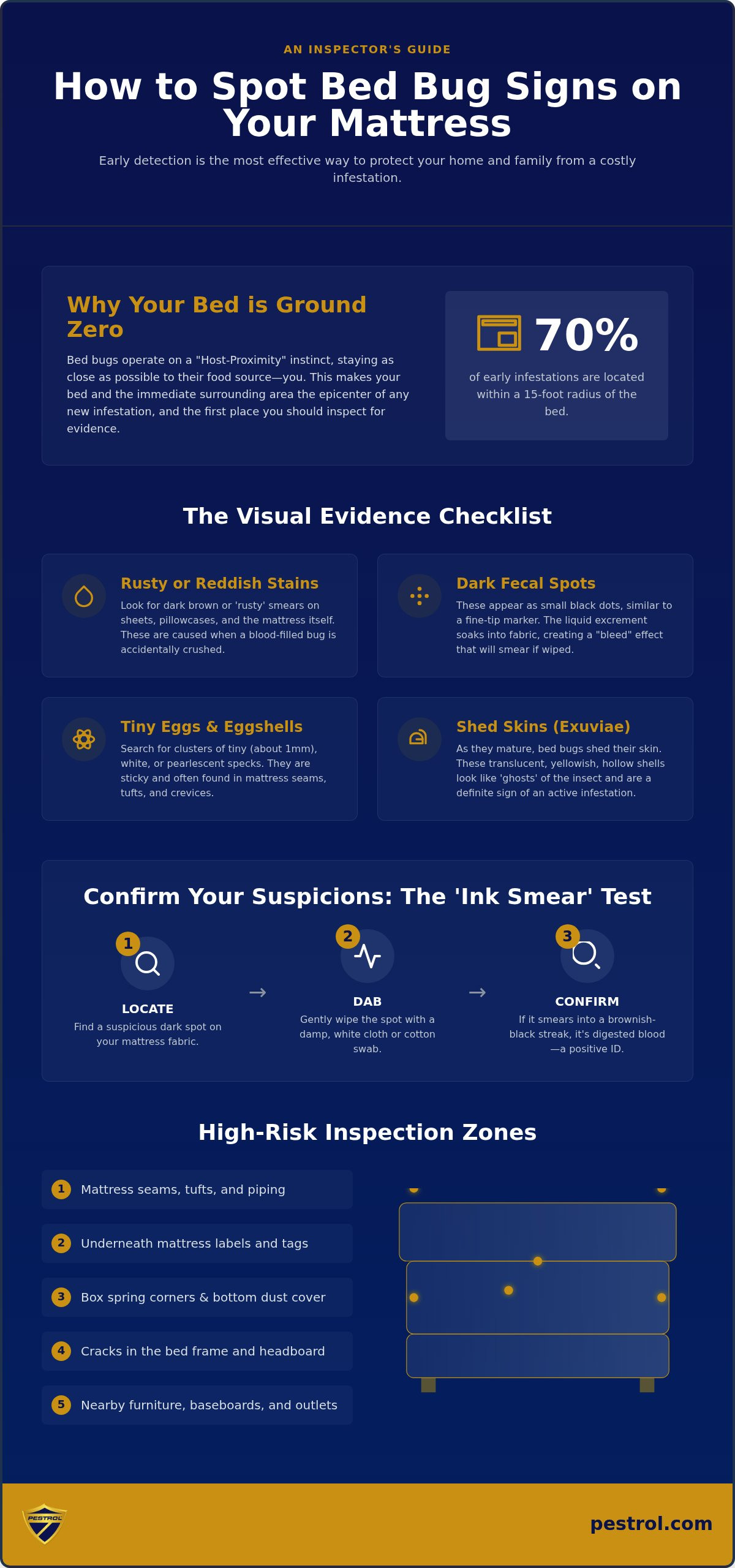
Your mattress isn’t just a place to sleep; it’s the epicenter of a bed bug’s world. These pests operate on a “Host-Proximity” instinct, meaning they prioritize staying as close to their food source as possible. Industry experts often observe that roughly 70% of early infestations are located within 15 feet of the bed. This short distance allows them to feed and return to safety quickly, minimizing the energy they spend and the risk of being crushed. Catching bed bug signs on mattress surfaces early is the only way to stop a small problem from turning into a building-wide crisis.
The construction of your bed also dictates where these pests hide. Traditional spring mattresses provide countless nooks within the piping and quilted fabric. In contrast, memory foam mattresses are denser, which often forces bugs to congregate in the external seams, zippers, or the bed frame itself. If you don’t spot these signals on the bed, the colony will eventually migrate to baseboards, bedside furniture, and even your window treatments. Acting now prevents that migration and protects the rest of your home.
The Biology of a Bed Bug Infestation
Bed bugs are biological heat-seekers. They use specialized sensors to detect the carbon dioxide you exhale and the body heat you emit while you rest. They prefer the textured surfaces of mattresses for egg-laying because the fabric provides grip and protection for their sticky, microscopic eggs. Because they follow a strict nocturnal cycle, they stay tucked away in dark crevices during the day. This behavior makes finding bed bug signs on mattress edges a forensic task. For those who want a comprehensive overview of bed bugs and their lifecycle, it’s clear that their survival depends entirely on staying hidden yet close to you.
NYC Apartment Dynamics: Why Your Mattress Isn’t an Island
In the densely packed neighborhoods of Manhattan and the Bronx, your mattress isn’t an isolated island. Infestations frequently travel through shared walls, electrical outlets, and floorboards between units. If a neighbor has an issue, your bed is the most likely destination for pests looking for a new host. Even in suburban Orange County townhomes, shared structural elements can facilitate this movement. A regular mattress check serves as your family’s first line of defense. Catching a problem here allows for targeted elimination before the pests spread through the walls and into other rooms.
The Visual Checklist: Identifying Bed Bug Signs on Mattress Fabric
Finding bed bug signs on mattress fabric requires a forensic mindset. You aren’t just looking for the insects themselves; you’re looking for the biological evidence they leave behind during their lifecycle. These signs are often the first red flags that appear before you ever see a live bug. By following a structured visual checklist, you can move from anxiety to action.
Rusty Stains and Crushed Insects
Reddish-brown smears on your sheets or mattress protectors are a classic warning sign. These spots usually occur when a bug is accidentally crushed during or after feeding. While fresh blood is bright red, these stains often appear “rusty” or dark brown because the blood has oxidized. Exuviae are the molted exoskeletons bed bugs leave behind as they mature. These translucent, hollow shells look like tiny, yellowish “ghosts” of the insect and are frequently caught in the fabric weave of your bedding.
Fecal Spotting and the ‘Marker Bleed’ Effect
Bed bug droppings are perhaps the most definitive evidence of an infestation. These look like tiny black dots, much like the mark from a fine-tip permanent marker. Unlike common household dirt, these spots exhibit a “marker bleed” effect where the liquid excrement soaks into the mattress fibers. You can perform a simple “ink smear” test by wiping the spot with a damp white cloth. If the dot smears into a dark brownish-black streak, it is digested blood and a clear indication of a problem.
Focus your search on the corners, along the seams, and especially under the mattress tag, where bugs love to hide. For more detailed locations, the EPA’s guide on How to Find Bed Bugs offers a great starting point. You should also look for egg clusters, which are tiny, white, grain-of-rice-sized specks often stuck to the fabric with a glue-like substance. If you discover any of these visual markers, it’s time to seek professional validation. A specialized Bed Bug Treatment plan can address the issue before these pests migrate to your furniture or shared walls. Early detection is your best tool for keeping your home safe and your costs low.
Hidden Bed Bug Signs on Mattress Seams and Box Springs
While the top surface of your bed might look clean, the most critical bed bug signs on mattress units are often tucked away in structural hiding spots. Bed bugs are thigmotactic, which means they have a biological drive to feel compressed on all sides. The “piping,” or the rolled fabric edges along the perimeter of your mattress, provides the perfect narrow channel for them to wedge into. If you don’t find evidence on the flat fabric, you must run a firm object along these seams to reveal hidden clusters. Don’t forget the mattress tag; this small piece of fabric is a notorious hiding spot for translucent eggs that are easily missed during a casual glance.
The bed frame itself requires a close look, especially where different materials meet. Wooden frames offer more natural pores and cracks for pests to inhabit, but metal frames aren’t immune. Pests frequently hide inside hollow legs or within the brackets where the rails meet. Check every screw hole and joint for dark spotting or live activity. These structural areas often harbor the colony’s core before it spreads to your baseboards.
Peeling Back the Layers: The Box Spring Inspection
The box spring is frequently the true nursery of an infestation. Most homeowners overlook the “dust cover,” which is the thin fabric stapled to the bottom of the box spring. Bed bugs often congregate on the interior side of this fabric or along the wooden frame it covers. You should look for “pepper-like” debris, which is a mix of fecal matter and shed skins, concentrated in the corners. Use a flashlight to peer into the gaps where the wood meets the fabric, as these dark recesses are where bed bug signs on mattress assemblies are most common.
The ‘Imposter’ Check: Bed Bugs vs. Carpet Beetles
Confusion often arises when homeowners find small, brown, shell-like fragments. It’s vital to distinguish between bed bugs and carpet beetles to avoid ineffective treatments. Carpet beetle larvae are covered in tiny hairs and leave behind bristly shell fragments. In contrast, bed bug nymphs are smooth, and their shed skins are translucent and shaped exactly like the insect. Misidentifying these pests can lead to using the wrong retail products. This mistake often frustrates homeowners and allows the real infestation to grow. If you’re unsure, professional validation is the only way to ensure you’re fighting the right battle.
How to Perform a Detailed Inspection for Bed Bug Signs on Your Mattress
Confirming an infestation requires more than a quick glance at your sheets. To get accurate results, you should approach the process like a forensic investigator. Before you begin, gather a “Forensic Kit” consisting of a high-lumen flashlight, a magnifying glass, and an old credit card. These simple household tools allow you to see microscopic evidence and reach into deep crevices that are otherwise inaccessible. Taking the time to perform a structured check can save you thousands of dollars in unnecessary treatments or, conversely, prevent a small problem from spreading through your entire New York home.
Step-by-Step Mattress Strip-Down
Start by removing your bedding slowly. If you rip the sheets off quickly, you risk scattering live bugs or eggs onto the nearby carpet and baseboards. Examine both sides of every pillowcase, sheet, and blanket as you move them to a sealed plastic bag. Pay close attention to your mattress protector. Even if it is marketed as “bed bug proof,” you must check for small tears or gaps in the zipper where pests might have squeezed through. Use your flashlight to scan for bed bug signs on mattress surfaces, specifically focusing on the corners where the fabric is gathered.
Tools of the Trade for Homeowners
The “Credit Card Swipe” is the most effective DIY technique for deep seam inspection. Insert the edge of the card into the mattress piping and drag it firmly along the channel. This action forces out hidden nymphs, shed skins, or fecal matter that is wedged deep within the fabric folds. Use your magnifying glass to inspect any debris you uncover; bed bug eggs are only about 1mm long and look like tiny, translucent grains of salt. Do not use high-heat DIY methods like hair dryers during your inspection. While heat is a professional tool, a hair dryer’s airflow is often strong enough to blow live bugs into your walls or electrical outlets, making the eventual cleanup much harder.
If you discover any evidence, document it immediately. Take high-resolution photos of the bed bug signs on mattress seams and any captured specimens. This documentation is vital for your exterminator to provide an accurate assessment and a targeted treatment plan. Clear photos help distinguish a minor localized issue from a more complex building-wide infestation.
Professional Bed Bug Treatment: Resolving Infestations in New York Homes
Identifying bed bug signs on mattress fabric is a vital first step, but how you react determines if the infestation ends or expands. Many New York homeowners instinctively reach for retail “bug bombs” or foggers. These products frequently fail because they don’t reach the deep structural gaps where the colony hides. Instead of solving the problem, a DIY approach often creates a cycle of frustration and wasted money. Professional intervention is the only way to ensure the pests are actually gone rather than just hiding deeper in your furniture.
The Danger of DIY in High-Density Areas
In the packed neighborhoods of Manhattan and the Bronx, shared walls and communal utilities turn a single bedroom issue into a building-wide threat. Retail chemical foggers often lack the power to kill modern, resistant bed bugs. Instead, the irritating chemicals trigger a “scatter response,” driving the pests through electrical outlets and baseboards into neighboring units. Professional-grade heat or specialized chemical protocols are necessary to penetrate the deep recesses where survivors wait. Without professional equipment, you’re merely pushing the problem into the walls rather than eliminating it. This migration makes future treatments more difficult and expensive for everyone in the building.
Pestrol’s Tiered Security for Peace of Mind
We approach every home with a protective guardian mindset, serving families from Monroe to Warwick with personal care. As a family-owned institution, we know that your home’s safety is non-negotiable. Our Home Pest Protection – Basic plan builds a proactive shield around your sleeping areas. By having a local expert visit your property in Goshen, Newburgh, or Wallkill for seasonal inspections, we can catch subtle bed bug signs on mattress tags or seams before they escalate. This early detection prevents the high costs and psychological stress of a widespread outbreak.
If your forensic inspection has already confirmed activity, don’t wait for the pests to migrate further. Transitioning from detection to a professional bed bug treatment NYC expert ensures the elimination is thorough and permanent. We use targeted protocols that prioritize your family’s health while ensuring no survivors remain to restart the cycle. Our team understands the unique layouts of local homes, from Chester townhouses to Manhattan high-rises. Scheduling a professional validation is the fastest way to stop the sleepless nights and secure your home against future outbreaks in 2026 and beyond.
Take Control of Your Sleep Environment Today
Mastering the forensic techniques mentioned in this guide gives you a massive advantage against these resilient pests. Identifying early bed bug signs on mattress seams and piping allows you to act before the colony migrates into your floorboards or neighboring apartments. Early detection is the primary difference between a simple localized treatment and a complex building-wide recovery.
As a family-owned and operated institution, Pestrol understands the unique challenges of New York living. We’ve spent decades perfecting specialized NYC apartment treatment protocols that prioritize your family’s safety and peace of mind. Our team proudly serves Manhattan, the Bronx, and Orange County with the personal care of a local neighbor and the authority of a seasoned guardian. We’re ready to help you move from anxiety to a clear, effective resolution.
You don’t have to face this challenge alone. Take the final step to reclaim your bedroom and ensure a restful, pest-free night for your family.
Frequently Asked Questions
What do bed bug stains look like on a mattress?
Bed bug stains typically appear as reddish-brown smears or dark, ink-like spots. The reddish smears often occur when a bug is accidentally crushed shortly after feeding. The darker dots are fecal matter, which looks like a fine-tip permanent marker has bled into the fabric. If you’re in a Manhattan apartment, these marks are often found near the headboard or along the mattress seams where bugs congregate between feedings.
Can you see bed bugs with the naked eye during the day?
Yes, adult bed bugs are visible to the naked eye and are roughly the size of an apple seed. However, they are nocturnal and highly skilled at hiding in dark crevices during daylight hours. You’re much more likely to see evidence like shed skins or fecal spotting than a live bug during the day. In areas like Goshen or Warwick, a thorough inspection of the bed frame’s joints is often required to find them.
Are tiny black dots on my mattress always bed bugs?
Not every dark speck is a sign of an infestation, but tiny black dots are a major red flag for bed bug signs on mattress fabric. To verify, try the damp cloth test. If the dot smears into a reddish-brown streak when wiped, it is likely digested blood from a bed bug. Other possibilities include mascara or charcoal dust, though bed bug fecal spots have a distinct “marker bleed” texture that soaks into fibers.
How do I tell the difference between bed bug signs and dust or lint?
You can distinguish bed bug evidence from common debris by its “stickiness” or how it interacts with the fabric. Dust and lint are easily brushed away or blown off the surface. Bed bug eggs are glued to the mattress fibers with a sticky substance, and fecal spots soak into the material like ink. If the debris doesn’t move easily when you swipe it with a credit card, it’s time for a professional evaluation.
Should I throw away my mattress if I find signs of bed bugs?
No, you don’t need to throw away your mattress in most cases. Modern Bed Bug Treatment protocols are designed to eliminate pests from within the mattress and bed frame. Discarding furniture can actually spread the infestation through your Bronx or Manhattan building as you move the item through hallways. Instead, use a high-quality mattress encasement after a professional treatment to seal any remaining pests inside and prevent new ones from entering your sleep environment.
Can bed bugs live on a memory foam mattress or just spring ones?
Bed bugs can inhabit both memory foam and traditional spring mattresses. While they can’t burrow through solid foam, they find plenty of hiding spots in the zippers, seams, and mattress covers. In Orange County homes, we often find them tucked into the small gap between the foam and the bed frame. Their “host-proximity” instinct keeps them close to you regardless of what material your mattress is made of, making every bed vulnerable.
How long after a bite do signs show up on the mattress?
Some signs appear immediately, while others take a few days to become noticeable. A crushed bug might leave a rusty blood stain on your sheets the same night you’re bitten. Fecal spotting usually appears within a few days as the bug digests its meal. Because these pests are elusive, homeowners in New Windsor often don’t notice the buildup of evidence until the population has grown for several weeks or even months of active feeding.
What is the very first sign of bed bugs on a bed?
The very first sign is often fecal spotting, which appears as tiny, dark dots on the sheets or mattress piping. Many residents in the Bronx also report unexplained, itchy red welts on their skin as an early warning. Because these welts can be confused with mosquito bites, the physical evidence of bed bug signs on mattress seams is the most reliable way to confirm you have an active problem that requires professional intervention.