



A roach sighting can put a restaurant’s kitchen and reputation under pressure. Response timing from a restaurant roach exterminator in NYC depends on the restaurant’s location, access to affected areas, and the scope of the problem. A sighting alone doesn’t determine a fixed arrival time.
It’s reasonable to want help quickly, especially when roaches or rodents appear near food, storage, or preparation areas. This guide explains what can affect a pest-control response, how integrated pest management addresses both the infestation and conditions that attract pests, and what restaurant teams can do in the meantime.
You’ll also learn how roach and rodent control fits into ongoing restaurant pest management, why prevention and follow-up matter, and which nearby areas are served. The aim is to make the next steps clear, so you can respond calmly and protect your food-service space.
Key Takeaways
- Response timing depends on the restaurant’s location, access to affected areas, and the scope of the pest problem.
- Learn how roaches and rodents can threaten food areas, and which sanitation and storage practices help reduce pest attraction.
- See how integrated pest management combines treatment with attention to entry points and conditions that support infestations.
- Understand why ongoing monitoring and follow-up matter for restaurant pest control, not just a one-time response.
- Explore Pestrol’s Home Pest Protection options and how they relate to pest concerns beyond a restaurant setting.
How soon for pest control in New York City, NY?
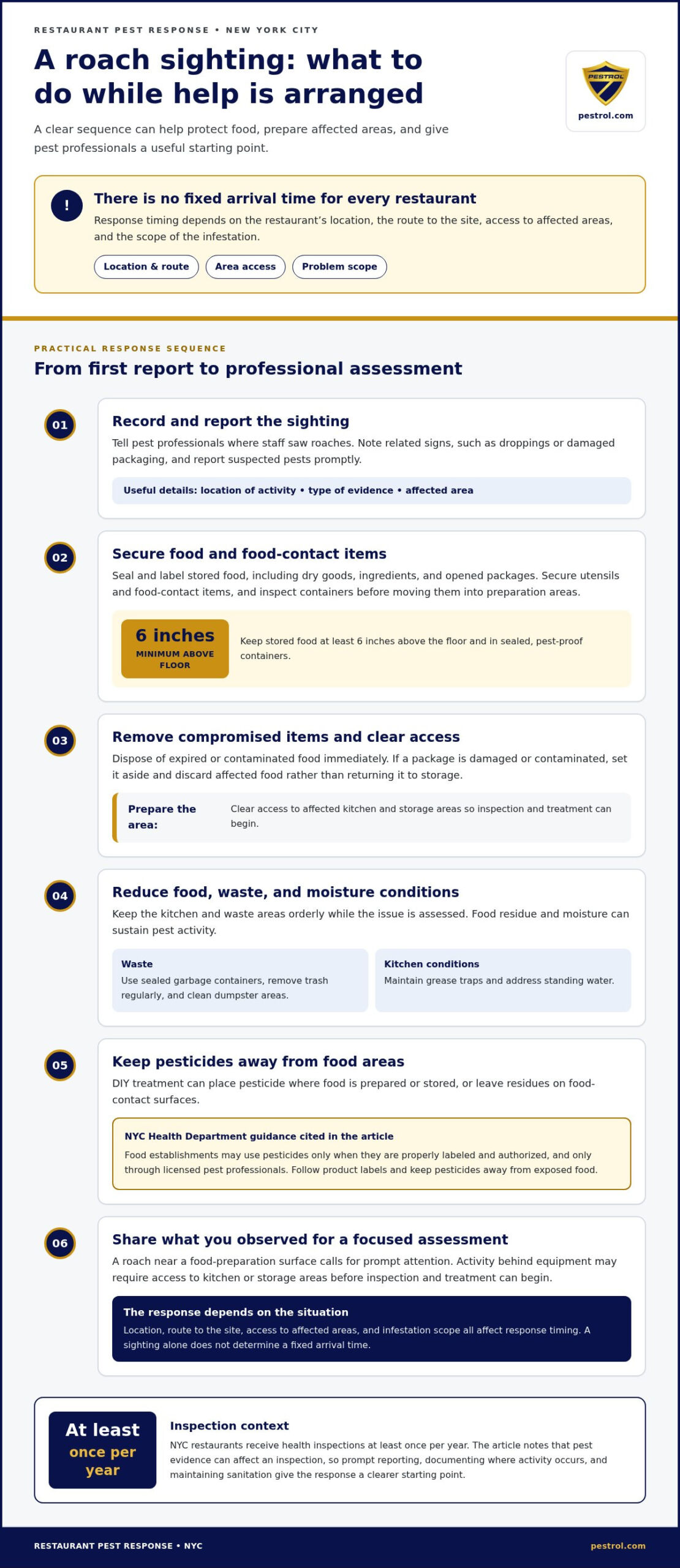
There isn’t one arrival time for every New York City restaurant. Response timing depends on the restaurant’s location, the route to the site, access to affected areas, and the scope of the infestation. A roach near a food-preparation surface calls for prompt attention; activity behind equipment may require access to storage or kitchen areas before inspection and treatment can begin.
While arranging professional help, protect food and reduce conditions that attract roaches. Store food in sealed, pest-proof containers, and keep it at least 6 inches above the floor. Dispose of expired or contaminated food immediately. These steps limit access to food and help prevent pests from spreading contamination through droppings, urine, or filth.
Keep the kitchen and waste areas orderly during the response. Use sealed garbage containers, remove trash regularly, and clean dumpster areas. Maintain grease traps and address standing water, since food residue and moisture can sustain pest activity. Staff should report suspected pests promptly and follow proper food-handling and cleaning practices while the issue is assessed.
- Seal and label stored food containers.
- Remove expired or contaminated items.
- Clear access to affected kitchen and storage areas.
- Keep waste sealed and remove it regularly.
To prepare a restaurant kitchen for roach extermination, secure food, utensils, and food-contact items, then clear access to areas where activity was seen. Tell the professionals where staff found roaches and note related signs, such as droppings or damaged packaging.
DIY roach treatment can put pesticide where food is prepared or stored, or leave residues on food-contact surfaces. The NYC Health Department says food establishments may use pesticides only when they’re properly labeled and authorized, and only through licensed pest professionals. Follow product labels and keep pesticides away from exposed food.
Protect food during ongoing pest management, too. Keep dry goods, ingredients, and opened packages sealed between shifts, and inspect containers before moving them into preparation areas. If a package shows damage or contamination, set it aside and dispose of affected food rather than returning it to storage.
NYC restaurants receive health inspections at least once per year, and pest evidence can affect an inspection. Reporting sightings quickly, documenting where they occur, and maintaining sanitation gives the response a clearer starting point. These actions support safer food handling while professionals investigate the source and treat affected areas.
Common restaurant pests, including cockroaches
Cockroaches, mice, rats, flies, fruit flies, ants, and stored-product insects can affect New York food-service spaces, and each pest leaves different clues. Roaches may appear near warm equipment or in cracks; mice may leave droppings around storage areas; fruit flies can gather near drains or produce. Identifying the pest from the evidence helps professionals target treatment instead of treating every sign as the same problem.
Cockroaches matter beyond the sighting itself. Their droppings and body parts can affect indoor air quality and trigger allergic reactions or asthma attacks in some children and adults. A roach found near a prep counter also signals a need to inspect nearby equipment gaps, shelving, and food storage. New York City inspection code 4M assigns Condition Level V when inspectors find 20 or more live roaches, while one live cockroach during an inspection carries 28 points.
Rodents create a separate set of risks. Droppings in a food-storage area can signal that pests have reached ingredients or packaging. NYC inspection code 4L assigns Condition Level V when a restaurant has two or more live mice or more than 100 fresh mice droppings. Code 4K assigns Condition Level V for three or more live rats or more than 100 fresh rat droppings. These examples show why inspection should cover storage, equipment edges, and less visible spaces.
Targeted restaurant pest control starts by identifying activity and likely access routes. Professionals can inspect cracks, gaps around pipes, spaces behind equipment, and locations where staff have seen pests. For roaches, gel baits can be placed in cracks and crevices, with dust applied inside wall voids behind equipment. This focuses treatment on harborage areas, away from open food and active preparation surfaces.
Rodent control also requires attention to entry points and food sources. A mouse seen beside a wall may be traveling along an edge or entering through a gap near a utility line. Inspection can help distinguish that route from activity around stored goods. Repairing openings and monitoring signs support treatment by reducing access and showing whether activity continues.
Not every insect sign calls for the same response. A fly near a drain, ants around a spill, and roaches behind a refrigerator point to different conditions. Record the location and type of evidence, then share those details with pest professionals. A focused inspection can connect sightings, droppings, and damaged packaging to likely problem areas, making follow-up more useful than treating a single visible pest.
NYC residents should report pests and conditions that attract them, including leaks, cracks, holes, and clutter in common areas, to the building owner.
NYC Health Code §81.23 is cited as requiring restaurants to remain free of rodents, insects, and other pests. A single pest-activity violation can lower a New York City restaurant’s health inspection letter grade and trigger re-inspection fees. Rodent droppings in food storage areas and evidence of cockroach activity can be relevant to restaurant inspections.
NYC restaurant cockroach and rodent control
Effective control combines targeted treatment, sanitation, and repairs to help prevent pests from returning. In New York City, food safety and inspection compliance depend on addressing activity throughout the restaurant.
Treatment Methods and Food Safety
Targeted treatment places pest-control methods where activity occurs while protecting food, equipment, and preparation surfaces. This matters because cockroach treatment must not contaminate food-service areas. The New York City Department of Health and Mental Hygiene says food establishments may use pesticides only when properly labeled and authorized, and only through licensed pest professionals. Keep exposed food and utensils protected during treatment.
Integrated pest management connects inspection findings with practical controls. A professional can identify roach harborages, rodent routes, and conditions that support activity, then select methods for those locations. Restaurants should minimize chemical treatments in food-preparation areas and follow pesticide label directions. For example, a gap behind kitchen equipment calls for attention to that harborage and opening, not indiscriminate application across a counter.
Flies require a different response from cockroaches. Staff can remove food residue, clean drains, and address moisture that attracts flying insects. Traps may help monitor activity, but they don’t replace sanitation or source control. Note whether flies gather near produce, waste, or drains; their locations can help professionals identify contributing conditions.
Preventing Kitchen Cockroaches
Prevention means reducing the food, water, shelter, and entry points that allow cockroaches to persist. Treatment alone can leave conditions that support renewed activity. Seal cracks and gaps around pipes, fit door sweeps, and maintain intact window screens. Keep dry goods in closed storage and clean spills beneath shelves and equipment.
For rodents, inspect utility-line openings and exterior gaps, then maintain physical barriers. Keep waste areas clean and remove food debris that could attract pests. Record sightings by location, such as a mouse near a delivery entrance or roach activity beside a refrigerator. These observations help distinguish an entry route from a kitchen harborage.
Routine prevention also requires follow-through. At the New York City Department of Health and Mental Hygiene’s request, food-establishment permittees must provide a contract for at least monthly preventive pest inspections and services. Keep inspection reports and corrective-action records organized, then address findings such as damaged screens or unsealed openings. Consistent documentation supports compliance and helps teams track whether control measures are working.
Rodent monitoring stations can help reveal activity along walls or near service areas. Place them where staff can inspect and record findings without obstructing food preparation. Pair monitoring with repairs and sanitation, since stations alone don’t close an entry point or remove an attractant. A recurring sign near a loading area, for instance, calls for attention to both the route and nearby waste handling.
Service areas in New York City and nearby regions
Service-area planning starts with the restaurant’s exact address and the location of the pest issue. Manhattan and the Bronx are among the targeted New York City areas, with nearby communities also included.
Coverage Across NYC Boroughs
In New York City, Manhattan and the Bronx are the boroughs specifically included in the local service area. Sharing the full street address helps identify the site and plan for building access. That matters in dense commercial areas, where a service entrance, shared corridor, or restricted loading area can affect how professionals reach the restaurant.
For example, a restaurant in Manhattan may use a service entrance rather than its public storefront. Provide the borough, exact address, entrance instructions, and affected rooms when arranging service. Note whether staff found roaches, rodents, droppings, or possible contamination, and identify areas such as the kitchen, storage room, or waste space.
Every property has its own layout and conditions. A basement storage room, loading area, and exterior waste space create different inspection priorities. Integrated pest management uses site-specific observations to inform inspection, treatment, prevention, and follow-up. The restaurant’s address helps orient the response, while evidence inside and around the building guides the work.
Nearby Restaurant Service Areas
Nearby service locations include Chester, Cornwall, Crawford, Goshen, Greenville, Highlands, Minisink, Monroe, Montgomery, Mount Hope, New Windsor, Newburgh, Palm Tree, Tuxedo, Wallkill, Warwick, Wawayanda, and Woodbury. Naming the municipality alongside the street address helps distinguish a nearby regional site from a Manhattan or Bronx restaurant.
For a restaurant close to a municipal boundary, provide the complete address rather than relying only on a neighborhood name. Precise location details help organize travel and distinguish local health-department jurisdictions and inspection standards. Keep those details separate from pest observations, which should identify the affected room and evidence found.
For an urgent concern, describe the pest, affected area, and any inspection finding. A roach sighting near food preparation differs from rodent droppings in storage, so concise details help professionals understand the issue. Share relevant records and access instructions, too. This information supports practical service planning without assuming every nearby address has the same route or site-access process.
Restaurants can also note building conditions that may relate to recurring activity, such as cracks, damaged door sweeps, standing water, or waste areas. Connecting those observations with the site address helps frame an integrated pest management response around the property. Clear location and condition details make follow-up more organized for restaurants across the stated service area.
NYC commercial roach extermination services and coverage areas
A commercial roach response starts with the restaurant’s address, affected areas, and evidence of pest activity. These details help shape inspection and treatment planning for a Manhattan and Bronx food-service site.
Share the exact location, including borough, street address, and entrance instructions. Then describe where staff found roaches, such as near a dishwashing area, dry storage, or a delivery entrance. Report whether anyone has seen live insects, droppings, egg cases, or damaged packaging. These observations help distinguish a localized sighting from activity that may involve several rooms.
Planning also depends on how the building can be accessed. A restaurant inside a shared commercial property may require directions to a service entrance or coordination around kitchen access. A street-level dining room may have different inspection needs from a basement kitchen. Identify restricted areas, food-storage rooms, and equipment that blocks access so the inspection can account for the premises, not just the visible sighting.
For New York City restaurants in Manhattan and the Bronx, describe the affected site clearly, even if the business operates multiple locations. For example, a restaurant with one kitchen in the Bronx and another in Manhattan should provide each address separately. Pest activity and building conditions can differ between sites, so reports should identify the location, room, date observed, and corrective work already completed.
Nearby regional coverage also requires a precise location. State the municipality and address rather than relying on a neighborhood name that could refer to more than one area. Keep service-area information separate from health-department jurisdiction: an address near a city boundary may involve different local procedures and inspection contacts. Accurate location details help avoid confusion when organizing commercial pest work.
Urgent reports should focus on operational facts. If a restaurant has a health inspection finding, share the violation details and any corrective-action deadline shown in its records. If staff found roaches beside exposed ingredients, identify the affected food area and steps taken to protect the food. This information helps professionals understand the immediate concern and plan an appropriate visit without confusing an inspection issue with routine prevention.
Commercial treatment is only one part of ongoing control. A useful service plan connects inspection observations with treatment locations, entry-point repairs, sanitation practices, and follow-up records. For example, recurring sightings near a loading area should prompt attention to that route and nearby conditions, not just the kitchen interior. Keep treatment logs, inspection reports, and corrective-action notes together for clearer follow-through.
Prepare a concise site summary before arranging service: address, access details, pest evidence, affected rooms, and relevant inspection records. That summary helps organize a restaurant pest response across Manhattan, the Bronx, and nearby communities while keeping the focus on the specific property and its needs.
Pestrol: Home Pest Protection – Basic
Pestrol’s Home Pest Protection – Basic is for household pest concerns, not a restaurant kitchen issue. If pests are also affecting your home, this plan offers a residential way to address that separate concern. Home Pest Protection – Plus and Home Pest Protection – Premium are additional options for home protection.
For a bed bug problem at home, Pestrol also offers Bed Bug Treatment. Keeping household and restaurant concerns distinct helps direct each issue to the relevant service. Share the details of your home pest concern with Pestrol to discuss the available option that fits.
Contact Pestrol to talk about home pest protection.
Take the next step toward a pest-ready restaurant
Use your pest observations to start a focused conversation: note where activity appeared, what staff found, and which areas need attention. Clear details help frame the problem and practical next steps for your food-service space.
When you need a restaurant roach exterminator in NYC, Pestrol’s restaurant pest control is a relevant next step for roach concerns in a commercial kitchen. Share the restaurant’s location and the conditions affecting your operation.
A calm, organized response helps your team move forward with confidence and keep prevention part of daily operations. For restaurant owners who also need to manage customer communications and maintain a strong brand presence online, platforms like fismbot.com offer AI-powered email and social media content tools to help keep marketing running smoothly.
Frequently Asked Questions
Do I need a monthly pest control plan or is a one-time treatment enough?
Monthly prevention suits ongoing restaurant needs; a one-time treatment addresses current activity but doesn’t replace preventive inspections. At the New York City Department of Health and Mental Hygiene’s request, food-establishment permittees must provide a contract for at least monthly preventive pest inspections and services. Recurring visits can also help staff track new signs and document corrective work as conditions change.
What happens if the pests come back after treatment?
If pests return, contact Pestrol and describe where and when activity reappeared. Pestrol’s stated service warranty is: “WE KEEP COMING BACK AT NO COST UNTIL PEST ARE GONE.” Keep a record of new sightings, including the room and nearby conditions, so follow-up can focus on where activity has resumed.
Will I get the same technician each time?
Not necessarily. Technician assignments can vary, so keep a consistent site record available for each visit. Note the areas inspected, treatment locations, pest evidence, and repairs still needed. For example, a log showing repeated roach sightings beside one cooler helps the visiting professional understand the pattern and continue the investigation without relying on staff memory alone.
How quickly can an NYC exterminator treat a restaurant for roaches?
There isn’t one fixed arrival time for every restaurant. A restaurant roach exterminator in NYC schedules a response around the address, route, site access, affected areas, and scope of activity. A report identifying roaches near food preparation, storage, or a documented inspection finding gives the service team useful context for planning.
How to choose a licensed commercial pest control company in New York City
Choose a licensed pest professional who uses integrated pest management and EPA-approved methods, minimizes chemical treatment in food-preparation areas, and provides service contracts, treatment logs, inspection reports, and corrective-action records. NYC food establishments may use pesticides only when properly labeled and authorized and applied by licensed professionals.
Best restaurant cockroach exterminators in NYC
Choose a licensed pest professional who uses integrated pest management and targeted treatment. Pestrol says it offers same-day emergency dispatch for restaurant pest problems, including a DOH violation.