




What if bite marks that look convincing still can’t tell you which pest caused them? When identifying bed bug bites vs mosquito bites, it’s natural to focus on shape, redness, or itchiness, but skin reactions vary and can look alike. Patterns and timing offer clues, not a definite answer.
Bed bug bites may appear in clusters or lines on skin exposed during sleep, sometimes hours or days after the bite. Mosquito bites often appear as scattered welts after time outdoors, though mosquitoes can also bite indoors. These differences may point you in a direction, but they don’t confirm what’s happening in your home.
This guide compares bite patterns and timing, then explains how to look for stronger evidence, such as blood spots, dark specks, shed skins, or live bed bugs near sleeping areas. You’ll also learn what to do next, from keeping a record to inspecting carefully and arranging professional bed bug treatment when room evidence supports concern. An evidence-based check can help you choose a sensible next step without jumping to conclusions.
Key Takeaways
- When identifying bed bug bites vs mosquito bites, treat appearance and bite patterns as clues, not confirmation.
- Timing and exposed skin areas can help you assess the possibilities, but neither gives a definitive answer.
- Look for possible signs around the bed and nearby furniture. A single mark or object may not prove bed bug activity.
- Record when bites appear, photograph changes, and inspect sleeping areas carefully without disturbing furniture or spreading belongings.
- Repeated physical signs or a suspected bed bug make professional assessment and targeted treatment sensible next steps.
Identifying Bed Bug Bites vs. Mosquito Bites by Appearance
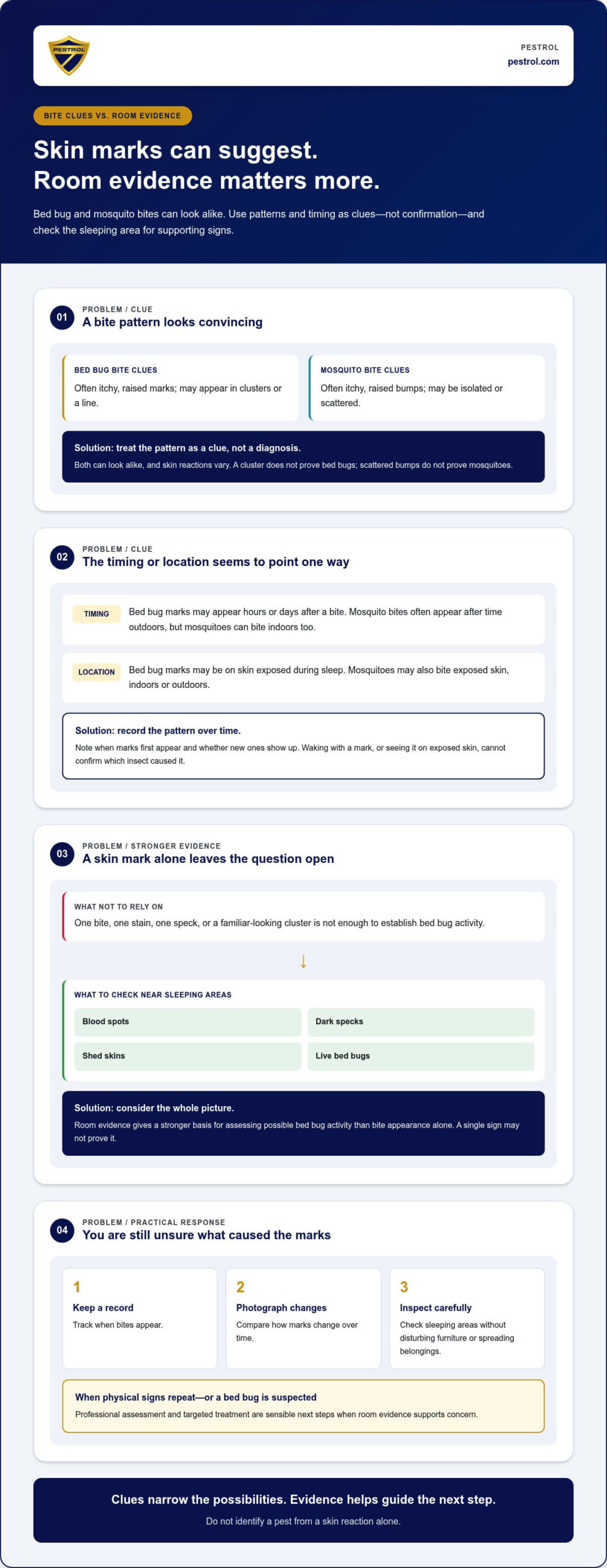
Appearance offers clues, but it can’t confirm which insect caused a bite. Bed bug marks may appear in clusters or lines, while mosquito bites are often isolated or scattered. Yet both can look like itchy, raised bumps, and reactions vary from person to person. For identifying bed bug bites vs mosquito bites, treat the pattern as one clue, not a diagnosis.
| Clue | Bed bug bites | Mosquito bites |
|---|---|---|
| Typical appearance | Often itchy, raised marks | Often itchy, raised bumps |
| Arrangement | May cluster or form a line | Often isolated or scattered |
| What it tells you | Pattern can be suggestive, not proof | Scattered marks can be suggestive, not proof |
Use the comparison to describe what you see, not to identify the pest with certainty. Several marks close together may fit a commonly reported bed bug pattern, but that arrangement doesn’t establish the cause. A few separate bumps aren’t definitive evidence of mosquitoes, either. The overview of bed bug bites and detection on Wikipedia offers additional background, but a skin mark alone still can’t confirm bed bug activity in a room.
What do bed bug bites usually look like?
Bed bug bites can appear as itchy, raised marks. Some people notice several close together or in a short line, while others see no clear pattern. Marks may differ from person to person, and a distinctive-looking cluster doesn’t prove bed bugs are present. Treat the appearance as a reason to look for other clues, not as confirmation.
How can mosquito bites look different?
Mosquito bites often look like itchy bumps scattered across the skin rather than a tight cluster. Their size and appearance can still vary depending on how a person’s skin responds. A bump that looks different from another one doesn’t identify the insect by itself. Bite appearance can suggest a possible cause, but it can’t reliably confirm which insect bit you.
Compare several details rather than relying on one mark: whether the bumps are grouped or scattered, whether they look similar, and whether their appearance changes over time. Even then, there is overlap. Two people can respond differently to bites from the same insect, and different insects can leave marks that look alike. A photo or familiar-looking pattern isn’t a final answer.
The most useful conclusion at this stage is modest: clusters or lines may point toward bed bugs, and scattered bumps may fit mosquito bites, but neither pattern settles the question. Next, consider when the marks appeared and look for physical evidence in the sleeping area. Room clues provide a stronger basis for assessing possible bed bug activity than appearance alone.
How Timing, Bite Location, and Skin Reactions Change the Clues
Timing, location, and skin reaction can help you assess a possible bite, but none works as a stand-alone test. You may first notice a mark after waking without knowing exactly when it appeared or what caused it. Both insects can bite exposed skin, so the body area alone rarely settles the question.
Does waking up with bites point to bed bugs?
Waking with new marks can raise a reasonable question about nighttime exposure, especially if you notice them repeatedly. But discovering a bite in the morning doesn’t prove it happened while you were asleep. You may have missed the mark earlier, or it may have become more noticeable later. Mosquitoes can also bite at night, including indoors, so one morning’s discovery isn’t conclusive evidence of bed bugs.
Location offers context, not a map. Bed bug bites may occur on skin exposed while sleeping, such as the face, neck, arms, or legs. Mosquitoes may also bite exposed areas, indoors or outdoors. Clothing, bedding, and sleeping habits affect which skin is uncovered, and neither insect follows a fixed pattern on every person.
Why do bite reactions differ from person to person?
People can react differently to bites from the same insect. One person may develop a noticeable itchy bump, while another has a milder reaction or sees little change. Redness, swelling, and itching can also vary between bites on the same person. These symptoms can show that the skin is irritated, but they can’t reliably identify the insect. A useful clue narrows the possibilities; it doesn’t prove the cause.
That distinction matters when identifying bed bug bites vs mosquito bites. A mark that appears overnight, or a cluster on exposed skin, can guide what to check next. It can’t confirm a pest by itself. Keep track of when you first notice marks and whether new ones appear, then consider that information alongside physical signs in the room.
If a reaction is severe, worsening, or otherwise concerning, seek medical care rather than trying to identify the insect from the skin. For home concerns, focus on careful observation. The EPA guide to bed bug control provides practical information about managing suspected bed bug activity. If you find supporting evidence around your sleeping area, Pestrol provides professional bed bug treatment.
Bed Bug Bites or Mosquito Bites: Which Home Clues Matter More?
Skin marks can suggest a possibility, but evidence in the room gives you a more useful lead. A mosquito bite isn’t proof of mosquitoes breeding indoors, just as an itchy cluster doesn’t establish bed bugs. Look for signs connected to the pest, especially around the bed and nearby furniture. Consider the overall picture rather than relying on one stain or speck.
What signs around a bed may indicate bed bugs?
Check accessible areas near where people sleep. Bed bugs can hide in narrow spaces, so a quick glance at the mattress surface may miss them. Look carefully without pulling furniture apart or moving belongings through the home.
- Mattress seams and tags: Look for small blood spots, dark specks, shed skins, eggs, or live insects.
- Bed frames and headboards: Inspect joints, crevices, and places where parts meet.
- Nearby furniture: Check seams and narrow gaps in bedside tables, chairs, or other furniture close to the bed.
- Other nearby edges: Look for visible signs around baseboards or cracks close to sleeping areas.
Each item is a possible clue, not automatic proof. A dark mark could have another source, and shed material may be difficult to identify by sight alone. Not seeing insects during one check doesn’t rule out activity, since bed bugs can remain hidden. If you find something suspicious, photograph it where it is and note its location rather than handling it or moving it elsewhere.
Why are home signs more useful than bite patterns?
Environmental clues matter because they relate to possible pest activity in the home. Bite reactions only show how skin responded, and those marks can resemble bites from other insects. Blood spots, dark marks, shed skins, eggs, or an insect near the bed may strengthen the reason to investigate, particularly when several consistent signs appear together.
Environmental evidence carries more weight because it can point to pest activity in the home, while a bite pattern only describes a skin reaction. A suspected insect or repeated signs in more than one nearby location make a closer inspection sensible. Still, don’t treat a single object as certain identification. Clear photos and the exact location of each clue can help with assessment.
Mosquitoes leave a different kind of household clue: adult mosquitoes may be present, especially near standing water where they breed. Their presence can support the possibility of mosquito activity, but it doesn’t explain every mark or confirm where a bite happened. For more guidance on signs and next steps, read Pestrol’s professional bed bug treatment guide.
What to Do When You Cannot Tell Which Insect Bit You
Uncertainty doesn’t mean you need to guess or take drastic action. Track what you notice, check your sleeping area carefully, and decide whether the evidence calls for further help. This makes identifying bed bug bites vs mosquito bites less about interpreting one mark and more about gathering useful details.
- Note when you noticed the marks. Write down the date and whether you first saw them after waking, after spending time outdoors, or at another point in the day. Record when you noticed them, not when you assume they happened.
- Photograph changes. Take a clear photo when you first see a mark and another if its appearance changes. Keep the dates with the photos so you can describe what changed over time.
- Record possible home evidence. Note the location of any suspicious specks, stains, shed material, or insect. Describe what you see without deciding what caused it.
- Make a careful visual check. Look over accessible mattress seams, the bed frame, and nearby furniture. Don’t dismantle furniture or carry belongings around the home during your check.
A quick inspection may not reveal anything, and that alone doesn’t settle the question. The goal is to observe without disturbing potential evidence. Keep notes and photos together, and don’t treat a skin mark or a single household finding as confirmed pest identification.
How should you document bites and possible evidence?
Use brief, factual notes: when you noticed a mark, where it is on the body, and whether it changed. For a possible room clue, record the date and exact location, such as a mattress seam or bed-frame joint. Dated photos and clear descriptions give a qualified pest professional useful context when assessing whether the evidence suggests bed bug activity.
When should you seek medical advice for a bite?
Seek medical advice if a reaction is severe, symptoms are worsening, or you notice signs of infection. A healthcare professional can assess your skin and advise on medical concerns, but bite symptoms alone can’t confirm which pest is in your home. Keep the medical question separate from the home inspection, and share your observations with the appropriate professional.
Comfort measures address discomfort, not the source of bites. Washing the affected area with soap and water may help with basic skin care, but it won’t identify or remove a pest infestation. Follow medical advice for symptoms, and use physical evidence in the room to guide pest-related next steps. For suspected bed bug activity, Pestrol provides targeted treatment.
If repeated signs or a suspected bed bug concern you, professional assessment can help clarify the next step.
When Bed Bug Evidence Calls for Professional Treatment
Bite marks alone usually aren’t a reason to assume you have bed bugs. Repeated physical signs near the bed, or an insect you suspect may be a bed bug, make professional help a sensible next step. Note where and when you found each sign, and keep photos if you have them. This helps move the decision beyond guesswork about skin reactions.
You don’t need to identify every mark or find a live insect before seeking help. Bed bugs can be difficult to spot, and not seeing one during a quick look doesn’t settle the issue. If you continue to find possible signs around the sleeping area, don’t rely on bite patterns alone to decide what’s happening. Pestrol’s professional bed bug treatment addresses suspected bed bug activity in the home.
What can professional bed bug treatment help address?
Pestrol provides targeted bed bug treatment for suspected bed bug activity in the home. Useful details include where you found possible stains, shed skins, eggs, or insects, and whether signs have appeared more than once. That context is more informative than trying to identify the pest from a bite pattern alone. Treatment addresses the pest concern, not skin symptoms, and bite comparisons can’t promise a particular outcome.
If you’re identifying bed bug bites vs mosquito bites, keep the two questions separate: a healthcare professional can assess a skin reaction, while physical evidence in the home helps guide a pest assessment. A possible bed bug or repeated signs near sleeping areas are stronger reasons to seek help than itchy marks by themselves. You don’t need to diagnose the issue before describing what you’ve noticed.
How can local residents take the next step?
Pestrol serves residents in Manhattan, the Bronx, Chester, Cornwall, Crawford, Goshen, Greenville, Highlands, Minisink, Monroe, Montgomery, Mount Hope, New Windsor, Newburgh, Palm Tree, Tuxedo, Wallkill, Warwick, Wawayanda, and Woodbury. If you live in one of these communities and suspect bed bug activity, note what you observed, where you found it, and whether similar signs have appeared again. Clear details help focus attention on the concern without turning uncertainty into panic. Pestrol is a family-owned and operated business offering professional bed bug treatment when home evidence supports concern.
Take the next step calmly. Share the signs you’ve noticed and get help addressing suspected bed bug activity through Pestrol.
Choose a Clear Next Step with Confidence
You don’t need to identify an insect from a bite mark before deciding what to do. Think of identifying bed bug bites vs mosquito bites as the start of an evidence-based decision, not a test you must pass. If you’re unsure, pause before making major changes at home. A calm, measured response helps you avoid acting on a guess while staying attentive to signs that may need follow-up.
Set a practical threshold: if concern continues or you find signs that point to bed bug activity, move from watching to getting help. Share what you observed and let the evidence guide the next step. That’s more useful than trying to interpret every new skin mark on its own.
Pestrol is a family-owned and operated business providing dedicated bed bug treatment in Manhattan, the Bronx, Chester, Cornwall, Crawford, Goshen, Greenville, Highlands, Minisink, Monroe, Montgomery, Mount Hope, New Windsor, Newburgh, Palm Tree, Tuxedo, Wallkill, Warwick, Wawayanda, and Woodbury. If suspected activity is weighing on you, take one manageable step toward addressing it.
You can move forward without panic. Start with what you know, then use Pestrol’s professional bed bug treatment to address suspected activity.
Frequently Asked Questions
Can you identify bed bug bites by their pattern?
No. A pattern can raise suspicion, but it can’t identify bed bugs on its own. Some people notice several marks close together, while others see no obvious arrangement. Compare what you see with physical signs in the sleeping area, and don’t treat a familiar-looking row as confirmation. If you’re unsure, keep a record of changes and use evidence in the room to guide your next step.
Are bed bug bites always in a line or cluster?
No. Bed bug bites don’t always appear in a line or cluster, and some people may have little or no visible skin reaction. The absence of a grouped pattern doesn’t rule out bed bugs. Likewise, a cluster doesn’t prove they’re present. Look at the full situation, including whether there are signs of insects around sleeping areas, instead of expecting everyone’s bites to follow the same arrangement.
How can I tell if bites came from mosquitoes or bed bugs?
You usually can’t tell with certainty from the marks alone. When identifying bed bug bites vs mosquito bites, consider when you noticed the marks and what was happening beforehand, but treat those details as clues. Then look for evidence that connects a pest to the home, such as an insect or repeated signs near a bed. If the skin reaction is the main concern, a healthcare professional can assess it.
Can bed bugs be present if I cannot see any bites?
Yes. Someone in the home may not develop noticeable marks, and skin reactions can differ from person to person. A lack of bites therefore doesn’t establish that a room is free of bed bugs. If you have another reason for concern, such as a suspected insect or repeated physical signs near a sleeping area, assess those clues on their own rather than relying on whether household members have marks.
How long do bed bug bites and mosquito bites last?
There isn’t one timeline that applies to everyone. A bite’s appearance and discomfort can change as the skin reacts, and people may notice marks at different times. Duration alone can’t reliably tell you which insect was responsible. If a reaction isn’t improving, gets worse, becomes painful, or raises concern, contact a healthcare professional for advice rather than using its appearance to identify a pest.
What should I do if I find bites but no bed bugs?
Don’t assume the bites confirm bed bugs, and don’t assume a quick search rules them out. Keep a dated record of marks and changes, then note any suspicious signs you see at home. Avoid using outdoor pesticides indoors or applying pesticides to skin. If you’re in Pestrol’s local New York communities, including Manhattan, the Bronx, Chester, Cornwall, Crawford, Goshen, Greenville, Highlands, Minisink, Monroe, Montgomery, Mount Hope, New Windsor, Newburgh, Palm Tree, Tuxedo, Wallkill, Warwick, Wawayanda, or Woodbury, Pestrol provides professional bed bug treatment for suspected activity.
Do bed bug bites spread disease?
Bed bugs are not known to spread disease to people. Their bites can still cause itching and disturb sleep, and scratching may lead to a secondary skin infection. Mosquitoes, in contrast, can transmit diseases, so seek medical advice if you feel unwell after a mosquito bite or have a concerning reaction. A clinician can assess health symptoms, while signs in the home help determine whether pest activity needs attention.