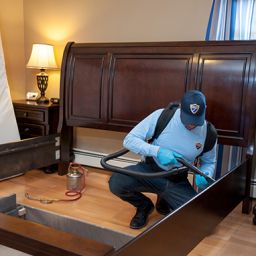




Why does a german roaches infestation persist even after you’ve scrubbed every inch of your kitchen with bleach? It’s a deeply frustrating reality for many New Yorkers who feel anxious or embarrassed about their home’s cleanliness. You likely believe that more cleaning is the only answer, but these pests are biological survivalists that can thrive on nearly nothing. You aren’t alone in this battle. Between January 2025 and June 2026, NYC 311 received over 135,000 pest-related complaints, proving that this is a systemic city crisis rather than a personal failure.
We want to help you reclaim your kitchen and protect your family from health risks like asthma triggers. You’ll discover the biological truth behind these resilient colonies and why professional-grade strategies are the only way to achieve total elimination. This guide covers the latest integrated pest management standards and explains how to prevent a future re-infestation. We’ll provide the clarity you need to stop wasting money on ineffective retail products and finally enjoy the peace of mind you deserve in your own home.
Key Takeaways
- Identify the “two-stripe” signature and learn why seeing even one roach in daylight signals a massive hidden colony nearby.
- Understand why the protective ootheca shield makes a german roaches infestation resistant to standard sprays and rapid reproduction leads to thousands of descendants.
- Stop using bug bombs that scatter pests into wall voids and learn why DIY foggers often make professional baits less effective.
- Recognize how shared plumbing and electrical lines in NYC apartments facilitate the spread of infestations between neighbors and require specialized urban tactics.
- Reclaim your kitchen using Integrated Pest Management (IPM) strategies that target the source nest rather than just treating temporary symptoms.
Identifying a German Roaches Infestation: More Than Just a Sighting
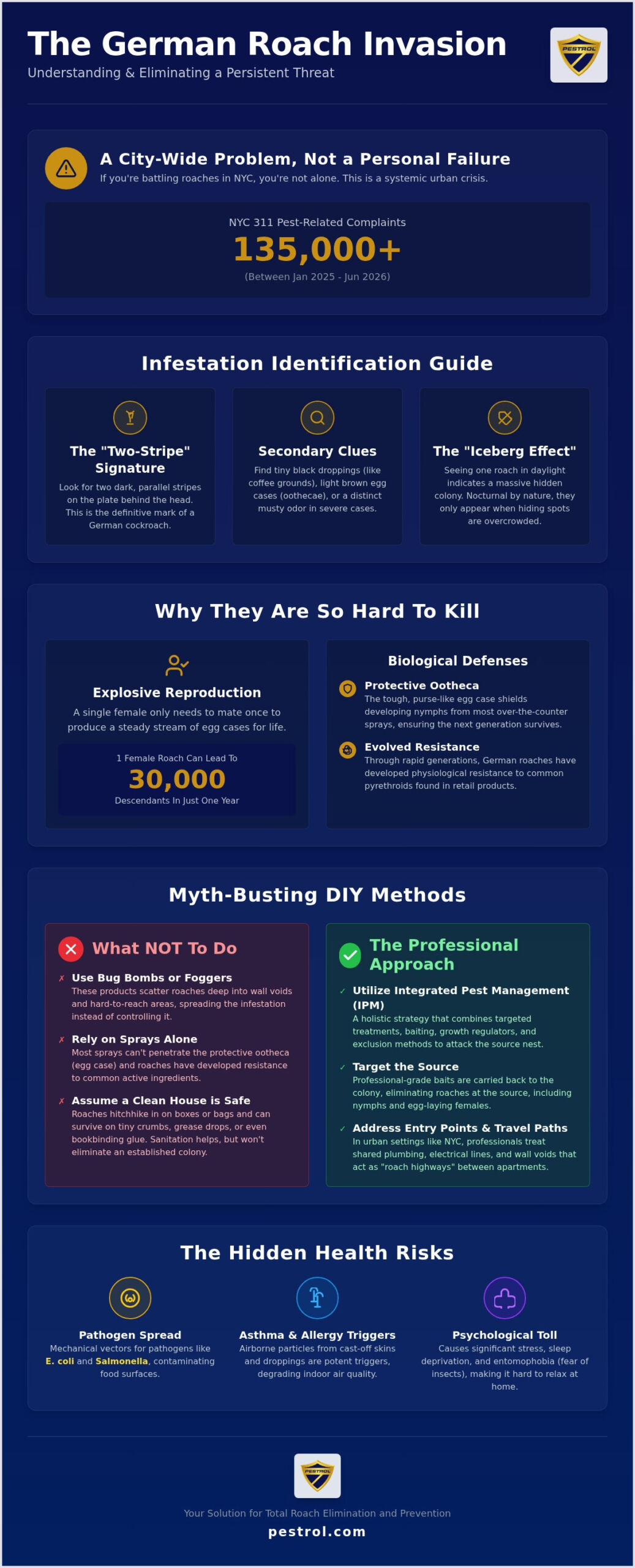
Identifying a german roaches infestation starts with recognizing the enemy’s uniform. Look for two dark, parallel stripes running down the pronotum, which is the small plate located just behind the insect’s head. This “Two-Stripe” signature is the hallmark of the Blattella germanica. Understanding German cockroach biology is essential because these pests behave differently than the larger American roaches you might find in a damp basement or sewer line. They are smaller, faster, and much more likely to establish a permanent residence inside your living space.
We often discuss the “Iceberg Effect” with our clients. If you see a single roach scurrying across your counter during the day, it’s a warning sign of a massive colony nearby. These insects are nocturnal and naturally avoid light. They only venture out into the open when their hiding spots are overcrowded or food sources are scarce. Seeing one usually means hundreds are tucked away behind your cabinets, inside your motor housings, and deep within your appliances. They don’t just wander in; they settle in and expand rapidly.
Look for secondary clues like tiny, black specks that resemble coffee grounds or black pepper. These are droppings, often found in the corners of drawers, along the tops of door frames, or behind picture frames. You might also find oothecae, which are light brown, purse-shaped egg cases. In severe cases, a heavy german roaches infestation produces a distinct, musty odor caused by pheromones they use to communicate. If you can smell them, the colony has already reached a critical mass that requires professional intervention.
Myth: “I Only See Them in the Kitchen, So They Are Only There”
It’s a common mistake to assume the problem is localized to where you cook. While they love the crumbs in your pantry, they use electrical outlets and wall voids as highways to travel throughout your home. Bathrooms and laundry rooms are frequent secondary hubs because they provide the heat and moisture these pests crave. The developmental stages of a cockroach are called instars, and during these periods, the tiny nymphs can compress their bodies to fit into crevices as thin as a credit card.
The Health Risks You Can’t See
The danger isn’t just aesthetic; it’s a matter of safety for your family. These pests are mechanical vectors for pathogens like E. coli and Salmonella, which they spread across food preparation surfaces as they forage. Their cast-off skins and droppings also become airborne, acting as potent asthma and allergy triggers that degrade the air quality of your apartment. Beyond the physical risks, living with an infestation takes a heavy psychological toll. It often leads to sleep deprivation and a condition known as entomophobia, making it impossible to feel relaxed in your own home. New York families concerned about indoor pest health risks should also be aware that outdoor threats like ticks are escalating, and exploring tick control services NYC professionals recommend can help protect your family from additional vector-borne diseases.
The Biology of Failure: Why German Roaches Are So Hard to Kill
A german roaches infestation is a biological masterclass in survival. These pests don’t just outrun you; they outbreed your best efforts. A single female can lead to a staggering 30,000 descendants in just one year. This explosive growth happens because females only need to mate once in their entire lives. They store sperm and produce a steady stream of egg cases, or oothecae, without needing another partner. This relentless reproductive cycle makes cockroach identification and habits critical for any homeowner trying to understand why their kitchen remains a battleground.
The ootheca acts as a biological shield. Most over-the-counter sprays simply cannot penetrate this tough, protective exterior. Even worse, these insects have developed a form of biological armor. Through rapid generations, they have evolved a physiological resistance to common pyrethroids found in most retail products. You are effectively trying to fight a modern urban war with outdated tools. When you spray, you might kill a few visible adults, but the next generation is already protected and evolving.
Myth: “A Clean House Can’t Have Roaches”
Many residents in high-end Manhattan apartments are shocked to find an active colony. It’s not always about your cleaning habits. Roaches frequently hitchhike into pristine homes via grocery bags, cardboard shipping boxes, or even inside used electronics. Once they arrive, the scavenger reality takes over. A roach can survive for weeks on the glue of a book binding or a single drop of grease behind a stove. While keeping a tidy home is helpful, sanitation is merely a control tool. It isn’t a cure for a german roaches infestation that has already established a foothold in your wall voids.
The Critical Role of Insect Growth Regulators (IGRs)
Traditional pesticides focus on the “knockdown,” which kills adult insects on contact. However, this ignores the thousands of nymphs waiting to hatch. This is where Insect Growth Regulators (IGRs) change the game. They act as a form of birth control for the colony by disrupting the molting process. Nymphs exposed to IGRs never reach sexual maturity, which effectively ends the reproductive cycle of the entire population. Our professional targeted treatment protocols integrate these regulators to ensure the population doesn’t just bounce back after a few weeks. If you’re tired of the endless cycle, a professional Roach Exterminator can provide the comprehensive care needed to break the infestation for good.
Myth-Busting DIY Methods: Why Bug Bombs Make It Worse
Many homeowners try to handle a german roaches infestation alone by reaching for total-release foggers, commonly known as bug bombs. This is usually the first step toward a much larger problem. These devices create a “Scattering Effect” that is counterproductive in an apartment setting. Because the fog cannot penetrate deep into the wall voids where roaches actually hide, the chemical residue on surfaces merely irritates them. Instead of dying, the colony retreats deeper into electrical lines or flees into your neighbor’s apartment. You haven’t solved the crisis; you’ve just pushed it into unreachable areas of the building.
Improper use of retail sprays also leads to bait aversion. If you spray a repellent chemical near a professional bait station, the roaches will avoid that area entirely. This renders the most effective professional tools useless. We also see many people over-apply “natural” solutions like boric acid or diatomaceous earth. When you pile these powders into thick mounds, roaches simply walk around them. To be effective, these must be applied as a nearly invisible dust. Additionally, store-bought chemicals have lower active ingredient concentrations that rarely overcome the biological resistance we see in 2026 urban colonies.
The Truth About Over-the-Counter Sprays
Most retail products are “repellents” that act like a chemical fence. While seeing a few dead roaches on your floor might feel like a victory, it rarely signals the end of the colony. These sprays only kill the insects that are out in the open. Using these products in small NYC kitchens is also a safety concern. Misusing pesticides near food storage areas can lead to accidental ingestion or skin irritation. Families with young children or pets who are worried about chemical exposure should explore safe residential pest control approaches that use precision-targeted, low-toxicity treatments instead of broad-spectrum repellents. Professional chemistry often utilizes non-repellents. These allow roaches to walk through the treated area and carry the active ingredient back to the nest, following the principles of Integrated Pest Management (IPM).
DIY vs. Professional Strategy Comparison
Choosing between a store-bought fix and professional care often comes down to long-term value and safety. Here is how they compare:
- DIY Methods: These have a low initial cost but success rates are typically below 20%. Results are temporary and often lead to “pesticide fatigue” where the homeowner gives up.
- Professional Strategy: This involves a moderate investment with a success rate over 95%. It includes precision equipment to place baits in unreachable crevices.
Our technicians use specialized tools to identify the source of the colony rather than just treating the symptoms. A structured Home Pest Protection – Basic plan is a much more cost-effective long-term solution than a cabinet full of half-used retail sprays. You get the peace of mind that comes with a results-first approach and a team that understands the unique challenges of New York housing.
The New York Challenge: Shared Walls and Urban Infestations
A german roaches infestation in New York is rarely a solo act. Because our buildings are so densely packed, your apartment shares more than just a wall with your neighbors. In Manhattan and the Bronx, these pests utilize the complex networks of plumbing, steam pipes, and electrical conduits as high-speed transit lines between units. If one tenant on the fourth floor has a problem, it’s only a matter of time before the roaches explore the piping to find new food sources on the fifth. You aren’t just managing your own space; you’re often dealing with the biological overflow of the entire building.
Contrast this with the dynamics we see in Orange County. In areas like Newburgh, the challenge often shifts to crawl spaces and basements. The 2026 weather patterns in the Hudson Valley have been particularly humid, creating ideal breeding grounds in damp subterranean areas. While city roaches are professional hitchhikers, these suburban populations often exploit moisture-heavy entry points to move from the foundation up into the living areas. Each environment requires a tailored approach to break the cycle of re-infestation.
Modern delivery culture has added a new layer to the problem. The “Cardboard Connection” is a primary way these pests enter even the cleanest homes. We strongly advise NYC residents to discard delivery boxes immediately after unpacking. The corrugated layers in cardboard provide the perfect insulation and hiding spots for roaches and their egg cases. Bringing a warehouse box into your kitchen is often like inviting a Trojan horse inside.
Apartment Living and the “Unit-to-Unit” Spread
Managing a german roaches infestation in a multi-unit building requires coordination and a clear understanding of your rights. Under the NYC Housing Maintenance Code, landlords are legally required to keep buildings free from pests and must utilize Integrated Pest Management (IPM) practices as mandated by Local Law 55. While the landlord holds the financial responsibility, you can take proactive steps to protect your sanctuary. Utilizing rodent proofing services techniques, such as sealing the gaps around radiator pipes and sink drains, can effectively block roach entry points and keep your home isolated from a neighbor’s issue.
Commercial Risks: Roaches in the Food Service Industry
The stakes are even higher for local businesses. A single roach sighting in a Newburgh restaurant can lead to a failed DOH inspection and devastating reputational damage. We use strategic monitoring with pheromone traps to catch hitchhikers before they can establish a nest. Maintaining compliance isn’t just about passing an inspection; it’s about protecting your livelihood and your customers. For specialized commercial advice, check out our guide on restaurant pest control NYC to ensure your kitchen stays clean and operational.
The Pestrol Solution: Total Roach Elimination and Prevention
Eliminating a german roaches infestation requires more than just a quick surface treatment. We begin every service with a comprehensive inspection to locate the “Source Nest” where the colony is actually breeding. Treating visible symptoms alone is a recipe for failure. Instead, we use Integrated Pest Management (IPM), which combines sanitation advice, structural exclusion, and high-tech targeted chemistry. As a family-owned institution serving the Hudson Valley and NYC, we treat your home with the same care we give our own, projecting the persona of a protective guardian for your family.
Our tiered Home Pest Protection plans provide a structured safety net for 2026. The Home Pest Protection – Basic plan serves as an essential starting point for seasonal security. For more complex environments or high-risk areas, our Plus and Premium tiers offer additional layers of defense and specialized care. Every plan is backed by our results-first mentality. Our local technicians don’t stop until the job is complete and your kitchen is safe again, ensuring long-term value for every client we serve.
What to Expect from a Professional Roach Treatment
Success depends on a clear partnership between the homeowner and the technician. Before we arrive, you’ll need to follow specific preparation steps. This includes clearing your cabinets and ensuring pet safety by following our guided instructions. Once the treatment begins, you might experience a “Bait and Wait” period. You may actually see more roaches during the first few days as our professional baits draw them out of their deep hiding spots. This is a sign that the protocol is working. We also schedule follow-up visits to ensure the second generation of nymphs is eliminated before they can restart the reproductive cycle.
Securing Your Home for the Future
Total elimination is only half the battle. Long-term success involves permanent exclusion. We identify and seal the tiny cracks and crevices where roaches hide, effectively locking them out of your living space. Ongoing monitoring is the best defense against a new german roaches infestation, especially in New York buildings with shared walls. Quarterly visits allow us to catch new “hitchhikers” from grocery bags or neighbors before they can establish a colony. New York homeowners who want comprehensive year-round protection should also consider that the same seasonal conditions driving roach activity in 2026 are fueling a record tick season, making it wise to review what tick control services NYC families rely on to safeguard their outdoor spaces. We are committed to your long-term peace of mind and the safety of your home environment.
Take Control of Your Home Environment Today
Living with a german roaches infestation in the heart of New York is a heavy burden, but you don’t have to carry it alone. You now understand that these pests are biological survivalists that thrive in our shared urban environments through rapid reproduction and chemical resistance. By moving away from ineffective bug bombs and embracing professional Integrated Pest Management, you can finally stop the exhausting cycle of re-infestation and reclaim your home’s safety.
As a family-owned institution local to the Hudson Valley and NYC, we bring specialized German roach protocols directly to your door. Our tiered Home Pest Protection plans are designed to fit every budget while providing the high-quality, expert care your family deserves. We pride ourselves on being your dedicated partners in maintaining a healthy and comfortable environment for your loved ones. It is time to stop worrying about food safety and start enjoying your kitchen again.
We have this situation under control and are ready to help you reclaim your sanctuary. Trust in a local team that understands the unique challenges of New York housing and is committed to your long-term peace of mind.
Frequently Asked Questions
How do I know if I have a German roach infestation or just a single bug?
Seeing one roach, especially during the day, is a major red flag for your home’s safety. These pests are social insects that thrive in clusters. If you spot a single bug, there are likely hundreds more hiding in the darkness of your wall voids or behind appliances. A german roaches infestation is often confirmed by finding small, pepper-like droppings or discarded skins in the back of your kitchen drawers.
Can German cockroaches fly, and does that help them spread?
While German cockroaches have wings, they rarely use them for sustained flight. They’re much more likely to scurry at high speeds or use their wings to glide short distances if they’re disturbed. They primarily spread through “hitchhiking” in cardboard delivery boxes or by traveling through the shared plumbing and electrical lines of NYC apartment buildings. They don’t need to fly when our urban infrastructure provides easy walking paths.
Is it true that German roaches can survive for a month without food?
Yes, these pests are incredibly resilient and can survive for about a month without a steady food source. However, they can only last about a week without water, which is why you’ll always find them near sinks, dishwashers, and bathrooms. They’re opportunistic scavengers that will eat non-food items like book bindings or toothpaste if crumbs aren’t available. This biological toughness is why professional intervention is necessary.
Why do I see more roaches after I use a bug bomb in my apartment?
Bug bombs use repellent chemicals that irritate the insects rather than killing the entire colony. This creates a “scattering effect” where the pests flee their deep hiding spots and move into the open or into neighboring units. You see more because you’ve disturbed them, but you haven’t solved the german roaches infestation. You’ve just made the survivors much harder to reach with the professional-grade baits we use.
Are professional roach treatments safe for my dogs and cats?
Our professional protocols prioritize the safety of your furry family members. We use targeted baiting and low-toxicity non-repellents that are placed in areas completely inaccessible to pets. During the initial application, we provide clear instructions on how to keep your animals protected. For families who are relocating and want their companions moved safely to a new home, Relopet provides expert international and domestic pet transport services. Modern pest management focuses on precision rather than the “spray everything” approach of the past, ensuring a healthy and stress-free environment for everyone in your home.
Complete eradication usually takes between two to four weeks depending on the severity of the colony. While you’ll see a significant drop in activity within the first few days, we must account for the egg cycle. Since most sprays don’t kill the eggs, we often schedule follow-up visits to eliminate the new nymphs as they hatch. Persistence is the key to achieving total elimination in New York homes.
What is the difference between a German roach and an American roach?
Size and location are the biggest indicators. German roaches are small, rarely exceeding half an inch, and stay close to food and water in kitchens or bathrooms. American roaches are much larger, often reaching two inches, and usually enter from sewers or damp basements. While American roaches are occasional invaders, the German variety is a domestic pest that settles in permanently to breed within your living space.
Will keeping my lights on at night stop roaches from coming out?
Keeping your lights on won’t stop roaches, though it might temporarily keep them in the shadows. While they’re nocturnal and prefer the dark, a hungry roach will eventually venture out regardless of the lighting. Over time, they can even become accustomed to the light if the colony is large enough. Lighting provides a psychological comfort for humans, but it isn’t an effective strategy for controlling a biological pest problem.