



Did you know that by the time you see a single moth fluttering in your closet, the real damage to your wardrobe has already been done? It’s a frustrating reality for many homeowners who discover that their favorite cashmere sweaters or heirloom rugs have become a feast for larvae. You’ve likely tried cedar blocks and deep cleaning, yet those tiny, devastating holes keep appearing. If you’re tired of this cycle, a professional moth damage prevention service offers the structural defense your home needs to stay protected. It often feels like a losing battle against an invisible enemy, and the fear of using harsh chemicals near your finest silks only adds to the stress.
We understand how much you value your collection, and we’re here to act as your expert guardian. In this guide, you’ll learn how professional prevention stops infestations at the source, preserving your expensive woolens and delicate textiles for years to come. We will explore the limitations of DIY fixes, the safety of modern 2026 treatment protocols, and how to establish a long-term plan that actually works. Your home should be a sanctuary for your belongings, and the right strategy ensures it stays that way.
Key Takeaways
- Understand why professional services are essential for identifying hidden breeding grounds that standard pheromone traps often miss.
- Learn why the moth larvae, not the flying adults, are the true culprits behind the destruction of your wool and silk garments.
- Discover how a specialized moth damage prevention service utilizes Integrated Pest Management to create a lasting barrier around your home.
- Find out how to conduct a professional-grade audit of your natural fiber items to detect early signs of activity before holes appear.
- Explore how tiered protection plans offer a structured, year-round defense to keep your high-end wardrobe and heirloom rugs safe.
What is a Moth Damage Prevention Service and Why Do You Need One?
Professional moth prevention is a comprehensive, multi-stage protocol that involves meticulous inspection, targeted elimination of larvae, and structural exclusion to keep pests out for good. It’s a specialized approach designed to protect your home’s most vulnerable assets from the inside out. Unlike basic retail solutions that rely solely on pheromone traps, a professional moth damage prevention service identifies the root cause of an infestation. We look beyond the flying adults to find the hidden breeding grounds where larvae thrive, ensuring the problem is stopped at the source.
In New York, we primarily focus on the Webbing Clothes Moth and the Casemaking Clothes Moth. These two species are responsible for the vast majority of textile destruction in our area. Understanding The Science of Moth Infestations is the first step in realizing that a few cedar chips or lavender sachets won’t protect your investments. These pests are highly specialized, feeding on keratin found in natural fibers, and they require professional expertise to fully eradicate.
Our local climate, combined with the historic architecture of Manhattan and Orange County, creates a perfect storm for these pests. Older brownstones often have deep voids in walls and flooring where hair, lint, and pet dander accumulate over decades. These hidden pockets provide a steady food source that DIY methods simply cannot reach. New York’s seasonal shifts also drive moths indoors during cooler months, seeking the stable temperatures and high-quality fabrics found in your home. This makes a recurring moth damage prevention service a necessity for anyone looking to maintain a healthy, pest-free environment.
The High Cost of Ignoring the Signs
The financial impact of a moth problem is often far higher than the cost of a professional protection plan. Replacing a single high-end cashmere sweater or a bespoke wool suit can cost hundreds, if not thousands, of dollars. Beyond the price tag, many homeowners face the loss of irreplaceable heirloom rugs or upholstered antique furniture that has been in the family for generations. There is also a significant psychological toll to consider. “Wardrobe anxiety” can be exhausting; you shouldn’t have to feel a sense of dread every time you open your closet to get dressed for an important event.
Signs You Need a Professional Prevention Service
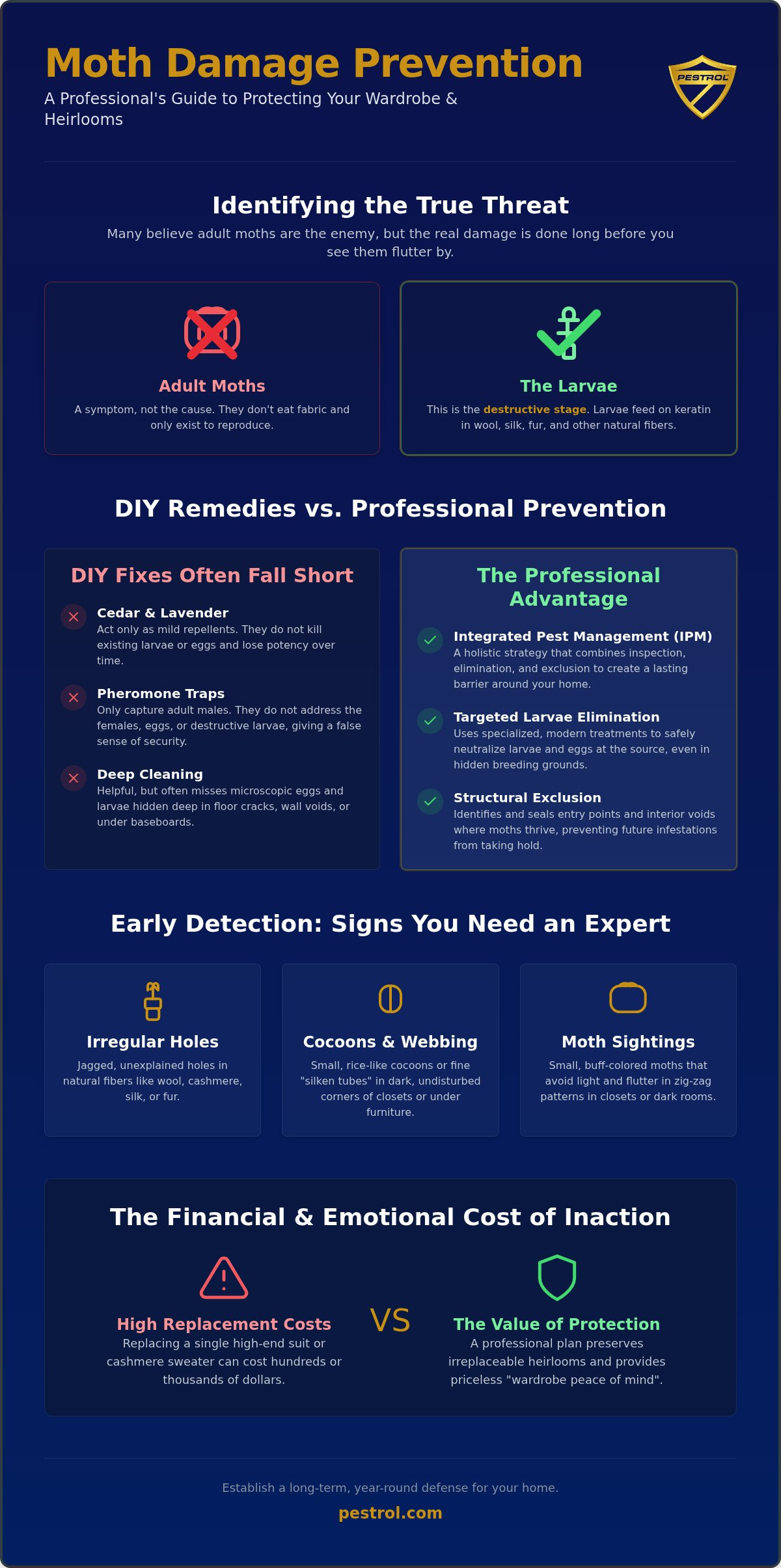
Early detection is your best defense against significant property loss. If you notice any of the following, it’s time to seek expert help before the damage spreads. Look for irregular, jagged holes in natural fibers like wool, silk, fur, or even leather. You might also find small “silken tubes” or rice-like cocoons tucked into the dark, undisturbed corners of your closet or underneath heavy furniture. Finally, keep an eye out for small, buff-colored moths that flutter in zig-zag patterns in dark areas. Unlike common pantry moths, these pests avoid light and prefer to stay hidden in the shadows of your home.
The Science of Moth Infestations: Why DIY Often Fails
Many homeowners mistakenly believe that a few flying moths in the hallway are the primary threat. In reality, those adult moths are merely a symptom of a much deeper problem. The true “hidden enemy” is the larvae. These small, worm-like creatures are the ones responsible for the holes in your favorite garments because they feed exclusively on keratin. This structural protein is found in wool, silk, fur, and even the pet hair tucked under your baseboards. A comprehensive moth damage prevention service focuses on these larvae rather than just the visible adults.
One of the biggest reasons DIY attempts fail is the resilience of moth eggs. These microscopic eggs can remain dormant in floor cracks or behind baseboards for several months, waiting for the perfect conditions to hatch. While you might think cedar blocks or lavender sachets are enough, they only act as mild repellents. They won’t eliminate larvae that have already hatched or eggs that are already present. If you’re struggling with a persistent issue, our team can provide a specialized Clothing Moth Control assessment to find these hidden hotspots.
The Lifecycle of the Clothing Moth
The journey from egg to destructive larvae is where the most significant damage occurs. In the controlled environments of NYC apartments, where temperature and humidity remain relatively high year-round, breeding cycles accelerate. This means an infestation can grow exponentially faster than in a natural setting. By the time you see a moth fluttering in your living room, the population has likely already established multiple generations within your closets. Prevention must happen before the larvae begin their feeding frenzy.
Why Household Cleaners Aren’t Enough
Standard cleaning routines, while helpful for general hygiene, often fall short of total elimination. High-efficiency vacuums frequently miss eggs tucked deep into carpet piles or within the gaps of historic hardwood flooring. Additionally, many people still rely on old-fashioned mothballs, which are increasingly avoided due to their toxicity and poor penetration in modern, walk-in closets. Professional services utilize Integrated Pest Management strategies that combine high-grade pheromone monitoring with targeted treatments. These professional-grade pheromones are far more potent than hardware store alternatives, allowing for earlier detection and a more decisive response.
Professional Prevention Service vs. DIY Remedies
While DIY remedies like cedar and lavender are popular, they often provide a false sense of security. These natural oils may repel moths in a laboratory setting, but they lack the reach needed for a complex home environment. A professional moth damage prevention service utilizes advanced tools and scientific methods to treat the entire structure, not just the front of a closet shelf. This level of precision is critical because it ensures that sensitive fabrics like heirloom silks and high-end woolens are protected without being ruined by improper chemical application. We focus on the areas where larvae actually hide, which is often far beyond the reach of a hardware store spray.
The core of a professional approach is Integrated Pest Management (IPM). This strategy focuses on long-term prevention through a combination of biological knowledge, habitat modification, and targeted treatments. Research from the University of Nebraska-Lincoln Extension confirms that effective control requires more than just localized sprays. It requires a deep understanding of the pest’s habits. By investing in a professional service, you move away from the constant, expensive replacement of DIY traps and toward a permanent solution that preserves the value of your wardrobe.
The Professional Inspection Advantage
Our experts identify hotspots that most homeowners overlook. We don’t just look in the closet; we check under heavy furniture, inside the felt of pianos, and deep within attic eaves. These are the quiet, dark places where larvae thrive undisturbed. By identifying the specific moth species, we can tailor a treatment protocol that matches their exact breeding habits. We also map the infestation to ensure it hasn’t spread to other rooms, creating a protective perimeter around your most valuable textiles and rugs.
Exclusion: Sealing the Entry Points
Moths don’t just appear out of nowhere. They enter your home through damaged window screens, attic vents, and even on the surface of used furniture you’ve recently brought inside. Professional exclusion involves sealing these microscopic entry points permanently. This proactive step is far more effective than trying to catch moths after they’ve already started laying eggs. This level of detail is a standard part of our Home Pest Protection plan, which provides the recurring maintenance needed to keep your home fortified against seasonal threats throughout the year.
A Strategy for Long-Term Wardrobe and Home Protection
Protecting your home requires more than a reactive mindset. A true moth damage prevention service focuses on a proactive, multi-layered strategy that eliminates risks before they manifest as holes in your clothing. It’s about creating an environment where pests cannot establish a foothold. Start by conducting a deep audit of every natural fiber item you own. This means removing everything from your closets, checking the undersides of rugs, and inspecting wool blankets stored in guest rooms. Once you’ve established a baseline, implement professional-grade monitoring. These high-potency pheromone traps act as an early warning system, telling us exactly when and where activity begins so we can respond immediately.
A recurring service plan provides year-round security by identifying seasonal shifts in pest behavior. In the winter, moths often retreat to the warmest, darkest parts of your home, such as behind heavy baseboards or inside wall voids. Our team knows how to track these movements and fortify these hidden areas. By engaging a consistent schedule, you ensure that your high-value textiles are never left vulnerable. This long-term commitment is the only way to effectively break the breeding cycle in historic New York homes and modern apartments alike.
Best Practices for Garment Storage
Many people rely on the myth of the cedar chest. While cedar smells pleasant, it only works in a perfectly airtight environment with a high concentration of fresh oils. For most, airtight plastic containers are a much more reliable choice. Always clean your garments before storage. Larvae are attracted to the microscopic traces of sweat and skin oils left on worn clothing. For those who prioritize professional garment maintenance, check out The Laundry Hub for specialized cleaning and pressing services. If you live in a cramped Manhattan apartment, vacuum-sealed bags are an excellent way to save space while creating an impenetrable barrier against pests. These simple habits, combined with professional oversight, keep your collection safe.
In regions like the Hudson Valley and Orange County, spring and fall represent the highest risk periods. As temperatures shift, moths become more active in their search for breeding grounds. Preparing your home for the winter hiding phase is essential to ensure you don’t wake up to a spring surprise. Integrating these steps into a quarterly home pest defense plan ensures that your defenses are updated as the seasons change. This recurring maintenance provides the safety and peace of mind that a one-off cleaning simply cannot offer.
Fortifying Your Home with Pestrol’s Specialized Moth Control
Choosing a professional partner to guard your home is a significant decision. Pestrol is a family-owned institution that treats every client with personal care and respect. We understand the unique challenges of New York living, from the historic brownstones of Manhattan to the sprawling estates in Newburgh and throughout Orange County. Our team doesn’t just provide a one-time fix. We offer a comprehensive moth damage prevention service that focuses on long-term defense and structural integrity. We take a results-first approach to ensure your environment remains healthy, comfortable, and entirely free of destructive pests.
Our Clothing Moth Control protocol is designed for those who demand thoroughness. We don’t rely on generic, over-the-counter solutions that fail to address the root of the problem. Instead, we use professional-grade tools and industry-specific terminology to explain exactly how we are fortifying your home. By choosing our moth damage prevention service, you are investing in a partnership with seasoned experts who are deeply rooted in the local community and committed to seeing every task through to completion.
Our Targeted Treatment Protocol
We take pride in our ability to treat sensitive environments with extreme precision. Closets filled with high-end cashmere and delicate silks require a gentle yet decisive touch. Our technicians apply treatments safely and effectively, ensuring that your most valuable items are never compromised. After every visit, we provide a detailed report on our findings. This includes specific recommendations for structural improvements, such as sealing gaps in floorboards or updating weather stripping on attic doors. This level of transparency is why many consider our approach the best exterminator for clothing moths in the region.
Peace of Mind with Recurring Protection
Every home has different needs, which is why we offer tiered Home Pest Protection plans. Our Basic, Plus, and Premium plans provide varying levels of security, allowing you to choose the coverage that fits your lifestyle and budget. While the Basic plan offers essential defense, our Premium plan incorporates the most advanced moth exclusion techniques available in 2026. This structured approach mirrors the efficiency of our work, moving quickly from identifying a need to offering a decisive resolution. We believe in building long-term relationships through persistence and reliable results.
Secure Your Home and Wardrobe for the Future
Protecting your high-value collection requires a shift from reactive cleaning to a structural defense. We’ve explored how the larvae of webbing and casemaking moths are the true culprits behind textile damage. While DIY traps might catch a few adults, a professional moth damage prevention service identifies the hidden breeding grounds and seals the entry points that lead to recurring infestations. By choosing a specialized protocol, you ensure that your expensive woolens, silks, and heirloom rugs remain preserved for years to come.
As family-owned local experts serving Manhattan, the Bronx, and Orange County, we bring a results-first mentality to every home. Our specialized Clothing Moth Elimination protocols are designed to provide the peace of mind you deserve. Don’t wait for the next hole to appear in your favorite sweater. Your home should be a sanctuary for your belongings, and we have the expertise to keep it that way. Fortify your closets today with a plan that actually works and protects your investments for the long term.
We are ready to help you maintain a safe, pest-free environment and ensure your home remains protected against any threat.
Frequently Asked Questions
How much does a professional moth prevention service cost?
The investment for a professional moth damage prevention service depends on the size of your home and the extent of the activity. Factors such as the number of closets, the presence of large heirloom rugs, and your choice of a tiered Home Pest Protection plan influence the final rate. We recommend a professional assessment to determine the specific needs of your Manhattan apartment or Orange County residence. This allows us to create a customized and cost-effective defense strategy.
Can moths actually eat through synthetic fabrics or just wool?
Moths primarily target natural fibers containing keratin, such as wool, silk, and fur; however, they can damage synthetics if they are blended with natural fibers. Larvae are also attracted to synthetic fabrics that have food stains, perspiration, or skin oils. While they can’t digest 100% polyester or nylon, they might chew through them to reach a food source beneath. Keeping all garments clean before storage in your Bronx home is a vital preventative step.
Is the professional moth treatment safe for my children and pets?
Our treatment protocols prioritize the safety of your family and pets while effectively eradicating pests. We use targeted applications in specific areas like baseboards and closet perimeters rather than broad, indiscriminate spraying. Our technicians are trained to follow strict safety guidelines to ensure that your living spaces in Manhattan or Warwick remain healthy. We always provide clear instructions on when it’s safe to re-enter treated areas to give you total peace of mind.
How often should I have my home inspected for moths in New York?
We recommend a professional inspection at least twice a year, ideally during the seasonal transitions of spring and fall. These periods are when moth activity typically spikes in New York as temperatures shift. For residents in historic homes in Goshen or Monroe, a quarterly Home Pest Protection plan is often the most effective way to maintain a permanent barrier. Regular monitoring ensures that any new activity is caught before it ruins an expensive wardrobe.
What is the difference between a clothing moth and a pantry moth?
The primary difference lies in their food source and behavior; clothing moths eat animal-based fibers while pantry moths target dried grains and flour. Clothing moths, like the webbing variety common in Manhattan, avoid light and prefer dark, undisturbed closets. Pantry moths are often seen flying near kitchen lights or found inside cereal boxes. Identifying the specific species is crucial for a successful moth damage prevention service because the treatment protocols for each are entirely different.
Do I need to wash all my clothes if I see one moth?
You don’t necessarily need to wash every item, but you should immediately inspect and clean any natural fiber garments near the sighting. High-heat laundering or professional dry cleaning kills eggs and larvae that are invisible to the naked eye. Professional laundering services, such as Laundry Breeze, can provide the deep cleaning necessary to ensure your wardrobe is properly protected. We suggest vacuuming the entire closet area and wiping down shelves with a damp cloth. If you find multiple items with damage, a comprehensive professional treatment is the most reliable way to stop the spread.
You will typically see a significant reduction in adult moth activity within the first few days of treatment. However, the full elimination of the population takes longer because we must break the breeding cycle of the larvae and eggs. Our protocols work systematically to neutralize every stage of the lifecycle. We continue to monitor the area in your New Windsor home to ensure that no dormant eggs hatch and restart the infestation later.
Can Pestrol help with moths in historic homes in Orange County?
Yes, Pestrol specializes in protecting historic properties throughout Orange County, including towns like Warwick and Tuxedo. These older homes often have unique architectural features, such as deep floorboard gaps and wall voids, that provide ideal hiding spots for pests. Our family-owned team understands how to apply treatments effectively without compromising the integrity of historic materials. We offer specialized Clothing Moth Control that is tailored to the specific challenges of Hudson Valley architecture.