




What should a termite protection plan cover, and how can you tell whether it fits your home? For a termite protection plan New York homeowners can assess with confidence, the scope should relate to the property’s conditions and any inspection findings, not a one-size-fits-all promise. It’s understandable to wonder whether your home is at risk, what warning signs mean, and whether a recommended service fits your needs.
Mud tubes, hollow-sounding wood, or discarded wings are reasons to arrange a professional assessment, but none confirms an infestation on its own. A clear explanation of what was observed, what remains uncertain, and what to do next can help you make an informed decision.
This guide explains termite risks and possible warning signs, what to evaluate in ongoing protection, and how to interpret inspection findings without trying to diagnose the problem yourself. Pestrol is a family-owned business offering termite control and residential home protection in its local service area. You’ll learn what to consider when comparing protection options and choosing a practical next step for your New York home.
Key Takeaways
- A termite protection plan is an ongoing service arrangement. Evaluate its written terms against your home’s conditions rather than assuming every property needs the same approach.
- Use an inspection to understand what was observed and what remains uncertain. Signs alone don’t establish the extent of termite activity.
- Compare plans by inspection scope, written recommendations, follow-up terms, and how well they address your property’s needs.
- Prevention and treatment for an active infestation serve different purposes. Review recommendations to see which need they address.
- Choose a termite protection plan New York homeowners can evaluate by its scope and fit for the property. Pestrol offers termite control as a local next step.
Why New York homeowners consider a termite protection plan
A termite protection plan is an ongoing service arrangement for assessing and addressing termite concerns over time, according to its stated terms. Unlike a one-time treatment for a specific need, an ongoing plan sets out what continued attention involves. The name alone doesn’t tell you what’s included. Compare the written scope with your property’s needs.
When comparing termite protection plan New York options, don’t assume every house faces the same threat. Instead, consider relevant property conditions, investigate concerns early, and choose an approach that makes sense for the home. An assessment can clarify what a sign may indicate and whether action is recommended. It can’t guarantee that termite activity or damage will always be prevented.
What termite protection can mean for a homeowner
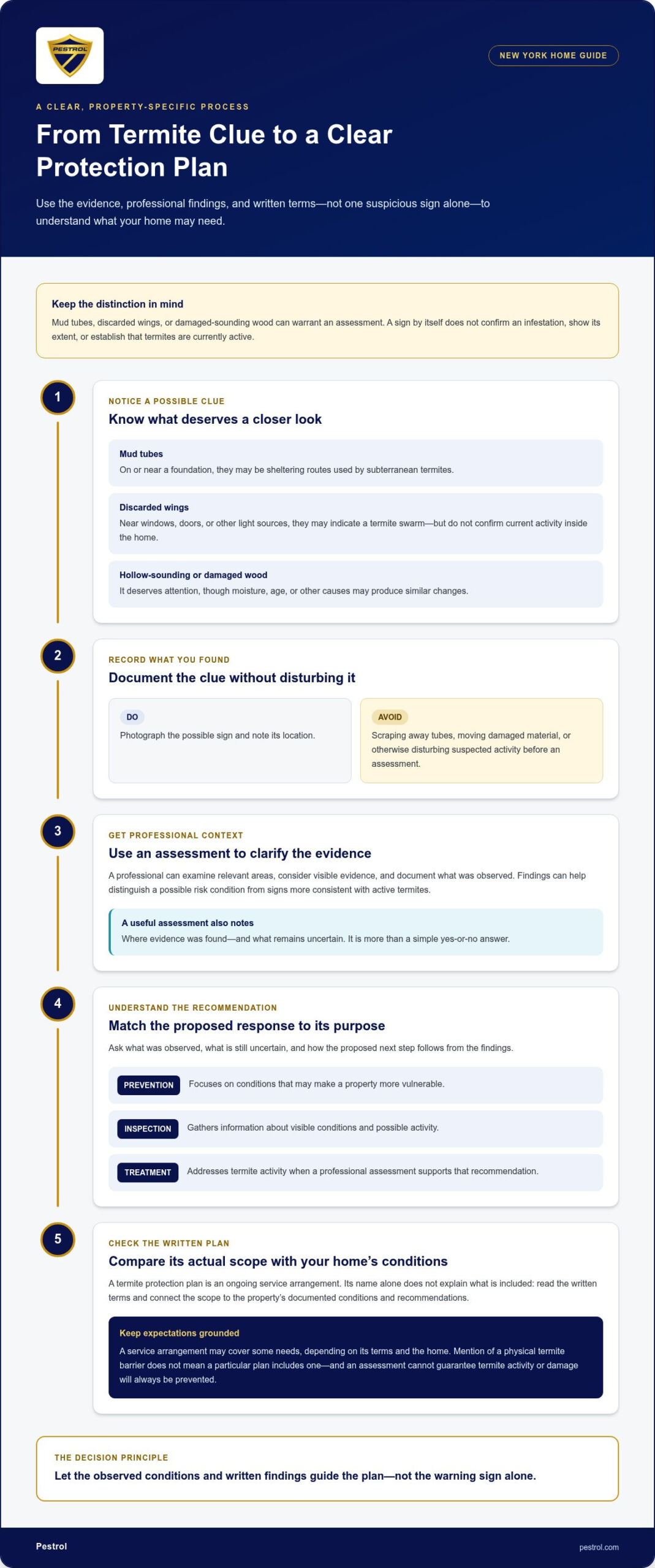
Prevention, inspection, and treatment are related, but they aren’t interchangeable. Preventive attention focuses on conditions that may make a property more vulnerable. An inspection gathers information about visible conditions and possible activity. Treatment addresses termite activity when a professional assessment supports that recommendation. A service arrangement may cover some of these needs, but its actual scope depends on its terms and the home. Physical termite barriers are one approach to limiting entry; their mention doesn’t mean a particular plan includes them.
Why local property conditions matter
Termite risk can vary from one property to the next, even on the same street. Moisture near the foundation, wood in contact with soil, and the condition of the building can all be relevant to an assessment. These details are why recommendations should be tied to the specific home rather than based only on its neighborhood or age.
The Eastern subterranean termite is the most common termite reported in New York. That regional context is useful, but it doesn’t establish that termites are active at every address. A finding at one home doesn’t prove nearby properties have the same conditions or level of risk. Manhattan, the Bronx, and communities in Orange County include varied buildings and property conditions, so a useful assessment considers the individual home.
Pestrol is a family-owned business offering termite control in its local New York service area. Whether you’re considering ongoing protection or responding to a concern, focus on clear terms and recommendations connected to your home’s observed conditions. This gives you a practical basis for deciding what makes sense without assuming one approach fits every property.
How termites affect New York homes and what an inspection can clarify
Termites can damage wood within a home, but the first clues aren’t always easy to interpret. A sign may warrant closer attention without showing whether termites are active, how far activity extends, or whether another issue is responsible. An inspection helps turn a worrying clue into useful information.
Which signs deserve a closer look?
Visible clues warrant professional assessment, not a homeowner diagnosis. Mud tubes on or near a foundation may be sheltering routes used by subterranean termites. Discarded wings near windows, doors, or other light sources may indicate a termite swarm, but wings alone don’t confirm that termites are currently active inside the home.
Wood that sounds hollow or appears damaged also deserves attention, though moisture, age, or other causes can produce similar changes. If you notice a possible sign, photograph it and note its location. Avoid scraping away tubes, moving damaged material, or otherwise disturbing suspected activity before an assessment. The U.S. Environmental Protection Agency explains how to identify and control termites, including differences among control approaches.
What an inspection helps establish
A professional assessment can examine relevant areas of the home, consider visible evidence, and document what was observed. Its value is more than a yes-or-no answer. Clear findings can help distinguish a possible risk condition from signs more consistent with active termites, while noting where evidence was found and what remains uncertain.
Use the written findings to understand the reasoning behind each proposed next step. Does the recommendation address observed activity, a condition that may increase vulnerability, or a need for continued observation? Monitoring, preventive attention, and treatment serve different purposes. The appropriate response depends on the findings and the property’s circumstances, not simply on one suspicious mark.
If a recommendation is unclear, ask for the evidence and reasoning in plain language. A well-grounded next step connects the condition observed to the action proposed, rather than treating every sign as proof of an extensive infestation.
For homeowners considering a termite protection plan New York option, documented findings can help clarify whether ongoing protection or a response to current activity is the more relevant consideration. Pestrol provides termite control in its local New York service area. If you’ve found a concerning clue, explore Pestrol termite control as a local next step.
How to evaluate a termite protection plan without overbuying
A useful plan should make its purpose clear. Before comparing labels or levels, compare the written scope with your home’s documented conditions. A recommendation tied to specific evidence is easier to evaluate than a broad promise of protection.
Questions that reveal whether a plan fits your home
Use the same criteria to compare options. Look for clear answers in the written terms rather than making assumptions based on a plan name.
| What to compare | What to look for |
|---|---|
| Inspection scope | Which areas or conditions are assessed, and what the inspection is intended to establish. |
| Written recommendations | What was observed, what action is proposed, and how the recommendation relates to those findings. |
| Follow-up terms | Which visits or services are included, when follow-up may occur, and what falls outside the stated scope. |
| Property-specific needs | Whether the plan accounts for the home’s condition and any documented termite concerns. |
Ask what evidence or conditions the plan is designed to address. Then compare its stated services and follow-up terms with the inspection findings. A higher tier or broader label isn’t automatically a better fit if its scope doesn’t address your home’s needs. For New York-specific background on termite identification and management, Cornell’s What to Do if You Spot Termites resource can help you understand the topic as you review recommendations.
Prevention, monitoring, and treatment are not interchangeable
Prevention addresses conditions that may increase vulnerability. Monitoring means watching for signs or changes. Treatment responds to termite activity when assessment findings support that action. The right response depends on the evidence. Preventive service alone shouldn’t be assumed to resolve an active infestation, and treatment doesn’t automatically define any ongoing follow-up.
Likewise, don’t assume routine pest coverage automatically includes termite-specific inspection, prevention, or treatment. Read the written terms for the exact services named. Pestrol offers residential Home Pest Protection at Basic, Plus, and Premium levels, as well as termite control. The names of those home protection levels shouldn’t be taken as proof of termite coverage; rely on the stated scope.
A thoughtful termite protection plan New York homeowners consider should explain both its purpose and its limits. No plan should be treated as a promise that termite activity or damage is impossible. Clear findings, defined services, and understandable follow-up terms help you avoid paying for a mismatch and make an informed decision about your home.
What to Do if You Spot Termites in New York
Seeing a possible termite sign can be unsettling, but it doesn’t automatically mean you’re facing an emergency or widespread damage. Start with a few careful steps. A clear record helps a professional assess what’s there and explain what, if anything, needs attention.
A calm first response to suspected termite signs
- Document what you see. Take clear photos and note the location and date. Include nearby details, such as whether the sign is on a foundation wall, wood, or near a window.
- Leave the area undisturbed. Don’t scrape away a tube, seal a suspected entry point, or apply an unlabelled product before an assessment. Changing the area may make it harder to understand what you found.
- Keep it accessible. Avoid placing items over the suspected area so it can be examined. Arrange a professional assessment, especially if you see repeated signs or changes in the same location.
A single clue may have more than one explanation. Unless there’s an immediate safety concern, document it and seek a professional opinion rather than attempting a diagnosis or treatment yourself.
How to make sense of the written recommendation
After an assessment, compare the proposed work with the findings. The written explanation should identify what was observed, where it was found, and how the recommendation addresses those conditions. If activity wasn’t confirmed, the report should still explain what concern or risk condition the proposed step is intended to address.
Look for plain-language answers to three questions: What is the purpose of the recommended work? What are its limits? What follow-up, if any, is included in the written terms? Prevention, monitoring, and treatment address different needs, so make sure the recommendation matches the evidence and your home’s circumstances. If a point is unclear, ask how the observation connects to the proposed action.
For homeowners considering a termite protection plan New York service, written findings can help distinguish an ongoing prevention question from a response to suspected or confirmed activity. Pestrol is a family-owned business offering termite control in its local New York service area. A documented, property-specific assessment helps make the next step more informed and less stressful.
Pestrol termite control: choosing a clear next step for your home
Termite concerns can leave homeowners unsure whether to monitor, investigate further, or consider treatment. A useful next step begins with what’s known about the home, not a promise that one plan fits every property. Pestrol is a family-owned business offering termite control in its local New York service area, including Manhattan, the Bronx, and Orange County communities.
A property-focused approach to termite concerns
Whether you’ve noticed a possible sign or received an inspection recommendation, look for a clear explanation of the findings. The proposed next step should connect to the conditions observed at your home and explain its purpose. For example, a recommendation may address suspected activity, a particular property condition, or a need for further attention. Understanding that distinction helps you assess whether the suggested work fits the concern.
Termite control is a distinct service consideration. Don’t assume a general residential Home Pest Protection plan or its tier automatically includes termite-specific attention. Review the written scope of any plan and compare it with documented findings. A termite protection plan New York homeowners consider should make its purpose and limits understandable. No plan should be treated as a guarantee that termite activity or damage can never occur.
Clear communication matters. You should be able to understand what was observed, why a particular next step is recommended, and what the recommendation does not address. If a detail is unclear, ask for it to be explained in plain language before deciding. That keeps the decision grounded in your home’s circumstances rather than uncertainty or a plan label.
Taking the next step with Pestrol
Start with the information you have: where you noticed a concern, what an inspection documented, and what questions remain. This gives you a practical basis for considering termite control for your home. If you’re also exploring broader household pest prevention, Pestrol offers residential Home Pest Protection plans at Basic, Plus, and Premium levels. Their names alone don’t establish termite coverage, so use the stated scope to understand what each option addresses.
You don’t need to diagnose the issue on your own. Reviewing the evidence and understanding possible next steps can help you protect your home without overcommitting to an approach that may not fit. Explore Pestrol’s termite-control service for your home.
Choose a termite protection path that fits your home
A termite concern doesn’t call for the same response in every home. Visible clues warrant assessment, while written findings help clarify whether the next step involves prevention, monitoring, or treatment. Evaluate any termite protection plan New York option by its stated scope, follow-up terms, and connection to your property’s documented conditions, not its label alone.
If you’ve spotted a possible sign, document it and leave the area undisturbed until it can be assessed. Clear recommendations should explain what was observed, why an action is proposed, and what its limits are. That makes it easier to protect your home without paying for a mismatch.
Pestrol is a family-owned and operated business offering termite control in its local New York service area, including Manhattan, the Bronx, Chester, Cornwall, Crawford, Goshen, Greenville, Highlands, Minisink, Monroe, Montgomery, Mount Hope, New Windsor, Newburgh, Palm Tree, Tuxedo, Wallkill, Warwick, Wawayanda, and Woodbury. Explore Pestrol termite control to take an informed next step for your home.
With clear information and a property-focused approach, you can move forward with greater confidence.
Frequently Asked Questions
Is a termite protection plan worth it in New York?
It can be worthwhile if ongoing attention fits your property’s conditions and the plan’s written terms explain what it does. Compare the scope, follow-up, and recommendations with inspection findings rather than buying based on a label or assuming every home has the same risk. Pestrol serves listed New York communities including Manhattan, the Bronx, Chester, Cornwall, Crawford, Goshen, Greenville, Highlands, Minisink, Monroe, Montgomery, Mount Hope, New Windsor, Newburgh, Palm Tree, Tuxedo, Wallkill, Warwick, Wawayanda, and Woodbury.
What does a termite protection plan usually include?
There isn’t one standard scope that applies to every plan. Depending on its written terms, an arrangement may involve inspection, preventive attention, monitoring, treatment, or follow-up, but don’t assume any of these are included unless they’re stated. Check what areas or conditions are addressed, what findings prompt a recommendation, and what follow-up is covered. The right scope should relate to your home’s needs, not just the plan’s name.
How can I tell if my New York home has termites?
Possible clues include mud tubes near the foundation, discarded wings, and damaged or hollow-sounding wood. These signs can prompt a professional assessment, but none confirms termite activity or shows how extensive it may be. Similar wood damage can have other causes. Photograph what you see, note its location, and avoid disturbing it before an assessment. A professional can interpret the evidence in the context of your home.
Can termites damage a home before I notice them?
Yes. Termites can feed within wood or in areas that aren’t readily visible, so damage may develop before a homeowner spots an obvious clue. That doesn’t mean hidden damage is present in every home. If you find suspicious signs or notice unexplained changes to wood, document them and arrange a professional assessment. Findings can help establish whether termites are involved and what response, if any, is appropriate.
What happens if an inspection finds termite activity?
The findings should explain what evidence was observed, where it was found, and what action is recommended. Review how the proposed work relates to those observations and your home’s conditions. Ask for the purpose, limits, and any written follow-up terms to be explained clearly. Treatment for confirmed activity, monitoring, and preventive attention address different needs, so the recommended next step should match the assessment rather than rely on a generic promise.
Does a regular home pest protection plan cover termites?
Don’t assume it does. A general home pest protection plan and termite-specific control are distinct considerations, and the plan’s written terms determine its scope. Look for explicit language describing termite inspection, prevention, treatment, or follow-up before treating any of these as included. Pestrol offers residential Home Pest Protection plans at Basic, Plus, and Premium levels, as well as termite control. A tier name alone doesn’t establish termite coverage.
What should I do when I find a termite mud tube?
Photograph the tube, note its location and the date, and leave it undisturbed so it can be assessed. Don’t scrape it away, seal the area, or apply an unlabelled product before a professional evaluation. Keep the spot accessible and arrange an assessment. A mud tube can be a sign of subterranean termite activity, but its presence alone doesn’t confirm whether termites are active or reveal the extent of any activity.